
The short answer
To remove efflorescence from concrete, fix any water feeding it, brush the white powder off the dry slab and collect it, then scrub with clean water and a stiff bristle brush. A hard film that survives is likely calcium carbonate: test an efflorescence remover on a hidden spot, follow its label, rinse well and judge the result dry.
How do you remove efflorescence from concrete driveways and patios?
You remove efflorescence from concrete in order of strength: dry brushing first, clean water second, and a remover only for the white film left after both. Efflorescence is the white mineral deposit water leaves behind as it dries out of a slab; our efflorescence explainer covers how it forms in brick and block. Start gentle, because BRANZ, New Zealand's building research body, warns that wire brushing and acid washing are likely to affect the surface of masonry or concrete.
The order for a driveway, patio, walk or set of steps:
- Find what keeps wetting the slab and fix what you can.
- Brush the powder off the dry slab and pick it up with a dustpan or shop vacuum.
- Scrub with clean water, then let the concrete dry completely before you judge it.
- For white film that stays, test a remover on a hidden spot and follow its label.
- Seal only after the slab is clean, dry and no longer blooming.
Why does outdoor concrete turn white?
Efflorescence turns outdoor concrete white when water inside the slab carries dissolved minerals to the surface and evaporates, leaving them behind. In concrete a common one is calcium hydroxide, a byproduct of cement hardening: the American Society of Concrete Contractors (ASCC) says it is produced at approximately 145 pounds per cubic yard as concrete hydrates, and reacts with carbon dioxide and water to form calcium carbonate, the white deposit.
That is why the white stuff on concrete after rain appears as the slab dries out, not while it is still wet. ASCC adds that efflorescence can show up during the first cure or any time afterward, and that it can also start with problems in the subgrade under the slab.
The deposit also changes with age. BRANZ describes a soluble powder that brushes off easily, then an insoluble stage that forms once the calcium hydroxide meets carbon dioxide in the air, and advises removing efflorescence as soon as possible, since the longer it is left, the harder it is to remove.
Is the white on your concrete efflorescence or something else?
The white on your concrete is probably efflorescence if the slab has never been sealed and the deposit sits on the surface as a powder or a thin, flat film. On a sealed slab the sealer itself is a second suspect, and three quick checks, listed below, sort them out.
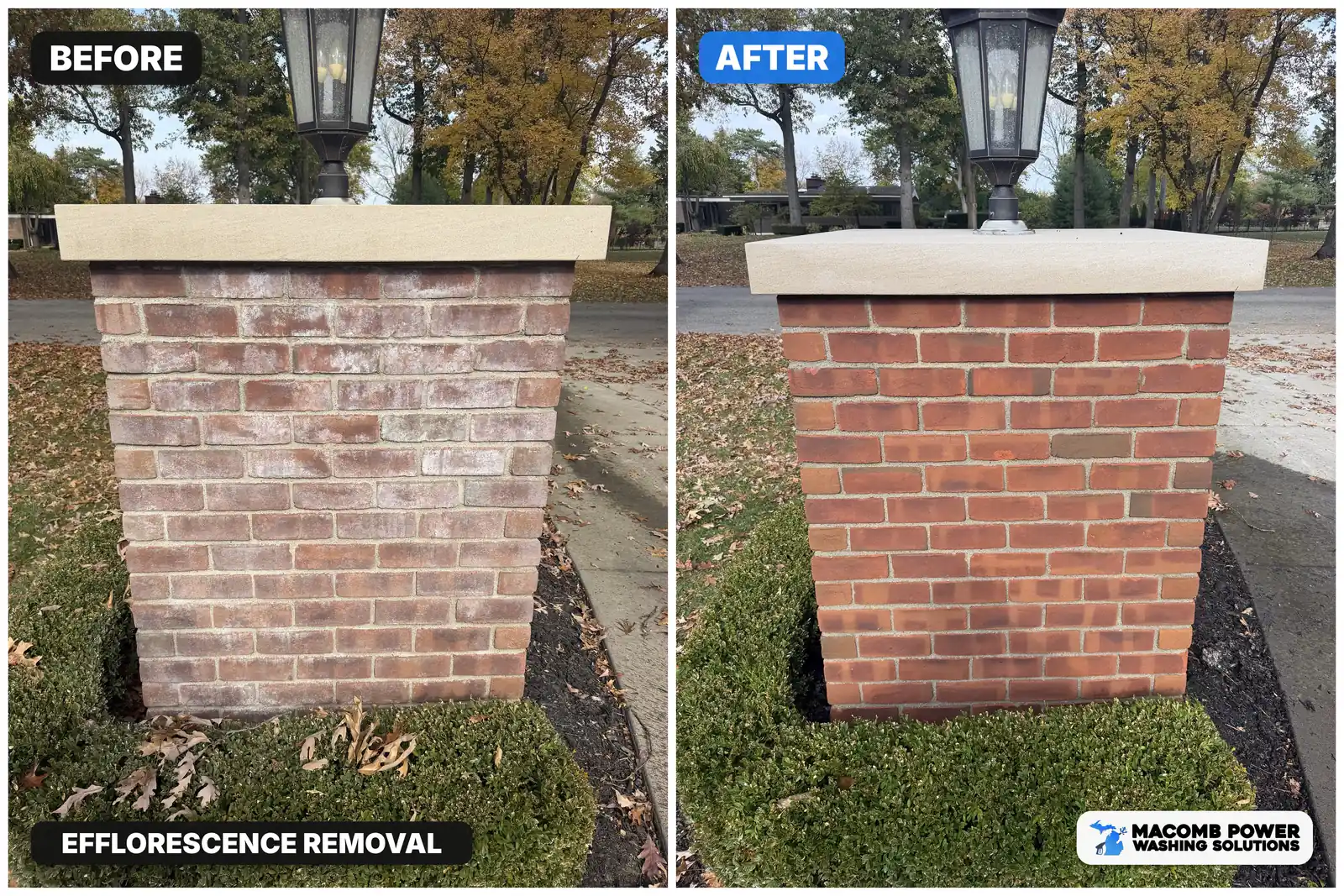
- Rub it with a dry fingertip. Fresh efflorescence is powdery and comes away on your skin or on a dry brush. White inside a sealer coat does not rub off.
- Wet a patch. BRANZ notes that calcium carbonate efflorescence becomes invisible when wet, so white that vanishes under water and returns as the slab dries fits efflorescence. On a sealed slab, treat that as a clue, not proof, because whitened sealer is also a moisture problem.
- Look for lifting. Flakes or sheets of film coming up from the surface point to sealer failure, not salt.
ASCC's sealer care guide lists whitening among the problems that heavy sealer application can cause, and Euclid Chemical, a sealer maker, says a solvent-based sealer that has lost its bond looks white because of moisture and air trapped under it. If the white is in the coating, or salt is trapped under it, a cleaner brushed on top cannot reach it; the repair is in our guide to fixing cloudy or peeling concrete sealer. Mineral spotting in a sprinkler's arc is a different deposit; see hard water and sprinkler stains.
Why does efflorescence show more on colored concrete?
Efflorescence shows more on colored concrete, stamped or plain, because white stands out against pigment and blends into gray. ASCC says efflorescence on gray concrete typically goes unnoticed because its color is similar to cured concrete, while on colored concrete it appears as a white film. As little as 0.2 ounces of calcium carbonate per square yard, ASCC adds, can cause a significant shift in color.
ASCC calls efflorescence on colored work a normal and expected occurrence during concrete hydration, so a new colored patio that clouds over is not by itself a sign of bad work. Cleaning it takes a lighter hand. For integrally colored block, the Concrete Masonry and Hardscapes Association (CMHA) says a weaker acid solution than on plain block may be needed to prevent etching that may alter colors and textures, and advises treating an entire wall rather than spots to avoid a mottled look. On a pigmented driveway or stamped patio, that means testing any remover where it will not show, then treating a full panel, joint to joint.
Stamped concrete is often sealed with an acrylic, the type ASCC's homeowner guide covers, so rule out the sealer first; caring for that coating is covered in how to clean sealed stamped concrete.
What order should the cleaning steps go in on a slab?
1. Water source first. CMHA's guidance says the reason for efflorescence should be established before any removal, that efflorescence near ground level may come from ground water, and that the problem should be repaired before the salts are removed. Redirect a downspout that empties onto the slab, re-aim a sprinkler that reaches it, and note any low spot where puddles sit. If the bloom still returns, our guide to why efflorescence keeps coming back goes deeper.
2. Dry brushing. On a dry day, sweep the white off with a stiff, dry bristle brush and collect it, as BRANZ advises for soluble efflorescence. BRANZ warns that water dissolves surface salts and can wash them back into the concrete, where they reappear as it dries. Skip wire brushes: CMHA notes that steel filings left behind can stain as they corrode.
3. Clean water. Next, scrub with clean water and the same brush. CMHA says most efflorescence can be removed by dry brushing followed by flushing with clean water. Then let the slab dry fully before deciding whether it worked, since carbonate film hides while the surface is wet.
4. A remover, used by its label. White film that survives brushing and water is likely the insoluble stage, which BRANZ says needs an acid wash or a proprietary cleaner. CMHA calls a dilute muriatic acid wash a last resort, and ASCC's guidance for colored concrete names "efflorescence remover or light muriatic acid wash" before sealing. The label comes first; BRANZ's general steps, adapted to a slab:
- Test on a small area out of sight, and let the test spot dry completely before judging it.
- Saturate the surface with clean water first and keep it wet while the product works. BRANZ says letting it dry is likely to cause further staining.
- Leave the product on only as long as the maker recommends, never let it dry on the surface, and rinse thoroughly.
- Wear eye protection, gloves and protective clothing, and protect nearby doors and other surrounding materials, as CMHA advises for acid work. Never mix an acid cleaner with bleach.
Remover types are compared in choosing an efflorescence remover and household acids in vinegar and muriatic acid; pavers get their own steps.
Should concrete be sealed after efflorescence is removed?
Concrete should be sealed after efflorescence removal only once it is clean, completely dry and has stopped blooming. ASCC's sealer care guide says that before resealing, the surface should be cleaned, any detergent rinsed off, and the slab completely dry. Euclid names sealer applied to a wet surface as one cause of blushing, and ASCC's colored-concrete sheet calls for removing efflorescence before sealing.
On the right slab, sealing helps. BRANZ, writing about walls, lists a clear sealer or water repellent, applied once the surface is dry, among the measures that control efflorescence. CMHA adds a caution for masonry: a clear coating put on a wall that tends to effloresce, without reducing the causes, may lead to surface spalling or deposits on or under the coating. Our comparison of penetrating and film-forming sealers covers which type suits a slab that stays damp.
Our concrete cleaning starts at $149 and concrete sealing at $299. Efflorescence treatment goes on the same itemized, written quote, sent within 24 hours, and if a downspout or sprinkler is feeding the slab, we point it out. After we seal, foot traffic stays off for 48 hours and vehicles for 72 hours.
Sources
- American Society of Concrete Contractors: Problems and Practice #6, Efflorescence and Colored Concrete (PDF)
- Concrete Masonry & Hardscapes Association: TEK 08-03A, Control and Removal of Efflorescence
- BRANZ Bulletin 593: Efflorescence (PDF)
- American Society of Concrete Contractors: Concrete Sealer Expectations & Maintenance Guide (PDF)
- Euclid Chemical: Diagnosing 5 Common Concrete Sealer Problems
Want This Handled Properly?
Macomb Power Washing Solutions holds a 4.9-star rating across 177+ Google reviews, and free estimates go out within 24 hours. We carry $2M general liability plus workers' compensation.