
The short answer
To remove efflorescence from pavers, brush or vacuum the powder off once they are dry, then scrub what remains with water and a stiff nonmetallic brush. Stubborn bloom on concrete pavers takes a buffered efflorescence remover, tested on a small area first. Clay brick pavers should not get unbuffered muriatic acid. Fix the water feeding it, or it can return.
How do you remove efflorescence from pavers?
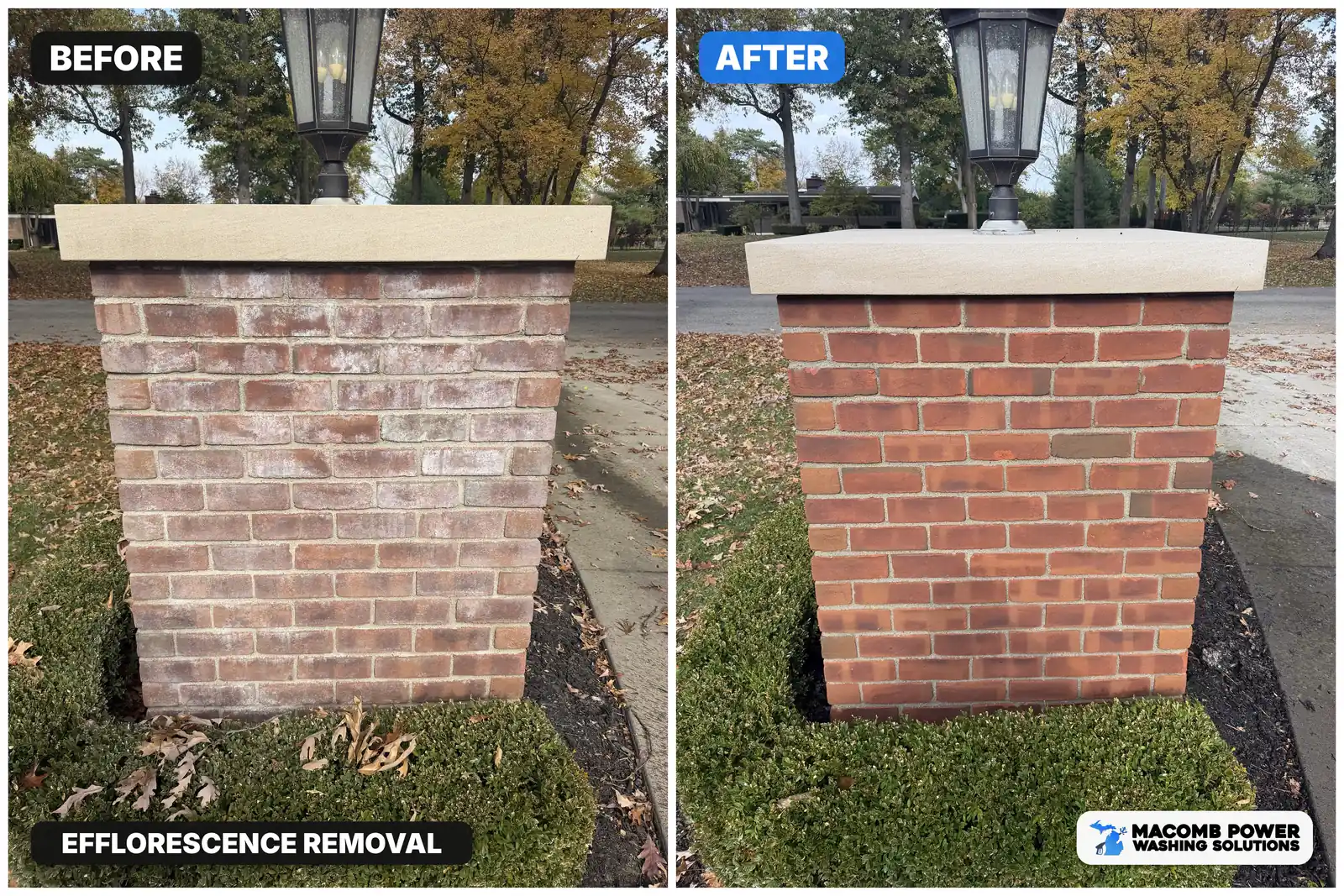
To remove efflorescence from pavers, start with the gentlest method and step up only as far as the paver material allows. The white is mineral salt left behind as water evaporates from the paver face (our efflorescence explainer covers why). Concrete and clay pavers share the first steps and part ways at the chemical one:
- Confirm what the white is. Polymer haze sits along the joints after a polymeric sanding job (see removing polymeric sand haze), and a milky film inside a sealer coat is a sealer problem, not salt.
- Once the pavers are dry, brush or vacuum the powder off and bag it, so it is not washed back into the joints.
- Scrub what remains with water and a stiff plastic or fiber brush. Skip steel bristles.
- If bloom remains, use a remover made for your paver type, after a test on a small, out-of-the-way spot.
- Rinse well and let the pavers dry before judging the result.
- Find the water that is feeding the salts, or the white can keep coming back.
Why are pavers past their first year still turning white?
Bloom in a paver patio's first months is not unusual. The Concrete Masonry and Hardscapes Association (CMHA) says in its Tech Spec 5 that efflorescence on concrete pavers can peak as soon as 60 days after installation and may remain for months. The Brick Industry Association (BIA) says in Technical Note 14 that on clay pavements it is often minimal and wears away with traffic and weather early in the pavement's life. If your pavers went in this year, read how long to wait to seal new pavers before buying a cleaner.
White on an older patio points to a steady supply of salt and water. TN 14 traces efflorescence on clay pavers to soluble compounds in other parts of the pavement or in the soil below, deposited on the face as absorbed water evaporates. Deicing chemicals the pavement soaks up can do the same (our ice melt guide covers which deicers suit each paver type). Where the salts come from groundwater or another persistent water source, the BIA calls proper surface and subsurface drainage critical. Unilock's list of signs of ongoing water infiltration includes leaky pipes, compromised waterproofing, high groundwater levels and inadequate drainage. After a rain, look for:
- a downspout that empties onto the pavers or right beside their edge
- low spots where water stands for hours
- a sprinkler head whose arc reaches the pavers
- white that gathers near the house, a planter wall or the spot where winter salt gets tracked in
Unilock notes that efflorescence can resurface as long as the conditions that started it persist, so cleaning without fixing the source only clears this season's deposit.
How is efflorescence cleaned off concrete pavers?
Concrete pavers make some of their own bloom from the cement in them, and CMHA states that efflorescence "does not affect the structural performance or durability of concrete pavers." Removal is about appearance and about preparing the surface for sealer.
Unilock's maintenance advice for concrete pavers starts with dish soap, water and a stiff plastic scrub brush, and it warns that a wire brush can leave rust marks. CMHA agrees on the brush: steel bristles loosen, rust and stain, while brass or plastic bristles are acceptable.
When scrubbing leaves white behind, the next step is a proprietary efflorescence remover made for concrete pavers; what is in those jugs, and how their acid strength affects color, is covered in our guide to efflorescence remover types. CMHA's procedure for using one, condensed:
- Try the cleaner on a small area first and check for color change, then adjust concentration and dwell time.
- Follow the paver supplier's or cleaner maker's directions for dilution and application.
- Work in sections, starting at the top of the slope.
- Scrub the cleaner on the surface, then rinse it away.
- Let the area dry for at least 24 hours before deciding whether it worked.
- Before a second application, ask the cleaner's maker whether it could discolor the pavers or expose aggregate.
CMHA also calls for protective clothing, chemical-resistant rubber boots and gloves, and eye goggles when applying acids or alkalies.
Why do clay brick pavers need brick cleaning rules?
Clay pavers are paving brick, so past the brush, the concrete-paver routine does not carry over. The BIA's Technical Note 14 says cleaning a brick pavement is essentially the same as cleaning vertical brickwork, which Technical Note 20 covers. For efflorescence, TN 14 says the deposit often can be vacuumed or brushed off once the pavers are dry. For salts fed by groundwater or other persistent water, it points to proprietary cleaners and drainage. TN 20's bucket-and-brush method, which it says also works on pavements, soaks the brick with water before the cleaning solution goes on and never lets the solution dry.
The acid warnings are the reason clay needs its own shopping list. TN 20 says not to clean brick with unbuffered muriatic (hydrochloric) acid, and warns that many cleaning products sold by polymeric sand makers are unbuffered hydrochloric acid and should not be used on clay pavers. It recommends confirming a cleaner's compatibility with the paver manufacturer, most of whom publish cleaning procedures, and testing any product on a small, inconspicuous area, because some have hazed, stained or discolored certain clay pavers. A remover sold for concrete pavers may not list clay at all: Alliance Gator's efflorescence cleaner, for one, lists concrete pavers, slabs and natural stones.
How do you protect polymeric sand joints while cleaning?
Polymeric joints face two risks during efflorescence removal: chemistry and force. On chemistry, TN 20 cautions that acid-based cleaning solutions may not be appropriate for brick pavements with polymeric sand or stabilized joint sand, one more reason to check with the paver maker first. Fresh joints may also need to cure first: Alliance Gator's data sheet says its own polymeric sand must cure for 48 hours above 59°F with no rain before its efflorescence cleaner is used.
On force, the BIA says stabilized sand joints generally tolerate pressure washing when the nozzle is kept clear of the surface and the jet is not aimed directly along the joints, and that aggressive pressure washing can strip sand in spots. CMHA adds that a wide spray pattern and a low angle of attack reduce the risk of dislodging joint sand, and that volume of water matters more to a good rinse than pressure.
In practice: scrub across the paver faces rather than into the joints, rinse with plenty of water at low pressure, and check the joints once the pavers dry. A joint that lost sand needs refilling.
Where does efflorescence removal fit in a paver restoration?
In a restoration, efflorescence removal belongs in the cleaning stage, ahead of any sealer. CMHA places efflorescence removal ahead of liquid joint stabilizers and ahead of sealing, and says all dirt, oil stains and efflorescence must come off before a sealer goes on. For most sealers, the cleaned pavers must then be completely dry, with at least 24 hours free of moisture or surface dampness. CMHA warns that the pavers can draw efflorescence up, or the sealer can whiten, if the surface and joints are not dry, a salt source sits in the sand, base or soil below, or the sealer is not breathable.
Our brick paver restoration follows that order. During the cleaning, efflorescence that persists gets its own treatment with a dedicated remover, because a general cleaner does little to a mineral deposit. The pavers dry, polymeric sand goes into the joints and cures, and where the pavers will be sealed, the sealer goes on last. Restoration starts from $399 for the clean, polymeric re-sand and seal together, itemized in a written quote within 24 hours. After we seal, keep foot traffic off for 48 hours and vehicles off for 72. If the bloom traces to a downspout, a low spot or a sprinkler, we will point to it. Whether a patio needs sealer at all is weighed in is sealing pavers worth it.
Sources
- Concrete Masonry and Hardscapes Association: Tech Spec 5 (PAV-TEC-005-22), Cleaning, Sealing and Joint Sand Stabilization of Interlocking Concrete Pavement
- Brick Industry Association: Technical Note 14, Paving Systems Using Clay Pavers (PDF)
- Brick Industry Association: Technical Note 20, Cleaning Brickwork (PDF)
- Unilock: Efflorescence 101, What Is It and How Do You Remove It
- Alliance Gator: Gator Efflorescence Cleaner, Technical Data Sheet (PDF)
Want This Handled Properly?
Macomb Power Washing Solutions holds a 4.9-star rating across 177+ Google reviews, and free estimates go out within 24 hours. We carry $2M general liability plus workers' compensation.