
The short answer
Choose an efflorescence remover whose label names your surface. On clay brick, use a proprietary cleaner made for brickwork, never unbuffered muriatic acid. On concrete pavers, use a buffered paver remover at the label's ratio; on poured concrete, one that lists cast-in-place concrete. Keep acidic removers off polished marble, limestone and travertine, and test a hidden patch first.
Which efflorescence remover should you use?
Use the efflorescence remover whose label names your surface, because the jugs on the shelf are made for different materials. One sold for concrete pavers may list slabs and natural stone and never mention clay brick; a masonry cleaner may list fired clay brick and rule out polished limestone. Efflorescence is mineral salt left on the face as water leaves the masonry (our efflorescence explainer covers the chemistry), so a remover comes after dry brushing and after the water source is fixed, not before.
| Surface | Look for on the label | Watch for |
|---|---|---|
| Clay brick walls and pillars | Fired clay brick listed; made for brickwork | Light-colored brick, colored mortar, stone trim, metal |
| Concrete pavers | Concrete pavers listed; buffered acid; dilution directions | Color change from stronger mixes; age limits for new pavers and fresh joint sand |
| Clay brick pavers | Clay pavers listed, and the paver maker agrees | Polymeric sand cleaners made of unbuffered hydrochloric acid |
| Concrete slabs, exposed aggregate | Cast-in-place concrete listed | Color applied to the surface rather than mixed through |
| Polished marble, limestone, travertine | Marked "no" on PROSOCO's acidic cleaner | Acid damage to the polished face |
What is in an efflorescence remover?
Many efflorescence removers are acidic, including some that advertise no muriatic acid. The Concrete Masonry & Hardscapes Association (CMHA) notes that many cleaners that take dirt and efflorescence off concrete pavers are a mix of detergent and acid. Four kinds of product show up on the shelf:
- Proprietary masonry cleaners. The Brick Industry Association (BIA) prefers these over site-mixed solutions on brick, because they are generally safer, easier to control and more consistent; many contain acid along with chemicals that make them easier to use properly.
- "Non-etching" acidic cleaners. PROSOCO's Sure Klean Light Duty Concrete Cleaner is sold as a non-etching acidic cleaner with no muriatic acid, and its data sheet lists a pH of 1.14 at a 1:2 dilution. "No muriatic acid" tells you which acid is absent, not how strong the product is.
- Buffered paver removers. CMHA says the acid in proprietary paver cleaning chemicals is buffered and blended so it cleans without damaging the paver surface.
- Removers made without hydrochloric (muriatic) acid. Alliance Gator's Efflorescence Cleaner states it contains none and is labeled for concrete pavers, slabs and natural stone.
The front of the jug gives a name; the safety data sheet (SDS) lists the active ingredients and incompatible materials. BIA warns that some cleaning solutions contain compounds that turn into muriatic or hydrofluoric acid once mixed with water, and says to check the SDS for them. Straight muriatic acid and vinegar are covered in our guide to vinegar and muriatic acid on efflorescence.
Which remover suits clay brick?
Clay brick takes a cleaner formulated for brickwork, and only once dry brushing and water scrubbing have failed. BIA's Technical Note 46 says efflorescence generally comes off through weathering, dry brushing or a stiff fiber brush and water, and that proprietary cleaners formulated specifically for brickwork handle heavy or stubborn deposits. Leaks are repaired and the brick dried first, or the efflorescence will return.
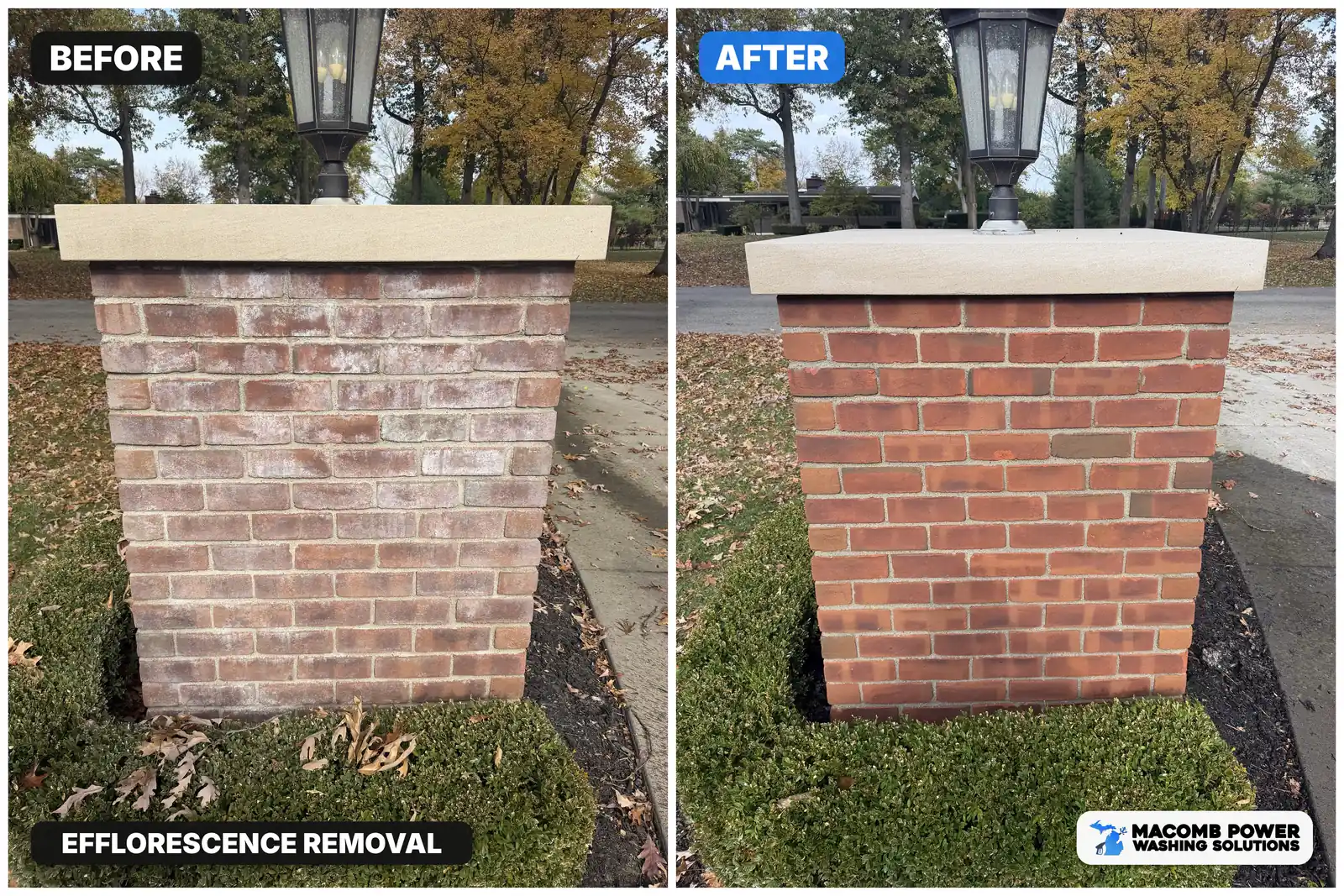
On the product's substrate chart, look for fired clay brick by name. PROSOCO's chart marks fired clay brick and clay pavers "yes" and unglazed terra cotta "no." Alliance Gator's label does not list clay brick.
BIA's Technical Note 20 says light-colored brick is more prone to "acid burn" than darker units, and that unbuffered acids and some proprietary cleaners tend to bleach colored mortar, so on a buff wall with tinted joints, judge the remover in a trial patch first. BIA also lists metal, glass, sealants, limestone, cast stone and ornamental trim among the materials to mask or protect from cleaning solutions. Rinse brick within BIA's limit of no more than 400 psi at the nozzle unless the brick maker permits more, even where a cleaner's sheet suggests higher pressure for porous masonry; see how pressure damages brick.
Which remover suits concrete pavers and slabs?
Concrete pavers take a proprietary paver efflorescence remover with buffered acid, mixed exactly as the label says. CMHA notes that cleaners with strong acids change paver color slightly, and that the type of acid, its concentration and its time on the pavers control how much. Alliance Gator's sheet puts a number on it: dilute 4 parts water to 1 part cleaner, because any stronger mix can discolor the pavers. It also says to wait at least 60 days after new pavers are installed.
Joints narrow the choice further. Polymeric or stabilized joint sand can rule out some acid-based cleaners, and fresh joint sand has a cure time to respect before any cleaner goes on; both limits, and the cleaning order around joints, are in how to remove efflorescence from pavers.
Poured slabs and exposed aggregate take a product whose label lists cast-in-place concrete; PROSOCO's sheet gives 1 part concentrate to 2 parts water for efflorescence on exposed aggregate. Color is the risk on decorative concrete. That sheet calls the product safe for most pigmented concrete but warns it may remove some surface-applied accent colors and damage polished or acid-sensitive surfaces. The driveway and patio method is in removing efflorescence from concrete.
What should you check on the label before you buy?
Check that the label covers your surface and that you can follow every step, because BIA and CMHA both treat the maker's directions as the rule for proprietary cleaners. BIA's Technical Note 46 ties insufficient prewetting, insufficient rinsing and strong concentrations to added staining, etched mortar joints and more water getting into brickwork. Read the label and SDS for:
- Surfaces and limitations. Your material by name. PROSOCO's sheet lists polished masonry, treated or coated glass and accent colors under limitations.
- Dilution. A fixed ratio, or a range to settle by testing. PROSOCO's is 2 to 6 parts water to 1 part concentrate, with cold water in the bucket first and the product added to it.
- Dwell time. Alliance says wait one minute, then scrub; PROSOCO says 3 to 5 minutes or until the stains are gone.
- Prewetting and "do not let dry." Both sheets start on a wet surface and say not to let the cleaner dry. BIA explains the prewet for brick: dry masonry absorbs the solution, which can leave white scum, efflorescence and other stains.
- Temperature and sun. PROSOCO asks for 40°F or above and no application before an overnight freeze; Alliance says not to apply under extremely strong sun.
- Rinse. CMHA says a large amount of water matters more than high pressure, and the final rinse should be water only.
- Handling. Alliance calls for goggles and rubber gloves; CMHA adds protective clothing and chemical-resistant boots. PROSOCO says to use polyethylene or polypropylene containers only, because acids and their fumes attack metal, and not to mix the product with other chemicals. Never combine an acidic remover with bleach.
How do you test a remover before using it everywhere?
Test a remover on a hidden patch with the dilution, dwell time and tools you plan to use, then let the patch dry fully before judging it. The references set different sizes and waits:
| Source | Test area | Wait before judging |
|---|---|---|
| BIA Technical Note 20 (brick) | 20 sq ft | Until dry, usually about one week |
| PROSOCO Light Duty Concrete Cleaner | At least 4 ft by 4 ft | 3 to 7 days |
| Alliance Gator Efflorescence Cleaner | About 4 sq ft | Not stated |
| CMHA PAV-TEC-005 (concrete pavers) | A small area | At least 24 hours |
BIA's Technical Note 46 suggests trying a cleaner at different concentrations in an inconspicuous spot. If one pass leaves bloom behind, CMHA says to ask the cleaner's maker whether a second application will discolor the pavers or expose aggregate, and PROSOCO warns that multiple applications may etch acid-sensitive surfaces.
If you would rather not pick a product, Macomb Power Washing Solutions stocks professional-grade treatments for efflorescence and cleans it as part of house washing (from $349) and hardscape restoration such as brick paver restoration (from $399 for cleaning, polymeric re-sand and sealing). Concrete cleaning starts from $149, and quotes are written and line-item, within 24 hours.
Sources
- Brick Industry Association: Technical Note 20, Cleaning Brickwork (PDF)
- Brick Industry Association: Technical Note 46, Maintenance of Brick Masonry (PDF)
- Concrete Masonry & Hardscapes Association: PAV-TEC-005, Cleaning, Sealing and Joint Sand Stabilization of Interlocking Concrete Pavement
- PROSOCO: Sure Klean Light Duty Concrete Cleaner, Product Data Sheet (PDF)
- Alliance Designer Products: Gator Efflorescence Cleaner, Technical Data Sheet (PDF)
Want This Handled Properly?
Macomb Power Washing Solutions holds a 4.9-star rating across 177+ Google reviews, and free estimates go out within 24 hours. We carry $2M general liability plus workers' compensation.