
The short answer
Often, yes. Efflorescence on brickwork less than a year old, which the Brick Industry Association calls new building bloom, usually fades as the wall dries and wind and rain clean it. Efflorescence that first appears after the first year, or comes back heavier each winter, usually has water feeding it and returns until that is fixed.
Does efflorescence go away on its own?
Does efflorescence go away if you leave it alone? Often it does, because the white film is a salt deposit that only grows while water keeps moving through the masonry (our efflorescence explainer covers the chemistry). The Brick Industry Association (BIA) says in Technical Note 23A that most efflorescing salts are water-soluble and many disappear with normal weathering, especially on new brickwork. The Concrete Masonry & Hardscapes Association (CMHA) says the same of concrete block: over time, the deposit gets lighter and covers less of the wall.
Both references attach a condition. CMHA's TEK 08-03A says the fading holds unless an outside source of salts or recurring water movement is present, and BIA ties efflorescence that shows up after a wall's first year to excess water getting in or poor drainage. So the answer splits in two. Bloom from construction moisture usually wears off. Bloom fed by a leaking pipe, a faulty drain or a sprinkler aimed at the wall keeps returning for as long as the water does.
How long does new building bloom take to fade?
BIA draws the line at one year. Efflorescence on brickwork less than a year old is "new building bloom": construction water leaving the wall, usually in a fairly uniform pattern across the surface. BIA says that in most cases it dissipates if the brickwork is allowed to dry and wind and rain are given enough time to clean it. CMHA describes the same early-age bloom on concrete masonry and says that, left unattended, rain water will eventually remove the salts.
Neither source puts a number of weeks on it, and on brick it can stretch across more than one winter. The National Research Council Canada's 1960 digest on efflorescence (CBD-2) observed that, in many cases, a building badly affected in its first winter may show much less in the second, less still in the third, and none the winter after. The pattern to look for is bloom that thins out year over year, not bloom that is gone by spring.
Concrete pavers have their own timeline. CMHA's Tech Spec 5 says paver efflorescence may appear immediately or within months of installation, can peak in as short as 60 days, may remain for months, and some of it may wear away. A patio laid during a dry spell may not bloom until the next stretch of wet weather. For deposits that need to come off before they wear away, CMHA points to a proprietary efflorescence remover; our guide to removing efflorescence from pavers covers that step. If sealer is planned, the bloom has to clear first; our post on how long to wait to seal new pavers covers that timing.
Why does efflorescence appear in winter and fade by summer?
If a wall that bloomed last winter looked clean all summer and is turning white again now, that is the usual timing for efflorescence in winter. The return by itself does not show whether the bloom is fading or still being fed. CBD-2 calls it usually a seasonal problem: the cool days and nights of fall seem to bring out salts that were not visible in summer, the deposit usually builds through the winter, it starts to fade only in spring, and by summer it has generally disappeared. BIA adds that on walls past their first year, efflorescence is often most severe in winter and cold weather.
The likely reason is evaporation speed. CBD-2 suggests that in summer, moisture may evaporate while it is still inside the bricks, so the salts are deposited within the brickwork rather than on its surface. In colder weather, evaporation may be slow enough that the water reaches the face first and leaves its salts there. CMHA puts it more firmly: efflorescence is more common in winter, when slower evaporation lets salts migrate to the surface. CMHA also points out that spring can bring another round, when moisture frozen inside the masonry is released by warm weather and carries more salts out.
That cycle is why a clean wall in July proves very little. CMHA notes that even after long rainy periods in summer, comparatively small amounts of efflorescence reach the surface, so a wall can be taking on water and still look clean. To judge whether bloom is fading, compare the same wall from one winter to the next. BIA's Technical Note 46 recommends seasonal inspections so materials can be seen in different weather, with photographs to record changes. At home, a phone photo of the same wall in late winter each year does that job.
When does waiting stop being the right call?
Waiting suits bloom that showed up while the wall was new, sits evenly across it and gets lighter each winter. These signs point to water that is still feeding the salts, and the haze will keep coming back until that water is dealt with:
- It first appeared after the wall's first year. BIA generally attributes that to excessive water penetration or poor drainage, and says efflorescence on an established building that used to be free of it usually means a new source of water.
- It is heavy in one area instead of even. CMHA reads heavy deposits that cover localized areas as water that has entered, or is entering, the wall higher up, and bloom near ground level as a possible sign of groundwater.
- It is not getting lighter from one winter to the next. Construction moisture runs out, so its bloom should thin over time. CMHA says efflorescence gets lighter with time unless recurrent water migration or an outside salt source is present, and BIA says masonry with persistent efflorescence should be scrutinized for unresolved water penetration.
- The masonry is changing. BIA's maintenance note groups efflorescence with spalling, deteriorating mortar joints, interior moisture damage and mold growth as conditions whose origin should be found and corrected. Salts that crystallize under the surface can also push brick faces off, a risk the explainer covers.
- There are stains or damp inside. BIA says interior surveys should note stains or damage to finishes that may indicate water ingress.
Any one of these makes it a water problem with a white symptom. Our post on why efflorescence keeps coming back walks through where that water gets in.
When should you clean it instead of waiting?
Cleaning makes sense when the bloom bothers you and the timing is right: the water source on an older wall has been found and fixed, a new wall's bloom is more than you want to live with for several winters, or pavers need to be clear before sealer goes on. BIA's maintenance note says potential water ingress should be investigated and resolved before efflorescence is cleaned, otherwise the efflorescence will return, and that leaks should be repaired and the brickwork allowed to dry.
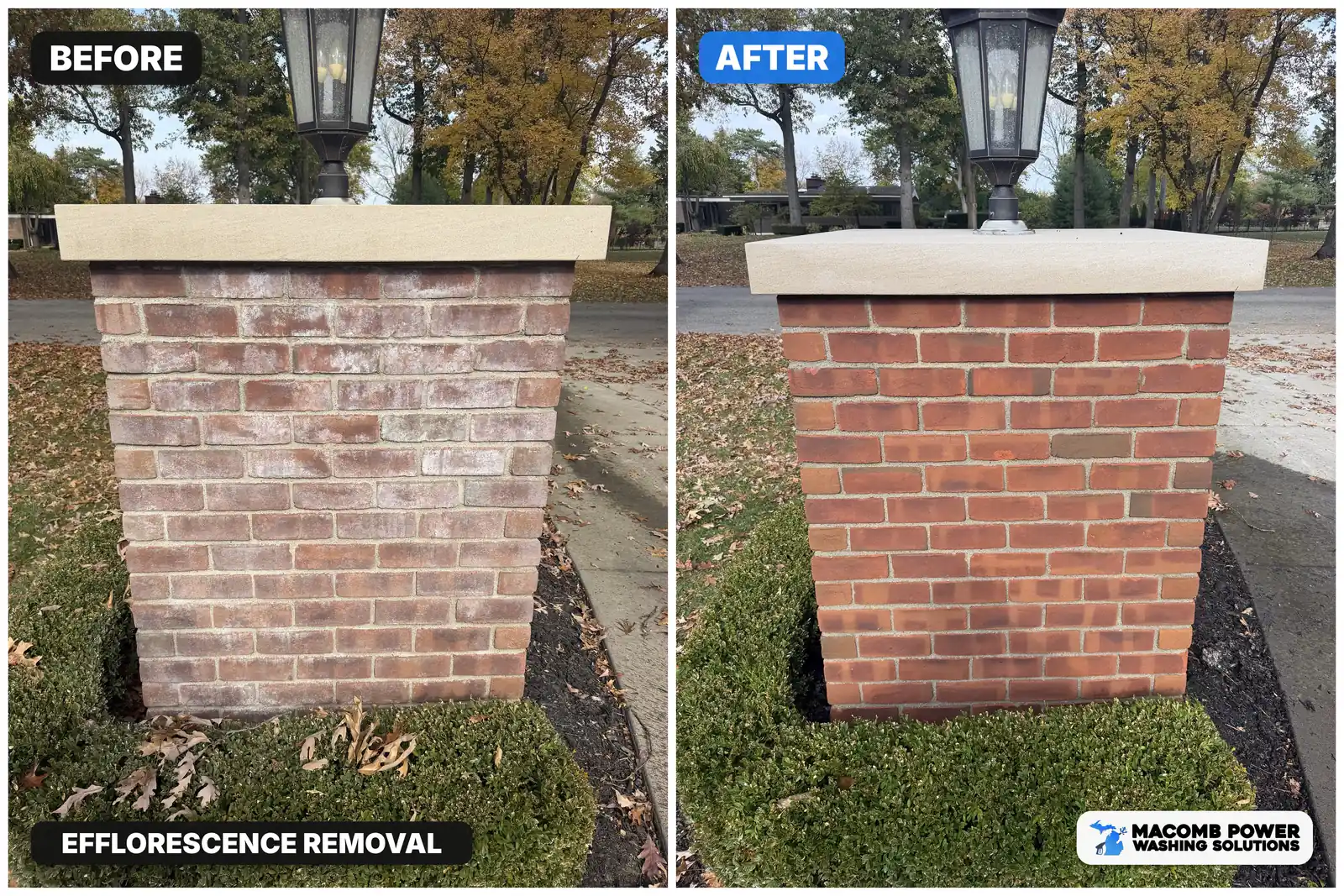
In fall and winter, start dry. BIA says efflorescence that normal weathering does not remove can usually be taken off by dry brushing, which adds no water to the wall; do it on a day when the brick is dry. Washing is the step to hold. BIA says it is usually not advisable to wash efflorescence off brickwork except in warm, dry weather, because the added moisture may bring more salts to the surface. Brushing in November and washing, if the wall still needs it, once warm, dry weather returns follows that advice.
Removal methods by surface are in separate guides, including pressure washing efflorescence off brick and removing it from concrete driveways and patios. We clean efflorescence as part of house washing, from $349, and brick paver restoration, from $399 for cleaning, polymeric re-sand and sealing together, and we tell you whether yours is new building bloom or a moisture flag. Every quote comes in writing within 24 hours.
Sources
- Brick Industry Association: Technical Note 23A, Efflorescence: Causes and Prevention (PDF)
- Brick Industry Association: Technical Note 46, Maintenance of Brick Masonry (PDF, December 2017)
- National Research Council Canada: Canadian Building Digest CBD-2, Efflorescence (T. Ritchie, February 1960)
- Concrete Masonry & Hardscapes Association: TEK 08-03A, Control and Removal of Efflorescence
- Concrete Masonry & Hardscapes Association: Tech Spec 5, Cleaning, Sealing and Joint Sand Stabilization of Interlocking Concrete Pavement
Want This Handled Properly?
Macomb Power Washing Solutions holds a 4.9-star rating across 177+ Google reviews, and free estimates go out within 24 hours. We carry $2M general liability plus workers' compensation.