
The short answer
Sometimes: vinegar dissolves carbonate deposits that plain water won't, but most efflorescence needs no acid: the Brick Industry Association (BIA) says most efflorescing salts are water-soluble and usually brush off dry. BIA's guidance doesn't list vinegar for efflorescence and says not to clean brick with unbuffered muriatic acid. Concrete block guidance keeps dilute muriatic acid as a last resort.
Does vinegar remove efflorescence?
Does vinegar remove efflorescence? It can, but its acid matters mainly for carbonate deposits that water won't dissolve, and on most white bloom a stiff brush does the job without acid. Efflorescence is salt left on the face by water leaving the masonry; our efflorescence explainer covers where it comes from. The Brick Industry Association (BIA) says in Technical Note 23A that most efflorescing salts are water-soluble, that many disappear with normal weathering, and that what remains "usually can be removed by dry brushing."
BIA's cleaning note, Technical Note 20, lists dry brushing, a stiff fiber brush with water, and a proprietary cleaner for stubborn buildup. Vinegar is not on that list. The note names vinegar only for polymeric sand haze on brick pavers and, mixed with hydrogen peroxide and distilled water, for brown manganese stains. None of the references below gives a vinegar strength or dwell time for efflorescence.
| Reference | Material | Vinegar on efflorescence | Muriatic acid |
|---|---|---|---|
| BIA Technical Notes 20 and 23A | Clay brick | Not listed | Do not use it unbuffered |
| CMHA TEK 08-03A | Concrete block | Not mentioned | A dilute 5 to 10 percent solution, as a last resort |
| NDSU Extension | Mineral deposits on basement walls and floors | Removes carbonate deposits; also used as a test | Not covered |
What does vinegar do to efflorescence salts?
Vinegar dissolves carbonates, which is why North Dakota State University (NDSU) Extension uses it to identify and remove carbonate deposits. Its guide to white deposits on basement walls says sodium and magnesium sulfate deposits "are dissolved easily by water," while calcium and magnesium carbonates are relatively insoluble in water and come off with "a dilute acid solution, such as vinegar." The test runs in that order: a few drops of water first, then a few drops of vinegar, and if neither dissolves the deposit, it may be mold.
BIA's table of common efflorescing salts lists calcium carbonate, most probably from mortar or concrete backing. On block, the Concrete Masonry & Hardscapes Association (CMHA) describes calcium carbonate efflorescence as a flat white deposit that can form a hard white crust and calls it "extremely difficult to remove." So vinegar's acid would matter on the stubborn kind, and for stubborn accumulations BIA advises a proprietary cleaner. A heavy white streak below a mortar joint may be lime run, and a film left when an acid wash isn't fully rinsed may be white scum; see white crust on brick that won't wash off.
If you scrub brick with vinegar anyway, test a small area first and follow BIA's rules for any cleaning solution: soak the area and the brick below, keep it wet, and flush it off with plenty of clean water before it dries. Dry masonry absorbs cleaning solution, BIA explains, which can leave white scum, efflorescence, or manganese or vanadium stains.
Is muriatic acid safe for efflorescence on brick?
No. BIA's Technical Note 20 says not to clean brick with unbuffered muriatic (hydrochloric) acid, and its quick-guide table repeats the rule for red brick and for white, tan, buff, gray and other colors. The reasons it gives:
- Using unbuffered high-strength acid "tends to cause further stains and damage mortar joints."
- Unbuffered acid tends to discolor brick, lighter shades most, an effect BIA says is frequently termed "acid burn," and it can promote vanadium and manganese stains.
- Acid solutions mixed too strong can etch brick and dissolve the cement-based material in mortar joints.
- Unbuffered acids tend to bleach colored mortars.
Muriatic acid can also feed the problem it was bought to fix. Technical Note 23A explains that, under certain conditions, lime reacts with unbuffered hydrochloric acid to form calcium chloride, a very soluble salt that can migrate to the surface and become efflorescence, and its table of salt sources lists two chlorides whose most probable source is acid cleaning.
BIA's alternative for stubborn deposits is a proprietary cleaner made for brickwork, used by its label. BIA notes that many of those contain acid too, so read the safety data sheet before buying; our guide to efflorescence remover types explains what to look for on it.
For any cleaning chemical, BIA calls for protective clothing, ventilation and the safety data sheet, since some of these chemicals and their fumes can be harmful. Dunn-Edwards' efflorescence bulletin, written for masonry about to be painted, gives the mixing rule for an acid wash: add the acid to the water, never the water to the acid. It also calls for goggles, rubber gloves and boots when acid-washing. Never mix bleach with muriatic acid, vinegar or any other acid.
When do concrete masonry guides allow dilute acid?
CMHA's guide for concrete block treats dilute acid as a last resort. Its TEK 08-03A, Control and Removal of Efflorescence, says to repair the cause first, then remove most efflorescence by dry brushing and a clean-water flush, with commercial cleaners as an option. "As a last resort," it describes dilute muriatic acid within these limits:
- A 5 to 10 percent solution, or 2 percent, which may be needed on integrally colored units to prevent etching that may alter color and texture.
- A test on a small, inconspicuous area first.
- A wall prewetted with clean water, so the acid is not absorbed deeply.
- No more than 4 square feet at a time.
- About 5 minutes, then scouring with a stiff acid-cleaning brush, never a wire brush, whose leftover filings can stain as they corrode.
- An immediate, thorough flush with clean water, and at least one month of weathering before paint.
CMHA adds that acid may slightly change the wall's appearance, so the entire wall should be treated to avoid mottling. Those limits were written for block, not clay brick, where BIA's rule against unbuffered muriatic acid stands.
Why do stone caps, sills and trim need protecting from acid?
Stone caps, sills and trim need protecting because a cleaner chosen for the brick can stain or pit the materials beside it. BIA's Technical Note 20 says to mask windows, doors, sealants, metal, glass, wood, limestone, cast stone, concrete masonry and ornamental trim from cleaning solutions. It warns that acid solutions in particular corrode metal, and that solution reaching metal frames can pit the metal or stain trim such as limestone and cast stone. Limestone and marble are acid-sensitive stones: the National Park Service's Preservation Brief 1 says acidic cleaners can etch and dissolve them. Cleaning chemicals may also damage plants and grass, so keep solution and runoff off plantings and soil.
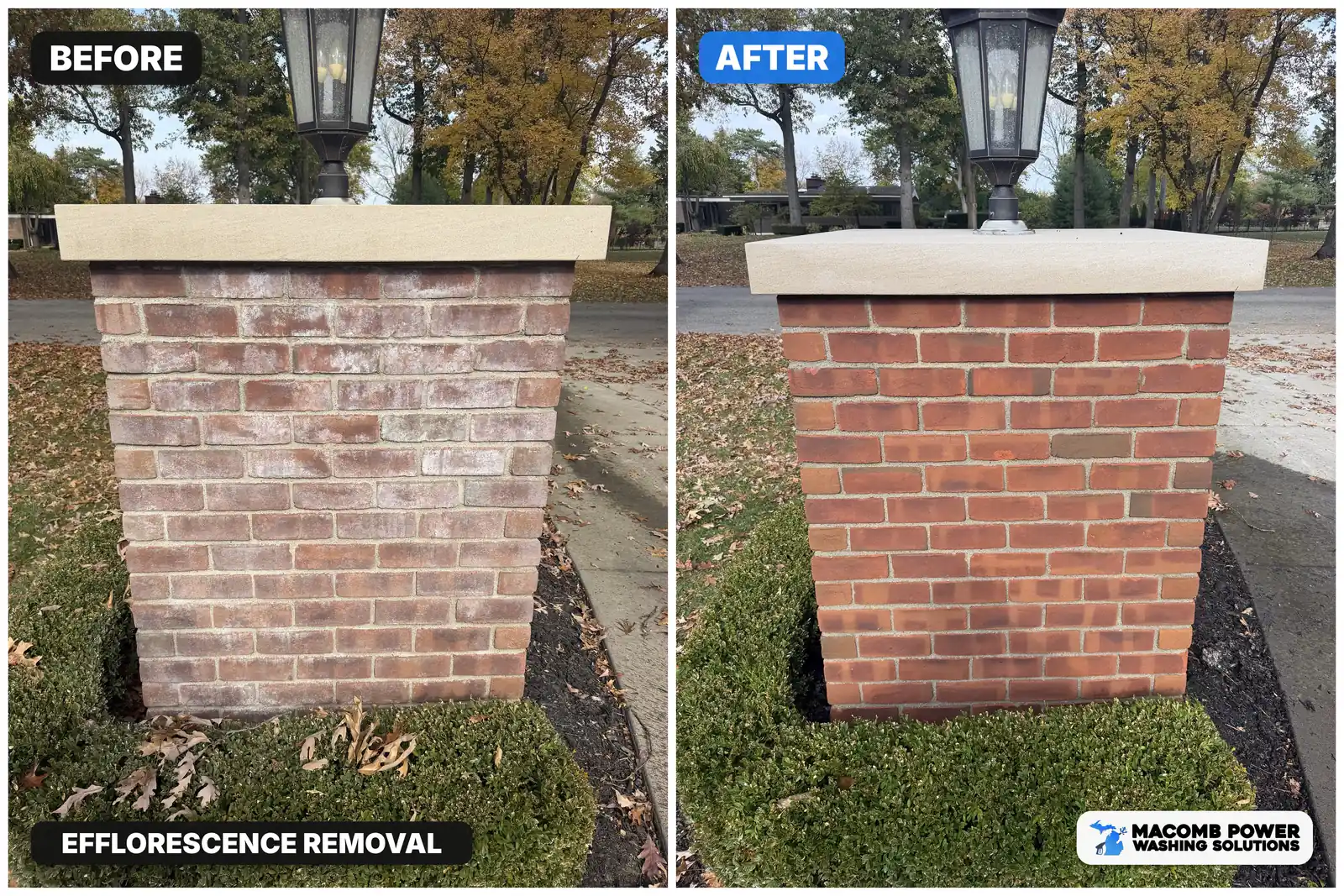
A brick pillar packs all of that into a few feet. In the photo, a light stone cap overhangs the top course, a black lamp stands on the cap, and shrubs crowd the base. Whether a light cap is limestone or cast stone, BIA's list covers both, so mask the cap and lamp either way. If the cap is limestone, our guide to cleaning limestone sills and trim covers the mild-detergent routine it gets instead, and efflorescence on brick pillars covers why pillars bloom.
What should you try before reaching for any acid?
Acid is the wrong tool in four common cases, so rule each one out first:
- It is not efflorescence. Run NDSU's drop test, water first, then vinegar; a deposit that dissolves in neither may be mold (see efflorescence vs mold).
- The wall is new. BIA says to allow one year of weathering to remove new building bloom.
- Water is still feeding it. Before cleaning efflorescence that keeps returning, BIA says to find and correct the source of water penetration and let the brick dry.
- A brush would do. Dry brush on a dry day with a stiff fiber brush, never a wire brush, and add water only for a film the brush leaves. BIA advises against washing efflorescence off except in warm, dry weather, because the extra water may bring more salts to the surface.
Past those, the next step is a proprietary cleaner made for brick, by its label and tested on a small area first, rather than a site-mixed acid. Timing matters in fall and winter: BIA says not to clean during freezing weather or when it is expected, and chemical cleaners generally work better at 50°F or above. If brushing doesn't clear it, we clean efflorescence as part of house washing, from $349, and brick paver restoration, with a written, line-item quote within 24 hours.
Sources
- Brick Industry Association: Technical Note 20, Cleaning Brickwork (PDF)
- Brick Industry Association: Technical Note 23A, Efflorescence: Causes and Prevention (PDF)
- Concrete Masonry & Hardscapes Association: TEK 08-03A, Control and Removal of Efflorescence
- NDSU Extension: Is it Mold or isn't it?
- Dunn-Edwards: Technical Bulletin, Efflorescence (PDF)
- National Park Service: Preservation Brief 1, Cleaning and Water-Repellent Treatments for Historic Masonry Buildings (PDF)
Want This Handled Properly?
Macomb Power Washing Solutions holds a 4.9-star rating across 177+ Google reviews, and free estimates go out within 24 hours. We carry $2M general liability plus workers' compensation.