
The short answer
You can pressure wash efflorescence off brick, but pressure is not what removes it. Most efflorescing salts dissolve in water, so a stiff brush and water usually do the job. A hard spray drives extra water into the wall, which can feed the next bloom. Fix the water source, brush dry first, then rinse gently in warm, dry weather.
Can you pressure wash efflorescence off brick?
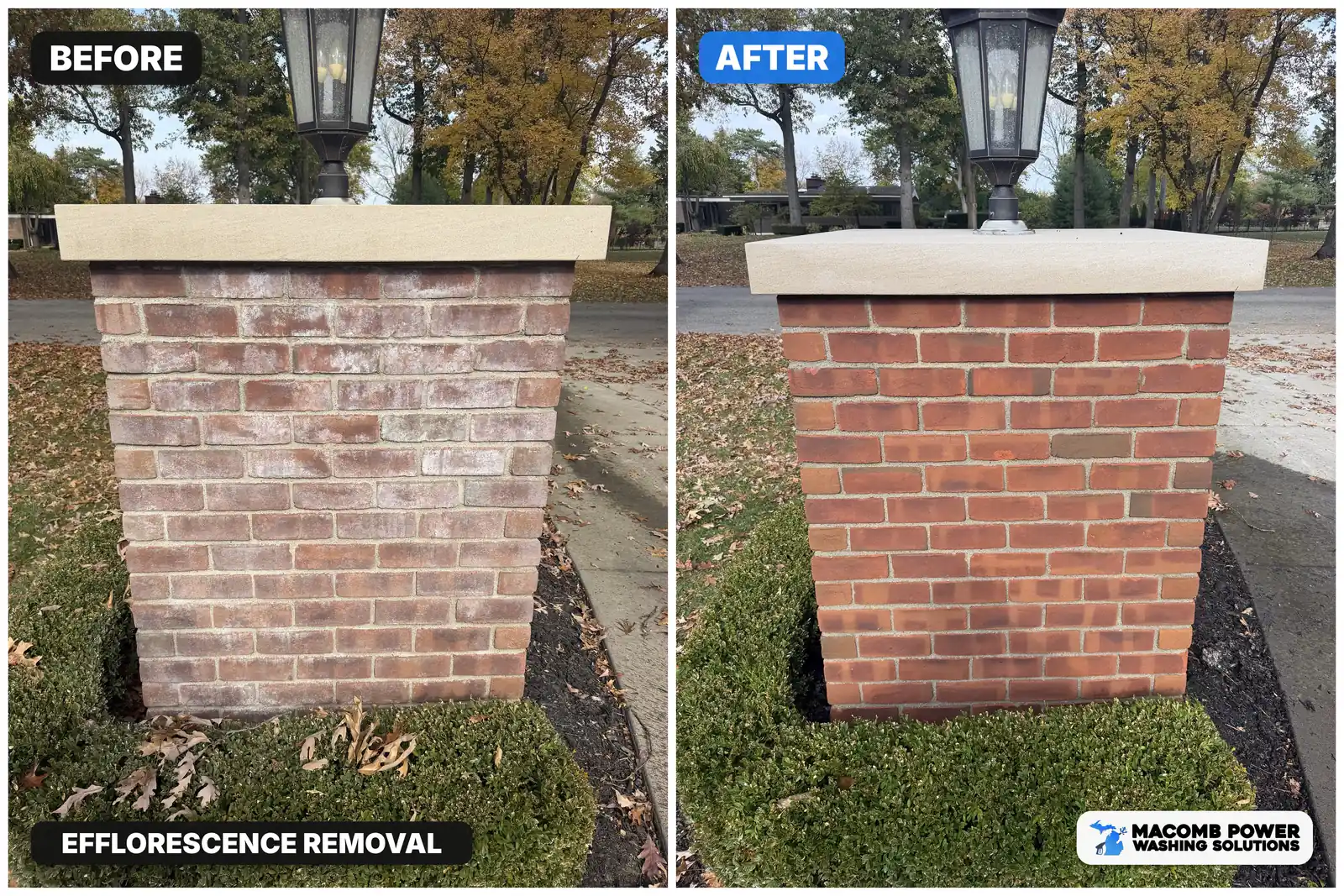
You can pressure wash efflorescence off brick, and the white will disappear for a while, but a spray wand is the least forgiving way to remove a deposit that a brush usually handles. (What the white deposit is, and where its salts come from, is in our efflorescence explainer.) For light deposits, the Brick Industry Association (BIA) starts with dry brushing, or a stiff fiber brush and water, not a pressure washer.
The catch is what a wash leaves behind. Spraying drives water into a wall that still has salt inside it, and that water is the raw material for the next bloom. Whether you call it pressure washing or power washing, the order that works is the same: stop the water feeding the wall, let the brick dry, brush, and bring in water only as far as the job needs, at low pressure and in warm, dry weather. What a hard spray does to mortar joints and brick faces is a separate risk, covered in can pressure washing damage brick.
Why doesn't more pressure dissolve more salt?
Removing efflorescence is a dissolving job. BIA describes most efflorescing salts as water-soluble, and the National Research Council of Canada's digest on efflorescence describes the usual water method as dissolving the salts by rinsing while scrubbing with a brush. The brush breaks up the crystals and the water takes them into solution. A harder jet does not make the salt any more soluble; it only adds force.
What extra pressure does change is where the water ends up. The Concrete Masonry and Hardscapes Association (CMHA), writing about block walls, says that using water to remove surface deposits, efflorescence included, puts additional water into the wall, particularly when it is applied under high pressure, and that this water may promote further efflorescence.
BIA applies the same reasoning to cleaning products. Its brick cleaning note holds a sprayed cleaning solution to 50 psi or less, because higher pressure can force the solution deep into the masonry where it becomes a source of future staining, and it tells crews to rely on the cleaner's chemical reaction rather than the brush or the sprayer's pressure. When brushing and water leave a stubborn deposit, BIA's next step is a proprietary cleaner used exactly as its maker directs, not more psi. Our guide to efflorescence remover types matches labels to surfaces.
Why does efflorescence come back days after a wash?
When the white returns within days, the wash itself may be the cause, because it put water back into the wall. The salt on the face is only the visible part of a supply held in the brick, the mortar and the materials behind them. Wash water soaks in, dissolves salt below the surface, and carries it back out as the wall dries.
The NRC digest says that when a wall is rinsed, some of the salts are probably carried back into the masonry and later form efflorescence again. BIA's efflorescence note says washing adds considerably more moisture, which may bring more salts to the surface, and for that reason it calls washing efflorescence off brickwork usually not advisable except in warm, dry weather. The National Park Service (NPS) notes that where dissolved de-icing salts have migrated into masonry, cleaning may draw them to the surface as efflorescence that may need a second treatment, and that a masonry wall may take over a week to dry after cleaning.
So a haze that returns in the first several days after a wash can be the wash water leaving the wall rather than a new problem, and a wash in cool weather dries slowly, which why efflorescence shows up in winter explains. If the white keeps returning long after the wash water has dried out, on brickwork more than a year old, BIA generally attributes it to excessive water penetration or poor drainage, and finding that water is the subject of why efflorescence keeps coming back.
What pressure and weather does brick cleaning call for?
BIA Technical Note 20 sets the numbers for brick, measured at the nozzle tip, and it says to consult the brick manufacturer before cleaning with pressurized water.
| Part of the job | What BIA Technical Note 20 says |
|---|---|
| Prewetting before a cleaner | Very low pressure, under 100 psi |
| Applying a cleaner by sprayer | Wide-angle fan tip at 30 to 50 psi, no higher |
| Rinsing | Low pressure, 100 to 400 psi |
| Upper limit | No more than 400 psi at the nozzle unless the brick maker permits more; 400 to 800 psi only with that permission; above 800 psi is not appropriate for brick |
| Nozzle | Stainless steel fan tip of 25 to 50 degrees, at least 12 in. from the brick |
| Air temperature | Water-based cleaning preferably only when the air will be 40°F or warmer and stay there until the wall is dry; ideally above freezing for seven days afterward |
The weather line matters most for efflorescence. BIA says not to clean during freezing weather, or when it is expected, both to protect the masonry and to avoid raising the risk of efflorescence, and it notes chemical cleaners generally work better at 50°F or above. A cold snap in the forecast is a reason to brush now and wash later.
What does a careful efflorescence cleaning look like?
A careful cleaning works from the least water to the most, and it starts away from the brick.
- Deal with the water first. BIA says to identify and correct the source of water penetration and let the brickwork dry before cleaning efflorescence that keeps recurring. CMHA likewise says the cause should be repaired before the deposit is removed.
- Confirm it is efflorescence. It should usually loosen under a dry brush. A hard crust that survives brushing and water is more likely lime run or white scum, which call for different cleaners; see white crust that won't brush or wash off.
- Brush on a dry day. Use a stiff fiber brush, not a metal one: BIA says metal brushes may damage mortar joints or cause further staining.
- Add water only if haze remains. Brush with clean water in warm, dry weather. BIA asks for clean, potable water, because water used for cleaning can itself be a source of salts and other contaminants.
- Use a cleaner made for brick on heavy deposits. Follow its label, test it on a small, hidden area first, prewet the wall at very low pressure, and rinse within the limits above.
- Judge the result dry. BIA judges trial cleaning after the brickwork has dried, usually in about one week.
When is a low-pressure rinse part of the job?
A rinse belongs in the job when water is already part of the method:
- After brushing with water, to carry the dissolved salt off the wall instead of leaving it to dry back onto the face. CMHA's block-wall guidance pairs dry brushing with a flush of clean water.
- After any cleaner. BIA calls a thorough, uniform rinse critical, because cleaner and dissolved material left on the wall can form white scum. Clear runoff at the base of the wall is its sign of an adequate rinse.
- When the brick is being washed anyway, for dirt or algae, in weather that suits it.
A rinse does not belong when the air will drop below 40°F before the wall dries, or while an active leak is still wetting the brick. On sound masonry, our default is a low, controlled rinse within the BIA limit, and we clean efflorescence as part of house washing and hardscape restoration. House washing starts at $349, and efflorescence work is priced on a written, line-item quote within 24 hours.
Sources
- Brick Industry Association: Technical Note 20, Cleaning Brickwork (PDF, 2018)
- Brick Industry Association: Technical Note 23A, Efflorescence: Causes and Prevention (PDF, 2019)
- National Research Council Canada: Canadian Building Digest 2, Efflorescence (T. Ritchie, 1960)
- Concrete Masonry & Hardscapes Association: TEK 08-03A, Control and Removal of Efflorescence
- National Park Service: Preservation Brief 1, Assessing Cleaning and Water-Repellent Treatments for Historic Masonry Buildings (PDF)
Want This Handled Properly?
Macomb Power Washing Solutions holds a 4.9-star rating across 177+ Google reviews, and free estimates go out within 24 hours. We carry $2M general liability plus workers' compensation.