
The short answer
Efflorescence keeps coming back because water is still moving through the brick and carrying salts to the face. Cleaning removes the deposit, not the supply. On a wall more than a year old, the Brick Industry Association points to excessive water penetration or poor drainage, so the fix is finding the joint, gutter, sprinkler or ground moisture feeding it.
Why does efflorescence keep coming back?
Why does efflorescence keep coming back after you brush or wash it off? Because water is still moving through the brick, dissolving salts and leaving them on the face as it evaporates. The Brick Industry Association (BIA) says efflorescence needs soluble salts in or touching the brickwork, water in contact with them long enough to dissolve them, and a pore structure that lets the solution reach the surface. The salts can come from mortar, concrete backing, trim, soil or the brick itself, and BIA calls excluding them all impractical. Water is the part you can reduce; our efflorescence explainer covers the chemistry.
BIA's maintenance note says water ingress should be investigated and resolved before efflorescence is cleaned, "otherwise, the efflorescence will return." The Concrete Masonry & Hardscapes Association (CMHA) says efflorescence becomes lighter and less extensive over time unless an external source of salts or recurrent water migration is present. A bloom that returns as heavy every year points to one of those; BIA says it is usually the water.
First make sure it is efflorescence, which BIA describes as generally water soluble; a hard crust that survives a wet scrub may be a different deposit. Then work through the troubleshooting list in BIA Technical Note 23A. Four of its seven steps follow.
How old was the wall when the white first appeared?
Start with dates. BIA calls efflorescence on brickwork less than a year old "new building bloom." Its salts often come from the mortar's cement and its water from construction, and in most cases it dissipates over time if the wall is allowed to dry (see does efflorescence go away on its own). On a wall more than a year old, BIA generally attributes it to excessive water penetration or poor drainage and says to examine construction details for leaks in the wall or surrounding construction.
Then ask what changed. BIA notes that efflorescence on an established building that used to be clean usually means a new source of water. Look at the season before the white appeared: a new sprinkler zone, a patio poured against the wall, a raised bed, a sagging gutter, roof or window work.
What does the location of the white tell you?
BIA's second step is to note where the efflorescence sits, on the building and on individual bricks and joints, because the location may show where water enters. On a new wall, BIA and CMHA both read a fairly uniform bloom across the facade as normal drying. Heavy white streaks just below mortar joints, or heavy deposits over localized areas, mean water has entered or is entering the wall higher up, CMHA says. Look above the white, not only at it.
| Where the white sits | What to check above or beside it |
|---|---|
| A level band about 1 to 3 feet above grade that shifts with the seasons | Ground moisture wicking up the brick; missing or poorly installed base flashing |
| Uneven patches at the base | Splash-back and surface water: downspouts emptying at the foundation, soil sloping toward the wall |
| Below a sill, cap, coping or wall top | Flat or back-sloped trim, open joints, missing drips or flashing; salts in stone or precast trim |
| Around window and door frames or expansion joints | Caulk and sealant that has torn, dried out or gone missing |
| Under the eaves or where a roof meets a wall | Gutter overflow, roof-to-wall flashing |
| Within reach of a sprinkler head | Spray hitting the brick, heads set too close to the foundation |
The National Park Service says rising damp usually leaves a whitish tide mark of efflorescence that fluctuates seasonally about 1 to 3 feet above grade, distinct from the uneven damp spots of foundation splash-back.
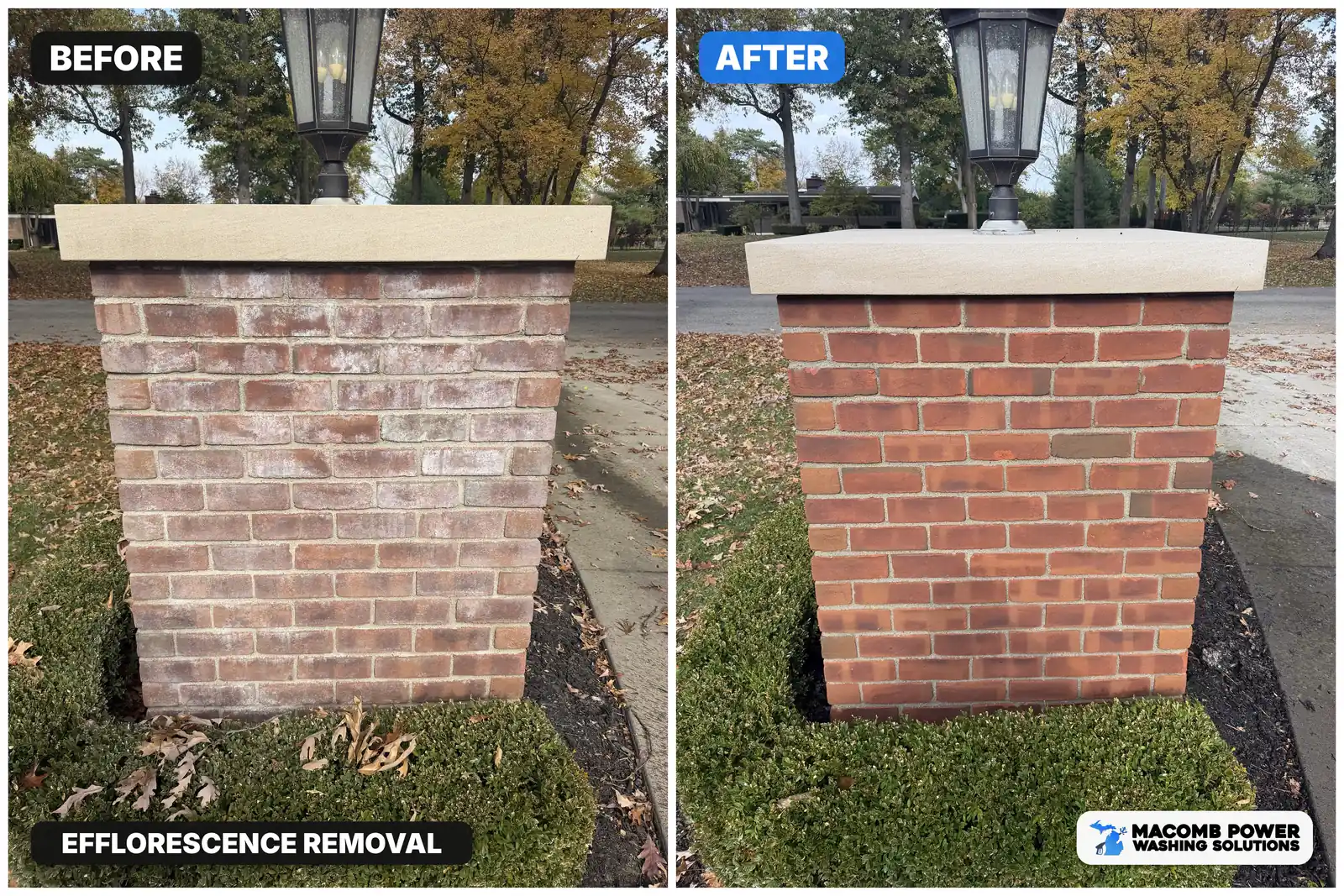
A freestanding pillar can take water from its cap and its base at once; see efflorescence on brick pillars, columns and mailboxes. White in a sprinkler's arc that won't rinse off may be mineral scale from the irrigation water.
Which parts of the wall should be inspected?
BIA's third step is to examine the masonry's condition; its maintenance note (Technical Note 46) gives a checklist. Walk each side and look for:
- Sealant joints around windows, doors and expansion joints that are torn, dry, missing or no longer elastic. BIA calls these the most frequent sources of water penetration into the wall assembly, and estimates 5 to 20 years before sealant joints may need repair, against 100 to 150 years or more for brick walls.
- Mortar joints eroded more than 1/4 in., crumbling, with voids, hairline-cracked, or cracked between brick and mortar, conditions BIA lists for repointing. BIA adds that cracks alone do not necessarily warrant immediate repair.
- Weeps, the small drain openings at flashing levels such as the base of the wall and over windows, that are missing or clogged.
- Caps, copings and sills with too little slope, cracked units, open joints or no drip.
- Flashing that is damaged, missing or open at its laps.
- Gutters and downspouts, roof overhangs, seals where brick meets other materials, and grade and drainage, also on BIA's list.
Some findings are beyond a moisture check. BIA counts cracks wider than 0.075 in. (2 mm), stepped or diagonal cracks, widespread spalling and rusted lintels among structural conditions for a professional engineer to investigate.
Which water sources are easy to miss?
BIA's last step is to consider miscellaneous sources once the obvious ones are ruled out.
- Sprinklers. The Park Service calls an irrigation system set too close to a building a frequently unsuspected, but serious, source of ground moisture, and says misplaced heads can add a tremendous amount of moisture at the foundation and on wall surfaces. Run each zone and watch where it lands.
- Downspouts and buried drains. By the Park Service's figures, a heavy rain of 2 in. per hour can send 200 gallons out of a house's downspouts in an hour, and broken underground pipes or downspout drainage can dampen walls some distance from the leak.
- Leaky pipes and faulty drains. Both are on BIA's list; the Park Service also says to check hose bibs for leaks and keep air conditioning condensate drain outlets clear.
- Indoor moisture. BIA says condensation contributes mainly when indoor moisture from cooking, bathing, washing or a pool reaches the exterior brick, and in most cases it evaporates before causing damage. Check it last.
What can a homeowner fix, and what needs a mason?
Much of the drainage work is owner work. The Park Service lists rehanging gutters, repairing downspouts and keeping vegetation off buildings among the repairs that, in most cases, can alleviate most exterior moisture above grade; for the ground, it lists sloping the grade away and carrying downspout water well away from the building.
- Keep gutters clear, and fix runs that sag or hold water.
- Extend downspouts so water leaves well away from the wall, and make sure buried drain lines flow.
- Re-aim sprinkler heads so the spray stays off the brick.
- Cut ivy away from the wall rather than pulling it off, as BIA advises.
Macomb Power Washing Solutions offers gutter cleaning from $149, with a typical two-story house at $175 to $300. We flush each downspout, test flow into underground drains, and repair or rehang runs that sag, hold water or leak at the seams.
Flashing, repointing and sealant replacement belong to a mason or another qualified contractor. BIA describes repairing or replacing flashing in an existing wall as invasive work, says repointing should be done only by qualified and experienced repointing craftspeople, and calls for repointing mortar no stronger than the original. Rising damp may call for new base flashing or a dampproof course.
Clean last. BIA's guidance is to repair leaks and let the brickwork dry before removing efflorescence, and to correct deficiencies before any coating goes on (see should you seal brick). When we clean efflorescence during a house washing visit, from $349, we tell you whether it looks like new building bloom or a moisture flag, and point out the water path when there is one. Methods are in can you pressure wash efflorescence. Then check the same walls each season.
Sources
- Brick Industry Association: Technical Note 23A, Efflorescence: Causes and Prevention (PDF)
- Brick Industry Association: Technical Note 46, Maintenance of Brick Masonry (PDF)
- Concrete Masonry & Hardscapes Association: TEK 08-03A, Control and Removal of Efflorescence
- National Park Service: Preservation Brief 39, Holding the Line: Controlling Unwanted Moisture in Historic Buildings (PDF)
Want This Handled Properly?
Macomb Power Washing Solutions holds a 4.9-star rating across 177+ Google reviews, and free estimates go out within 24 hours. We carry $2M general liability plus workers' compensation.