
The short answer
Clean sealed stamped concrete with mild dish soap, a soft brush and a full rinse, then treat stains with matched cleaners: a degreaser for oil, mild acid for rust or leaf marks, diluted bleach for mildew and a spot cleaner for sap or tar. Macomb Power Washing Solutions cleans concrete from $149 and seals it from $299.
How do you clean sealed stamped concrete without hurting the sealer?
Sealed stamped concrete is cleaned without hurting the sealer by using the mildest cleaner that works, a soft brush instead of high pressure, and a full rinse so no residue dries on the film. Most stamped patios and driveways carry a clear acrylic coat on top of the colored surface. The job is to lift dirt and stains off that coat while leaving the coat itself in place.
The sealer on stamped concrete is a sacrificial layer, meaning it wears away so the colored concrete under it does not. The American Society of Concrete Contractors (ASCC), in its homeowner sealer guide, describes sealers as scratch and stain resistant, not scratch and stain proof. Euclid Chemical's troubleshooting bulletin goes further and says cure-and-seal products and penetrating sealers will not prevent stains from oil, tree debris or fertilizer. A sealed patio still stains. The sealer buys time to clean a spill before it sets, and Euclid adds that a cleaner strong enough to remove a stain may take some sealer with it, and the sealer may then need reapplying.
What routine cleaning does a sealed stamped patio need?
Routine cleaning for a sealed stamped patio is a sweep, a wash with mild dish soap and water, some scrubbing and a thorough rinse. The ASCC guide names dish soap, a little elbow grease and thorough rinsing as the maintenance that keeps sealed decorative concrete in shape. Dish soap loosens dust, pollen and grime without attacking the acrylic, and the rinse carries it away.
Rinsing well is the step people shorten. Soap left to dry leaves a dull film on the sealer, and the ASCC guide says any detergent must be carefully rinsed off, with the surface completely dry, before sealer is reapplied.
Spills need prompt attention. The ASCC guide warns that stains set over time if they penetrate and eat into the coating. A spill wiped up the same day sits on the film, while the same spill left for weeks has time to work into it. Euclid's advice is to sweep tree debris and fertilizer granules off sealed concrete as often as possible.
Can you pressure wash sealed stamped concrete, and how gently?
Sealed stamped concrete can be pressure washed if it is done gently: low pressure, a wide fan tip, the wand kept at a distance and always moving. The ASCC guide lists power washing, along with a walk-behind scrubber or thorough hand scrubbing, as acceptable ways to clean decorative concrete before a reseal. For that pre-reseal cleaning, ASCC's best-practice sheet on sealing stamped concrete recommends a power wash at a minimum of 3,500 psi, followed by 24 hours of dry time. That figure is for prep ahead of a new coat, when wear on the old film no longer matters. Routine cleaning between reseals stays with soap, a soft brush and a garden hose.
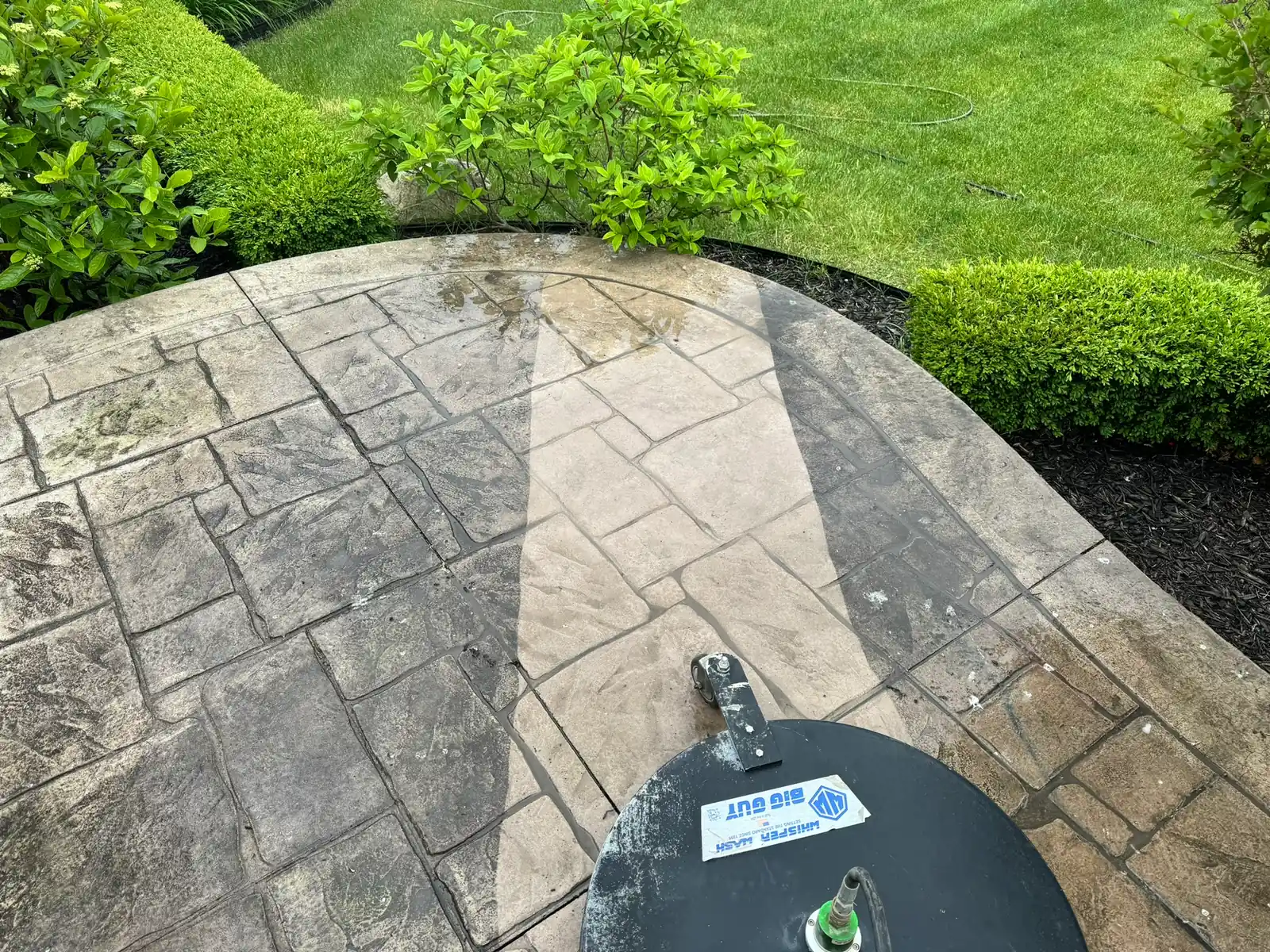
A narrow, high-pressure stream held close to stamped concrete cuts lines into the sealer and can wear into the colored surface beneath it, which shows as lighter streaks once the slab dries. On flat sections, a rotary surface cleaner keeps the force even, and the texture and grout lines of a stamped pattern get a fan tip and a brush. Our concrete cleaning service, from $149, uses commercial surface cleaners and adjusts the pressure to each surface's age and condition.
How do you remove oil and grease from a sealed surface?
Oil and grease come off a sealed surface with a household detergent or a degreaser such as Simple Green or a common engine degreaser, which is what the ASCC guide recommends for oil stains on sealed concrete. On an intact film the oil sits on the coat instead of soaking straight into the concrete, so a fresh drip often blots up with an absorbent and then cleans off with degreaser and a soft brush.
Gasoline and solvent spills are a separate concern on a solvent-based acrylic. Euclid notes that this type of film stays re-dissolvable after it dries, which is why gasoline or other chemical spills can damage it. Old oil is harder too, since stains set once they work into the coating and a faint outline may remain. A solvent-based poultice built for bare driveways can soften a solvent-based acrylic film the same way, so on a sealed slab it gets tested on a hidden spot first. Our guide to oil and rust stain removal on driveways covers those methods for unsealed concrete.
How do you remove rust and leaf marks from sealed stamped concrete?
Rust and leaf marks on sealed stamped concrete come off with a mild acidic cleaner such as Lime Away, CLR or a cleaner made for concrete, which is the ASCC guide's recommendation for both stains. Read the product label before using it, though. CLR's own directions say to avoid contact with painted, coated or sealed surfaces, so on a sealed stamped slab pick a cleaner whose label allows sealed concrete. Rust spots usually trace back to metal furniture feet, planters or tools left on the slab, while leaf marks show where wet leaves sat.
Acid needs care on a colored surface. Dilute the cleaner as its label directs, test it on a hidden corner, keep the contact time short and rinse thoroughly. Acids react with the cement paste in concrete, so any acid used on a stamped slab stays mild, brief and well rinsed.
Leaf marks are a fall problem on stamped patios under oaks and maples. Wet leaves release tannin, a brown, water-soluble plant compound, which marks the surface wherever leaves lie in piles. Clearing leaves before rain keeps the marks small. Leaf prints on bare concrete and black walnut hull stains are covered in our guide to removing leaf and walnut stains from concrete.
How do you clean mildew and algae off a shaded stamped patio?
Mildew and algae on a shaded stamped patio are cleaned with diluted household bleach, which the ASCC guide says handles most mildew when it is treated promptly. Shaded patios along a north wall or under trees stay damp longest after rain, and the green or gray film shows there first.
On a sealed, colored surface, use bleach at the weakest strength that works. Pre-wet nearby plants, keep the solution on for only a few minutes, then rinse the patio and the plants well. Test a corner first on stained or tinted concrete, since colors and sealers vary in how they react. Bleach must never be combined with ammonia or acid products, because those mixtures release toxic gases.
How do you clean off tree sap, road tar and spring salt residue?
Tree sap and road tar come off sealed stamped concrete with a spot cleaner such as Goo Gone or Dissolves-It, which the ASCC guide names for both. Apply it to the spot only, let it soften the residue, wipe it up and rinse the area with soapy water. Because a solvent-based acrylic stays re-dissolvable, try the cleaner out of sight first to see whether it softens or dulls that sealer.
Winter salt shows as a white, crusty film near the garage and along walks. In Macomb and Oakland County, road salt carried in on tires and boots dries on the sealer through the winter. A spring rinse with plain water, followed by a mild soap wash where the film remains, clears the salt before the season's first full cleaning or reseal. Which deicers are kindest to a sealed stamped slab is covered in our guide to safe ice melt for concrete and pavers.
Which cleaners and tools damage an acrylic sealer?
Strong solvents, strong acids, abrasive tools and close-range high pressure are the cleaners and tools most likely to damage an acrylic sealer. Xylene re-dissolves a solvent-based acrylic, which is why Alliance Gator uses a drop of it to identify one and Euclid uses it to rework a failed coat. A wire brush or scouring pad scratches the film, and Euclid notes that plasticizers in rubber-backed mats and tires can react with sealer and leave it sticky or marked.
| Stain on sealed concrete | Cleaner to use | What to avoid |
|---|---|---|
| General dirt and pollen | Mild dish soap, soft brush, full rinse | Leaving soap to dry on the film |
| Oil and grease | Detergent or degreaser such as Simple Green | Solvent poultices meant for bare concrete |
| Rust and leaf marks | Mild acidic cleaner whose label allows sealed concrete | Strong acids, long contact time, products labeled not for sealed surfaces |
| Mildew and algae | Diluted household bleach, short dwell | Strong mixes; any mix with ammonia or acid |
| Tree sap and road tar | Spot cleaner such as Goo Gone or Dissolves-It | Flooding the area with solvent |
| Winter salt film | Plain water rinse, then mild soap | Leaving salt on into spring |
How does gentle cleaning stretch the reseal cycle in Michigan?
Gentle cleaning stretches the reseal cycle because each harsh cleaning removes some sealer along with the dirt. The ASCC guide's rule of thumb is new sealer every two to three years for high-traffic, sun-exposed areas and four to five years for lighter-traffic areas. A stamped driveway in Michigan, with tires, road salt and freeze-thaw, belongs in the high-traffic group.
The signs that cleaning is no longer enough are faded areas, patchy spots and color that looks uneven, most visible right after rain or a rinse. Our guide to when to reseal stamped concrete explains how to read them. Macomb Power Washing Solutions quotes a clean-and-reseal in writing within 24 hours, with concrete sealing from $299 and no travel fee anywhere in the service area.
Sources
Want This Handled Properly?
Macomb Power Washing Solutions holds a 4.9-star rating across 177+ Google reviews, and free estimates go out within 24 hours. We carry $2M general liability plus workers' compensation.