
The short answer
To clean pavers without a pressure washer, sweep or blow off debris, treat individual stains, then scrub small sections with mild soap or a concrete-paver cleaner and a plastic or brass bristle brush. Rinse with plenty of water from a garden hose, keep cleaner off nearby plants, and sweep sand into low joints once dry.
How do you clean pavers without a pressure washer?
You clean pavers without a pressure washer by hand: cleaner brushed on, the pavers scrubbed, then a thorough rinse from a garden hose. That is the method the Concrete Masonry and Hardscapes Association (CMHA) describes in its Tech Note PAV-TEC-005, which says residential patios, walks and small driveways can get an adequate cleaning without spray equipment and calls it a method for do-it-yourselfers refurbishing a small area.
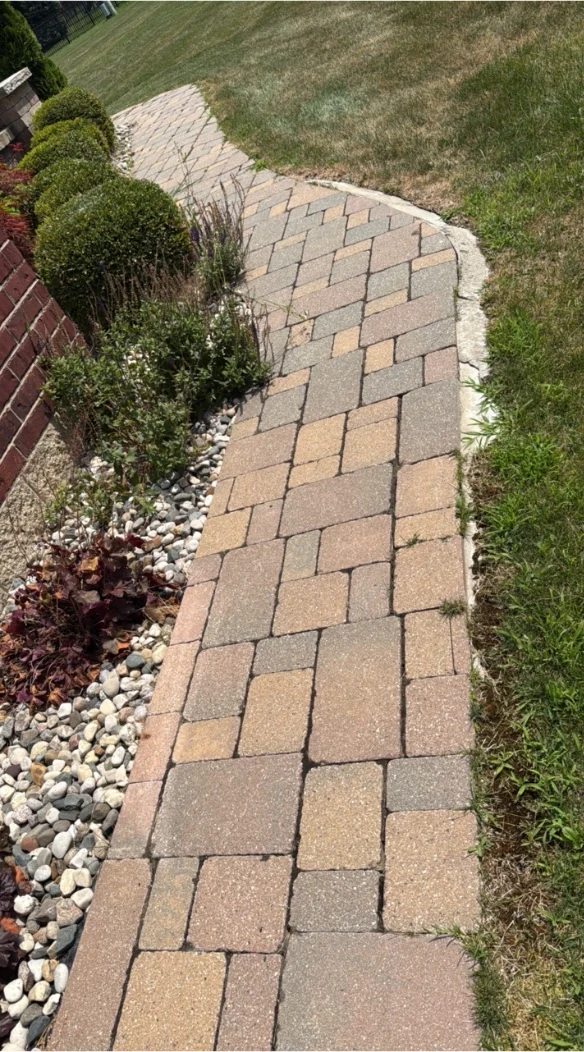
The steps below are for concrete pavers. Clay brick pavers follow brick cleaning rules instead; see how to clean clay brick pavers.
What tools and cleaner does a hand wash need?
A hand wash needs the items in the table below, plus goggles, rubber gloves and the mildest cleaner that does the job. The brush is the one item with a firm rule. CMHA does not recommend steel bristles, which loosen from the brush, rust and leave stains; brass or plastic bristles are acceptable. Unilock, a paver maker, gives the same warning about wire brushes and the metal particles they leave behind.
| Item | What it does |
|---|---|
| Push broom or leaf blower | Removes grit first, so it does not scratch the paver face while you scrub |
| Plastic or brass bristle brush | Scrubs without shedding steel that rusts |
| Bucket, warm water, dish soap | Lifts everyday dirt; Unilock starts with a few squirts of soap |
| Cleaner made for concrete pavers | Takes over when soap leaves grime behind |
| Garden hose and spray nozzle | Rinses with volume instead of force |
| Plastic sheeting or twine | Covers or ties back plants beside the pavers |
| Clean, dry joint sand | Refills joints that drop during the wash |
Move up in strength only when the milder step fails. If soap and water leave grime, switch to a cleaner sold for concrete pavers, the kind CMHA recommends. For a particular stain, CMHA notes that a remover's label often lists the stains it removes. Test any cleaner on a small spot out of sight first, as CMHA and Unilock both advise.
For mildew, Unilock's cleaning guide suggests pouring white distilled vinegar on the spots and leaving it 10 to 15 minutes before rinsing; its stain guide suggests one part vinegar to three parts water for leaf or berry marks, rinsed well afterward. Unilock warns against muriatic acid as a routine cleaner, saying it can etch concrete pavers and alter their color, and CMHA says cleaners with strong acids change paver color slightly. Never mix bleach with vinegar, any other acid or ammonia. Bleach strengths are covered in bleach on pavers.
What order should the cleaning steps go in?
The steps go from dry to wet and from specific to general: debris, then stains, then the general wash. CMHA's sequence removes stains on specific areas first and cleans the entire pavement after.
- Clear and inspect. Move furniture, grills and planters off the pavers. Unilock's first step is to look for cracked or broken pavers and replace them if needed.
- Dry clean. Sweep or blow off leaves, dirt and grit. CMHA's maintenance guide says a leaf blower does this very effectively but cautions against removing joint sand.
- Rinse and look. Unilock suggests a quick hose rinse to separate surface grime from true stains, then marking spots of oil, rust, mildew, algae or moss so you can treat them in order.
- Spot-treat stains. For stain removers, CMHA says to begin at the bottom of the slope and work up in manageable sections. The used cleaner drains down over pavers already treated, and the dry pavers ahead stay easy to read.
- Wash in sections. Scrub one small zone at a time with the soap solution or paver cleaner, rinse it, and check the result before moving on.
- Final rinse and dry. Rinse low spots well; CMHA warns that sediment or cleaner left to pond in them may stain the pavers. Once the surface dries, Unilock suggests looking again in different light and repeating spot treatment where marks remain.
How do you scrub and rinse without washing out the joint sand?
You keep the joint sand in by scrubbing the paver faces, rinsing with a wide, low spray and checking the joints once the surface dries. A hose can still lower the joints: Unilock's stain guide mentions joints that look low after heavy rinsing, and CMHA's maintenance guide says pavements exposed to excessive cleaning, driving winds or concentrated runoff may lose some joint sand.
- Brush the faces. Unilock's stain guide says to protect the joint sand during any cleaning, so work the bristles across the paver faces rather than down into the joint lines.
- Keep the spray low. Unilock's cleaning steps say to spray at an angle no greater than 30 degrees, from a hose or a power washer, to avoid washing out joint material.
- Rinse with volume, not force. CMHA puts water volume ahead of pressure for rinsing, so a hose on its shower or fan setting does the job.
- Refill once dry. If plain-sand joints look low after rinsing, Unilock says to let the area dry fully, then sweep clean sand across the surface to fill the gaps. Polymeric joints are not topped up this way; low or cracked ones are cleared and refilled.
Top-up or full re-sand: see re-sanding pavers after washing. Nozzle and angle for a pressure washer are in pressure washing pavers with polymeric sand.
How do you protect the lawn and plants beside the pavers?
You protect the lawn and plants by covering them before you start, planning where the cleaner will drain and keeping it from running onto them. CMHA's precautions, condensed:
- Tie back or cover branches, shrubs and plants beside the pavers.
- Turn off automatic sprinklers during cleaning and drying.
- If you are unsure which way water runs, test with plain water first to find trouble spots.
- Steer cleaning fluids across the pavers, not onto grass or beds. CMHA warns that acidic cleaners may harm vegetation and grass.
- Before using a strong acidic remover that could drain toward plants, soak them with clean water. CMHA says this cuts how much cleaner rinse water they absorb.
The rinse water needs a plan as well. Michigan's Department of Environment, Great Lakes, and Energy (EGLE) explains in its power washing guidance that roadside ditches and the curbs and gutters along roads are storm sewers, and that storm sewer water travels to a stream, river or other water body without treatment. Keep soapy rinse water from running down the driveway into the street, a catch basin or a ditch, and do not leave it standing: EGLE warns that wash water left to pool on driveways can carry its contaminants to a storm drain in the next rain.
When is a hose and brush not enough?
A hose and brush fall short when the area is large or the marks are more than surface dirt. Unilock notes that soap and water may not remove stubborn or deep-seated stains and can be time-consuming on large, heavily soiled areas. CMHA recommends a professional company for most cleaning jobs and says the extra time a do-it-yourself job takes should be weighed against hiring one with the equipment and chemical experience. Marks with their own causes and fixes:
- Oil and grease: CMHA says deep-set oil often needs repeated remover applications; see oil stains on pavers.
- Orange or brown spots: rust stains on pavers.
- White powder or haze: efflorescence on pavers, or polymeric sand haze if it follows a fresh sanding.
- Green film or moss: why pavers turn green.
- Black, crusty spots that survive scrubbing: possibly lichen; see black spots on a patio.
Some problems are not cleaning problems. Sunken, rocking or broken pavers and edges drifting into the lawn call for paver repair and re-sanding, which we quote from photos or in person, with a written estimate within 24 hours.
If you would rather hand off the job, a paver patio or walk is priced as brick paver restoration, which cleans, re-sands the joints with polymeric sand and seals, from $399. Poured concrete beside it falls under concrete cleaning, from $149. How often to repeat a clean is covered in how often pavers should be cleaned.
Sources
- Concrete Masonry & Hardscapes Association: PAV-TEC-005, Cleaning, Sealing and Joint Sand Stabilization of Interlocking Concrete Pavement
- Concrete Masonry & Hardscapes Association: PAV-TEC-006, Operation and Maintenance Guide for Interlocking Concrete Pavement
- Unilock: Removing Stains from Pavers
- Unilock: How to Clean Pavers
- Michigan EGLE: Mobile Power Washing Environmental Compliance Guidance (PDF)
Want This Handled Properly?
Macomb Power Washing Solutions holds a 4.9-star rating across 177+ Google reviews, and free estimates go out within 24 hours. We carry $2M general liability plus workers' compensation.