
The short answer
Only if the wash took the joints down. Once the pavers dry, check them: the hardscape trade group CMHA says to top up joint sand that has dropped more than 1/2 inch with dry masonry sand. Polymeric joints are not topped up; failed ones are cleared at least 1 1/2 inches deep and refilled with polymeric sand.
Do you need to re-sand pavers after power washing?
You need to re-sand pavers after power washing only when the wash took the joint sand down. The Concrete Masonry and Hardscapes Association (CMHA) names a power washer as one way to clear debris in spring and fall in its maintenance guide, PAV-TEC-006, with a caution: be careful not to remove the joint sand.
The guide lists pressure washing, excessive cleaning, driving winds and concentrated runoff as causes of joint sand loss and draws a clear line: once the sand has dropped more than 1/2 inch, top it up immediately. CMHA also notes that sediment settling into the top of the joints helps hold the sand in place. Once the surface dries, the joints show which case applies:
| What you find after the wash | What it usually means | Next step |
|---|---|---|
| Joints full, or down less than 1/2 inch | Little or no sand lost | No re-sanding; recheck at the next cleanup |
| Plain-sand joints down more than 1/2 inch | Sand washed or blown out | Top up with dry masonry sand on a dry day |
| Polymeric joints cracked, flaking or washed out | The set sand in those joints has failed | Clear at least 1 1/2 inches deep and refill with polymeric sand |
| Low joints beside a dip, a tipping edge paver or widening gaps | The base or edge restraint has moved | Repair the base or edge first, then sand |
How do you check whether the joints lost too much sand?
Check the joints after the pavers have dried. Standing water hides how deep a joint is, and wet polymeric sand feels softer than it will be: Alliance Gator, a polymeric sand maker, says its sand is designed to soften when wet and turn hard again as it dries. A probe in a wet polymeric joint can make a sound one feel failed.
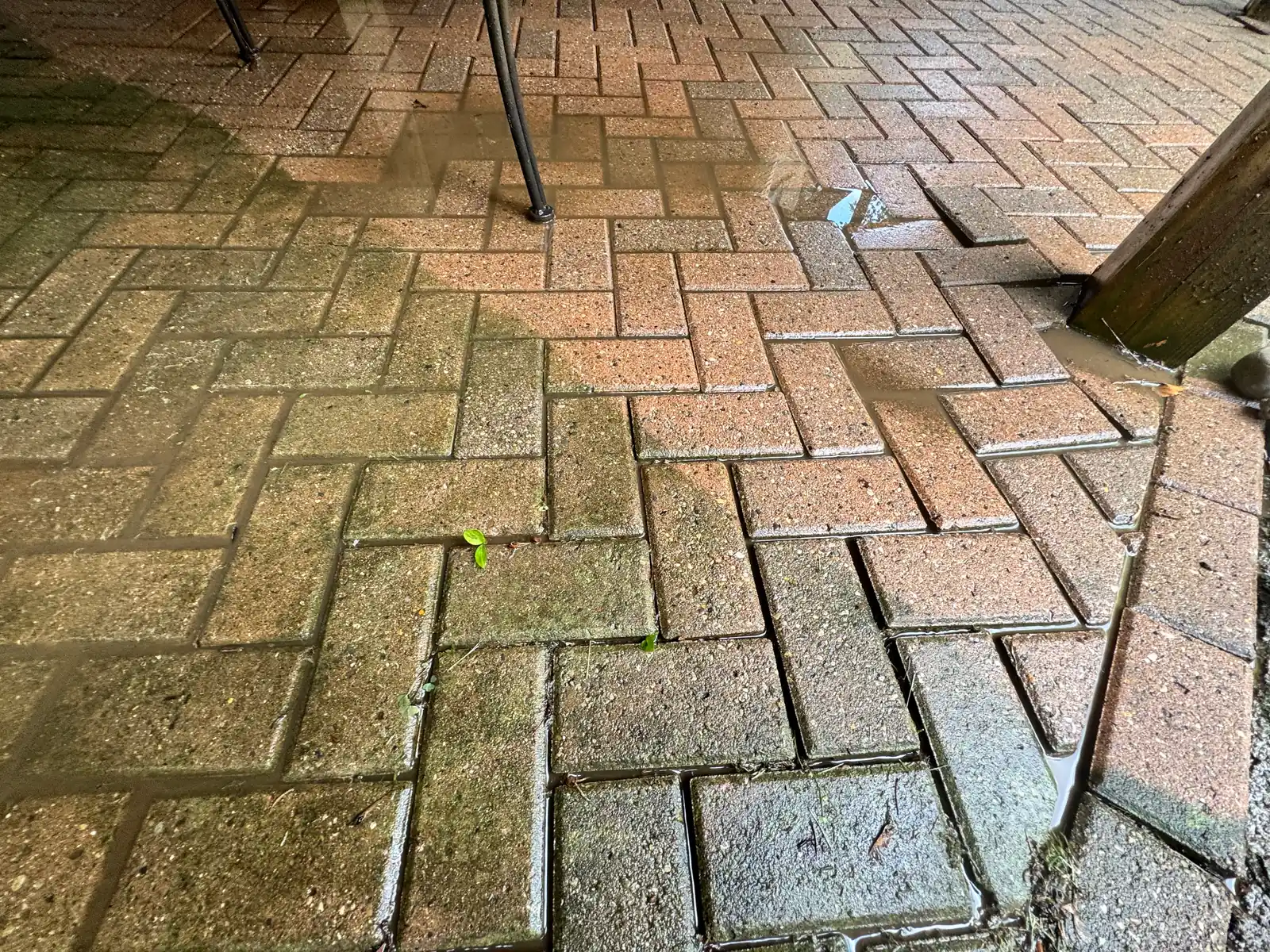
Start where sand loss tends to begin:
- Where the spray hit hardest. Joints that took a narrow tip or a steep angle lose sand first; our guide to pressure washing pavers with polymeric sand explains why.
- At downspouts and eaves. CMHA singles out downspouts and the drip line under eaves as places where concentrated water erodes joint sand.
- Along the outer edge. CMHA's maintenance guide says a failing edge restraint shows up as joints widening at the perimeter, most noticeably within 1 to 2 feet of the edge.
Slide a ruler into a few joints in each spot; more than 1/2 inch of drop is the cue to refill. Then scratch the top of a joint with a screwdriver. Plain jointing sand comes up as loose grains. Polymeric sand has a firm, set top, and Alliance calls a hardened top crust with dry, unhardened sand beneath it a normal condition for its polymeric sand, so softer sand under the crust is not a failure on its own. A set surface that is cracked, flaking or missing in pieces is.
Can you top up the joints, or does the old sand have to come out?
Plain-sand joints can be topped up; polymeric joints get cleared and refilled instead.
Plain sand. CMHA tops up with dry masonry sand on a dry surface, spread back and forth with a wide push broom until the joints are full to the bottom of the paver chamfers, the small bevels along each paver's top edges, then the extra is swept off the surface. CMHA does not recommend polymeric sand for topping up joints.
Polymeric sand. Alliance Gator calls filling part of a joint with one material and the rest with another "topping" and says it can make the sand fail and come out of the joint; it adds that partly filling joints with regular sand makes the joint surface peel and flake off. For a repair, Alliance says the existing sand comes out at least 1 1/2 inches deep and the new polymeric sand is finished 1/8 inch below the paver's top or chamfer, so the paver shields it from feet and tires. Unilock, a paver maker, gives the same finish height. Our paver repair and re-sanding page lays out how we clear, fill, compact and activate those joints.
On heavily textured pavers, Unilock says polymer particles caught in the grooves can leave a stubborn haze, and it recommends regular jointing sand with a joint-stabilizing sealer instead.
How dry do the pavers need to be before new sand goes in?
Completely dry. Water is what activates polymeric sand, which is why CMHA says no moisture should be on the surface or in the joints until dry-stabilized sand goes into the joints. Unilock asks for a completely dry surface and clear weather, and Alliance Gator links white haze to damp pavers and high humidity; our guide to polymeric sand haze covers getting that film off.
That rules out sanding right after the rinse. SEK-Surebond, a maker of paver cleaners and sealers, says to let the surface dry for 24 hours after cleaning or rain before installing joint sand. Clay pavers deserve a second look, because Alliance warns they can still be damp when they appear dry. The bag still has the last word: Alliance's Gator Nitro, for one, is installed on a wet surface.
Can you re-sand pavers this late in the fall?
A plain-sand top-up can go in on any dry day, since plain sand has nothing to activate or cure. Polymeric sand in November depends on the forecast. Alliance Gator says its polymeric sand is engineered to be installed above 32°F, that sand installed in colder weather may never set up, and that sand which does not dry will not harden properly. Add SEK-Surebond's 24 dry hours after cleaning or rain, and a late-fall polymeric job needs a run of dry days above the minimum on the sand's label, which varies: Alliance's Gator Dust needs above 59°F. No calendar date closes that window; the week's forecast does.
If the window never opens, the polymeric work moves to spring. We schedule re-sanding around the forecast and follow the label of the sand going into the joints.
When does a low joint point to a base problem instead?
A low joint points to a base problem when the pavers around it have moved too: a dip that holds water, an edge row that tips or spreads, or joints clearly wider than the rest. Cracked polymeric joints count too: Alliance Gator says polymeric sand does not crack on its own; cracks come from paver movement, such as rocking. New sand fixes none of those. CMHA says joint sand stabilizers do not add to the load-bearing capacity of the pavement, Unilock wants the base stable before polymeric sand goes in, and SEK-Surebond lists sunken pavers, failed edging and heaved pavers among the repairs to finish before cleaning and sealing.
What each sign tends to mean, per CMHA's maintenance guide:
- Dips and puddles. Settlement of the soil or base, often from poor compaction, or a saturated base, overly thick bedding sand or washed-out bedding. CMHA confirms a dip with a 10-foot straightedge or string line, since color changes can make flat pavers look uneven and shadows exaggerate a dip.
- Edge trouble. A loose edge restraint lets joints open along the perimeter and the outer pavers rotate or settle.
- Wide joints. Joints are typically specified at 1.5 to 3 mm (0.05 to 0.12 inch). Much wider joints can come from a weak edge, nearby settlement or heave, sideways movement or missing joint sand.
- Raised pavers. Units standing more than 1/8 inch above their neighbors should be fixed before winter, because shovels and plows can catch them and plows can chip their edges.
Those repairs come before the sand. Our paver repair service lifts sunken or heaved pavers and resets them on a corrected base, resets shifted edges, repairs or replaces edge restraints, and re-sands joints with polymeric sand, on its own or as part of a brick paver restoration with cleaning and sealing. Repairs have no published price: we quote them from your photos or in person, with a written estimate within 24 hours. If tree roots or drainage are behind the movement, the estimate says so; that work is outside what we do.
Sources
- Concrete Masonry & Hardscapes Association: PAV-TEC-006, Operation and Maintenance Guide for Interlocking Concrete Pavement
- Concrete Masonry & Hardscapes Association: PAV-TEC-005, Cleaning, Sealing and Joint Sand Stabilization of Interlocking Concrete Pavement
- Alliance Gator: FAQ, Gator Jointing Material
- Unilock: Polymeric Sand Guide
- SEK-Surebond: Technical Bulletin TB18, Ready to Seal? Prepare or Beware (PDF)
Want This Handled Properly?
Macomb Power Washing Solutions holds a 4.9-star rating across 177+ Google reviews, and free estimates go out within 24 hours. We carry $2M general liability plus workers' compensation.