
The short answer
Pavers turn green when algae or moss grows on a surface that stays shaded and damp. Algae is a thin, slick film on the paver faces; moss forms compact cushions in the joints and along the edges. Scrape and brush with plastic or brass bristles, wash without emptying the joints, then fix the shade and water, or it returns.
Why are my pavers turning green, and how do I get it off?
Pavers turn green because algae or moss has found a surface that stays shaded and wet. A pest guide from Oregon State University (OSU) says algae grows on walls, sidewalks and patios in shady locations, and that moist, shaded patios are ideal for moss. The Royal Horticultural Society (RHS), the British gardening charity, adds that these growths do not damage the surfaces they grow on but can make patios, paths and steps slippery. Getting the green off is the easy part; keeping it off means changing what keeps that spot damp.
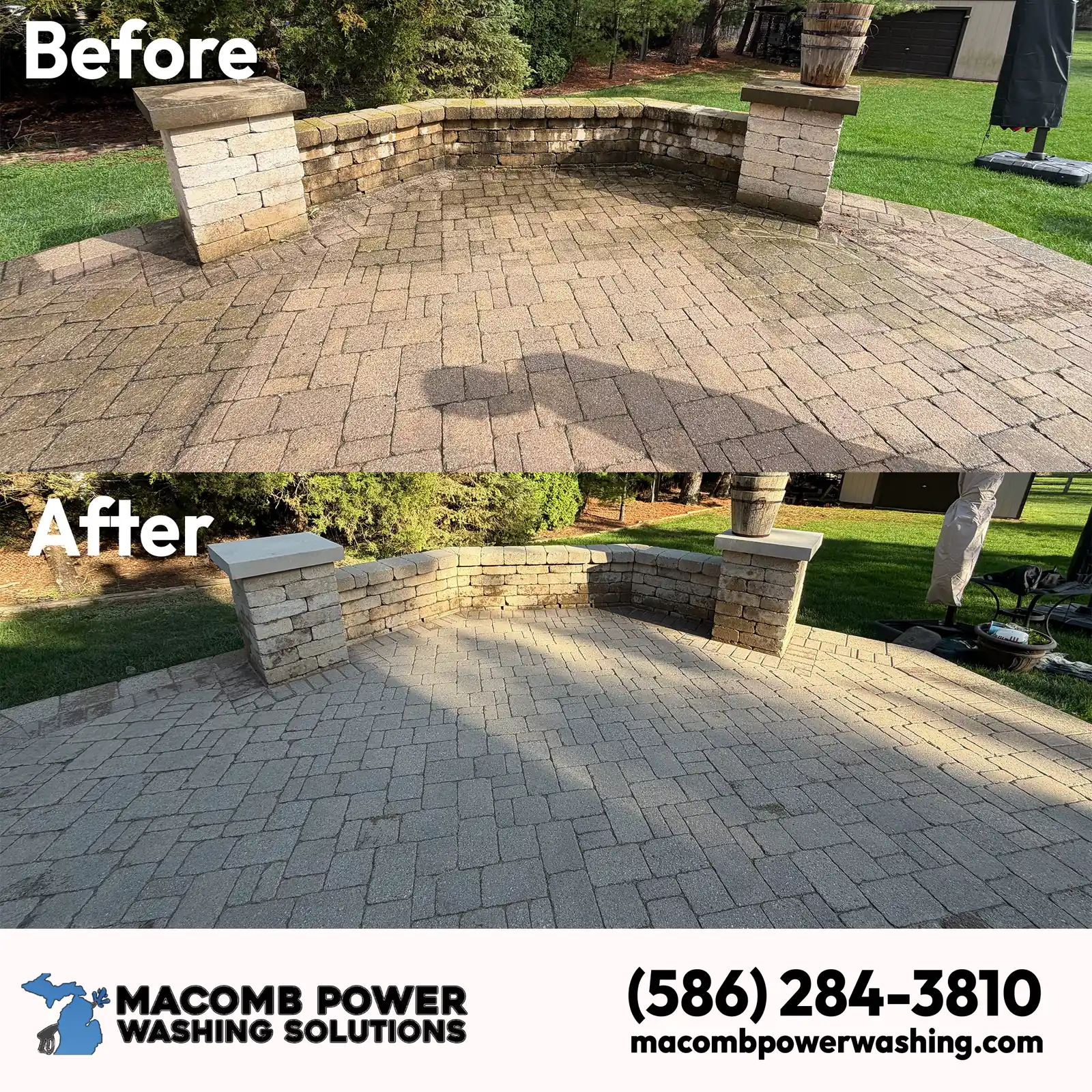
The order for a concrete paver patio or walk:
- Work out whether it is algae, moss or lichen; lichen has its own guide, linked below.
- Scrape and brush off what you can while the pavers are dry, with plastic or brass bristles.
- Wash with a wide spray at a low angle, or use a moss or algae product exactly as its label directs.
- Sweep out the dead growth, check the joints and refill any sand that came out.
- Thin the shade, move water away from the pavers and keep leaves swept off.
Is it algae, moss or lichen?
All three can read as green from across the yard. Up close, each has its own shape.
- Algae is a flat green film or powdery coating on the paver faces. The RHS describes algae as having no true roots, stems or leaves, forming only a thin layer on top of hard surfaces. It is the green that turns a shady walk slick after rain.
- Moss is a small plant that grows in compact cushions, carpets or tufts. The RHS notes that mosses often grow in the spaces between paving, and that creeping mosses spread onto the edges of hard surfaces from neighboring ones.
- Lichen forms thin, flat crusts, and the RHS says one type is often mistaken for an old patch of chewing gum. Dark round spots that survive pressure washing are covered in our guide to black spots on a patio.
Green on nearby walls is its own topic: see stains on light brick and cleaning segmental block walls.
Why do some patios stay green while others don't?
Some patios stay green while others stay clean because algae and moss need water, and shade decides how long the water stays. The RHS says algae thrive in wet conditions and may grow faster in shady areas with poor air circulation, with build-ups often following wet winters. Unilock, a paver manufacturer, says moss generally develops in shaded areas that are slow to dry after rain, such as the part of a patio under a large tree.
A green band along the north wall, a corner under an evergreen or a strip beside a privacy fence is shade at work, the same pattern that turns one side of a house green. Anything that keeps pavers wet longer adds to it:
- a downspout that empties onto the pavers
- a sprinkler whose arc reaches the patio
- a low spot where puddles stand for hours after rain
- beds or lawn that drain onto the pavers, carrying soil with the water
- leaves left lying on the surface
The Concrete Masonry and Hardscapes Association (CMHA) suggests inspecting interlocking pavement in spring during or right after a rain, because the rain readily shows settlement, ponding and run-on from neighboring planted areas. CMHA also recommends pavement slopes of typically at least 2% so surface water drains away.
How do you get moss and algae off without hurting the joints?
You get moss and algae off pavers by removing as much as you can dry, then washing in a way that leaves the joint sand in place. CMHA lists pressure washing among the causes of joint sand loss.
1. Scrape and brush first. OSU suggests scraping moss with a dull blade such as a putty knife, scrubbing with a stiff bristle brush or sweeping with a stiff broom. The RHS mentions wire brushes for hard surfaces in general, but CMHA rules out steel bristles on concrete pavers, since bristles that break off rust and stain; use brass or plastic.
2. Protect the area. CMHA advises tying back or covering plants beside the pavement, working out where cleaning fluid will drain and turning off automatic sprinklers.
3. Wash or treat. OSU says pressure washing is effective for patios and recommends it for algae. On pavers, keep the spray wide and low and let water volume, not pressure, do the rinsing; our guide to pressure washing pavers with polymeric sand covers the technique. A moss or algae killer is the other route, with limits covered below. Use one product at a time: the New Jersey Department of Health warns never to mix cleaning products, especially anything containing bleach. Bleach strengths are in can you use bleach on pavers.
4. Check the joints. Sweep off loosened growth, let the pavers dry and look along the joint lines; re-sanding after power washing explains when low joints need a refill.
Keep rinse water that carries moss killer or cleaner out of the storm drain. OSU says runoff containing moss control products should not reach storm drains or waterways, because the chemicals can harm aquatic life.
Do moss killers keep pavers clean for good?
No. A moss killer kills the growth that is there, but it does not keep pavers clean for good. OSU says the dead material still has to be removed, the treatments wash off in rain, and they do not provide long-term control or prevent regrowth. The RHS says most products are non-persistent, so repeat applications are needed, and that algae, lichens and mosses return if the growing conditions stay the same.
OSU warns that products containing zinc or copper are corrosive and may stain concrete, and that zinc and copper are harmful to fish and other aquatic life. It describes moss-killing soaps made with ammonium and potassium salts as effective, biodegradable and non-corrosive. OSU also advises reading the label front to back, applying the product only where the label allows, and not applying it when it is raining or rain is expected within 24 hours.
Pressure washing has the same limit. The RHS calls it a temporary solution, since growth returns if conditions remain the same, and cautions that where drainage is poor the extra water can make damp problems worse.
How do you keep pavers from turning green again?
You keep pavers from turning green again by helping them dry faster after rain and keeping organic debris off them.
- Thin the shade. OSU suggests removing or thinning overhanging branches; the RHS says pruning lets the drying effects of sun and wind reach the area.
- Move the water. Redirect a downspout that empties onto the pavers and turn sprinkler heads away. The RHS also advises keeping drains clear of leaves so rainwater drains away quickly. CMHA says depressions come from settlement of the base or the soil beneath it; settled pavers can be lifted and reset through our paver repair service.
- Sweep in spring and fall. CMHA recommends routine maintenance in spring and fall, including a fall sweeping to remove dirt and leaves, taking care not to remove joint sand. The RHS adds that regular brushing helps stop growths from taking hold.
- Keep the joints full. Unilock says the jointing sand between pavers is generally meant to keep vegetation out, and that once organic material like moss gets into the joints it is extremely difficult to get out again. Joints that have already failed are covered in weeds growing through polymeric sand.
Sealing is a separate decision with its own trade-offs, set out in is sealing pavers worth it.
When a paver patio needs more than a sweep, our brick paver restoration starts from $399 for the clean, polymeric re-sand and seal together. Green on the siding, fence or outdoor furniture nearby is soft washing work, where a solution applied at low pressure kills algae, mold and mildew. Quotes are itemized and in writing within 24 hours, with no travel fees.
Sources
- Oregon State University, Solve Pest Problems: How to Manage Moss on Roofs & Walkways
- Royal Horticultural Society: Algae, lichens, liverworts and mosses on hard surfaces
- Concrete Masonry & Hardscapes Association: PAV-TEC-005, Cleaning, Sealing and Joint Sand Stabilization of Interlocking Concrete Pavement
- Concrete Masonry & Hardscapes Association: PAV-TEC-006, Operation and Maintenance Guide for Interlocking Concrete Pavement
- Unilock: How to Grow Moss Between Pavers
- New Jersey Department of Health: Hazard Alert, Mixing Bleach with Other Cleaning Products
Want This Handled Properly?
Macomb Power Washing Solutions holds a 4.9-star rating across 177+ Google reviews, and free estimates go out within 24 hours. We carry $2M general liability plus workers' compensation.