
The short answer
Clean clay brick pavers the way you clean brick: sweep, soak them with water, scrub with mild detergent and a stiff nonmetallic brush, then rinse thoroughly. With a pressure washer, stay at or under 400 psi at the nozzle unless the paver maker allows more, never aim the jet along the joints, and skip muriatic acid.
How do you clean clay brick pavers without damaging them?
You clean clay brick pavers with the gentlest method that works, because they are fired brick and the Brick Industry Association (BIA) applies its brick cleaning guidance to them. Its Technical Note 14 (TN 14) says clay pavers resist absorbing stains and stay clean in most settings with regular sweeping. When sweeping is no longer enough:
- Sweep off leaves and grit, and scrape hardened residue with a plastic or wooden tool.
- Find the paver maker's cleaning instructions; TN 20, the BIA's note on cleaning brickwork, says most paver makers provide them.
- Soak the pavers with clean water before any cleaner goes on, and keep them wet until the last rinse.
- Scrub with water, a mild detergent and a stiff fiber or plastic-bristle brush.
- Rinse with plenty of water at low pressure, never aiming a jet down a joint line.
- Once dry, check the joints and refill any that lost sand.
Try every product on a small, hidden area first. TN 14 reports that some cleaning solutions and polymeric sands have hazed, stained or discolored certain clay pavers.
How can you tell clay brick pavers from concrete pavers?
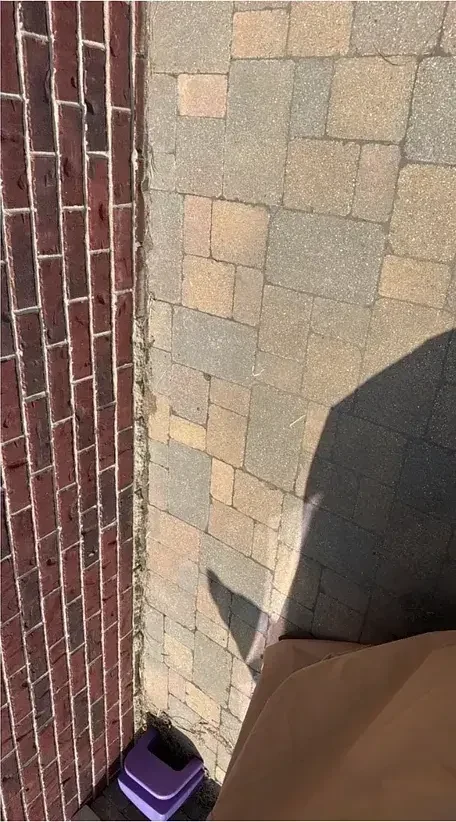
People say "brick pavers" for concrete pavers too, so confirm the material before you buy a cleaner. Two checks settle most patios:
- Paperwork and spares. The installer's invoice, leftover pavers or an old pallet tag often names the maker, and the maker's website says what the product is. A product sheet citing ASTM C902 or ASTM C1272 means clay; TN 14 names those two as the standards for exterior clay pavers.
- A chipped corner or cut edge. TN 14 says the color of a clay paver is typically consistent through its body and highly resistant to weathering and fading because the fired clay is vitrified. A core that differs from the face does not fit that description. A matching core is only a clue, not proof.
Until you know for sure, stay with the methods the BIA favors for brick paving: sweeping, low-pressure water and mild detergent, with no acids or strong removers.
Why do clay pavers follow brick cleaning rules?
Clay pavers follow brick cleaning rules because they are made like brick. TN 14 says they are manufactured in much the same way as face brick, and that cleaning a brick pavement is essentially the same as cleaning vertical brickwork, which is the subject of TN 20. Three of TN 20's brick rules matter most outdoors:
- Gentle methods first. TN 20 says the right method is the gentlest one that cleans effectively, and to try a bucket and brush or water cleaning before chemical cleaners.
- Wet before, rinse after. TN 20 names failure to saturate brick before and after a chemical or detergent cleaner as a cause of cleaning failures. Dry brick soaks up the solution, which can leave white scum, efflorescence, or manganese or vanadium stains. Never let a cleaner dry on the pavers.
- Texture holds dirt. Dirt penetrates deeper into textured faces, TN 20 notes, and wire-cut and other textured brick offer more surface area to take up water and acid. It adds that pressurized water can help rinse rough-textured brick completely.
Waiting has a cost: TN 20 says stains left to accumulate will likely need stronger products and methods, raising the risk of damage. White powder on clay pavers has its own steps in removing efflorescence from pavers.
How much water pressure can a clay brick patio take?
A clay brick patio should be washed at no more than 400 psi, measured at the nozzle tip, unless the paver maker allows more. That is the BIA's limit for brick in TN 20, and TN 14 sends paver cleaning to the same note. The limit comes with conditions:
- a 25 to 50 degree fan tip, held at least 12 inches from the surface
- under 100 psi when pre-wetting
- 400 to 800 psi only where the brick manufacturer permits it
- nothing above 800 psi, which TN 20 says is not appropriate for brick and may damage it
- no pressurized water on sand-finished or surface-coated brick, which TN 20 says to clean by hand
TN 20 also says to consult the brick maker before using pressurized water. Our pressure washer PSI chart puts clay pavers under this brick limit, not in the higher range it lists for concrete pavers.
Whitacre Greer, a clay paver maker, agrees in its maintenance sheet: low-pressure water helps remove soil, detergent in the water can speed the job, and high-pressure water may damage clay pavers and compromise sand-filled joints. TN 20 adds that low-pressure cleaning on brick paving can work better with hot water and mild detergents. Brick walls are covered in can pressure washing damage brick.
Which cleaners are safe on clay pavers, and which should you skip?
Water and mild detergent come first. TN 20's quick guide to brick by color lists water, detergents, emulsifying agents or suitable proprietary compounds for red, tan, buff, gray, brown and speckled brick, and rules out unbuffered muriatic (hydrochloric) acid for all of them. For spot stains on brick paving, TN 20 suggests:
- Food and paint: scrape off the hard residue, then scrub with a stiff bristle brush and scouring powder.
- Food stains and tire marks: scrub with a detergent or a proprietary cleaner.
What to skip or handle with care:
- Muriatic acid. TN 20 says improperly mixed or overly concentrated acid can etch brick or dissolve the cement in mortar joints, and that unbuffered acid tends to discolor brick, lighter shades in particular, an effect it calls acid burn.
- Cleaners from polymeric sand companies. Per TN 20, many of them consist of unbuffered hydrochloric acid, and clay pavers should not get them.
- Acid on stabilized joints. TN 20 says acid-based solutions may not be appropriate for brick pavements with joint sand stabilizers or polymeric sand.
- Steel brushes and metal tools. TN 20 says metal brushes may damage mortar joints or cause further staining, and steel bristles can leave particles that rust.
Whitacre Greer says acid-based cleaners are used at your own risk on clay pavers, and that any cleaner should follow its maker's directions exactly, after a small test area. Read the surfaces list on the label: a remover that names only concrete pavers says nothing about clay. TN 20 also warns that cleaning chemicals may damage plants and grass, so keep runoff away from beds and out of storm drains.
Do mortared and sand-set brick patios clean differently?
Yes, mainly in how much force the joints can take. TN 14 says mortar-filled joints generally stand up better to aggressive cleaning such as pressure washing, while sand-filled joints that will face it should be built with stabilized joint sand or treated with a stabilizer. Its selection table recommends sand-set clay paving for pressure-washed sites on that condition.
Sand-set patios. TN 20 says stabilized sand joints generally tolerate pressure washing when the nozzle stays clear of the surface and the jet is not aimed along the joints. TN 14A, the BIA's note on clay pavers laid in sand, warns that aggressive washing can strip joint sand in spots and even undermine the pavers. It recommends a joint sand stabilizer where cleaning is intensive and stabilized sand once joints run wider than 3/16 inch, and because wind and rain erode the tops of the joints, it calls for periodic re-sanding. Whether yours need sand after a wash is covered in re-sanding pavers after power washing; our paver repair and re-sanding service handles low joints and sunken pavers, quoted from photos or in person.
Mortared patios. Mortar does not wash out like sand, but TN 20 warns that high-pressure water can etch mortar joints. For colored mortar, TN 20 says many makers do not recommend chemical cleaners, that unbuffered acids and some proprietary cleaners tend to bleach it, and that mild detergents are generally recommended. TN 14 lists mortar joint maintenance among the trade-offs of mortared paving, so cracked joints call for a mason, not a stronger wash.
Our brick paver restoration starts from $399 for the clean, polymeric re-sand and seal together. Clay brick pavers are usually cleaned and re-sanded without the sealer, for the reasons in the sealing answer below, and your written quote, sent within 24 hours, itemizes each stage.
Sources
- Brick Industry Association: Technical Note 14, Paving Systems Using Clay Pavers (PDF)
- Brick Industry Association: Technical Note 14A, Paving Systems Using Clay Pavers on a Sand Setting Bed (PDF)
- Brick Industry Association: Technical Note 20, Cleaning Brickwork (PDF)
- Whitacre Greer: Clay Paver Maintenance (PDF)
- Brick Industry Association: Technical Note 6A, Colorless Coatings for Brick Masonry (PDF)
- New Jersey Department of Health: Hazard Alert, Mixing Bleach with Other Cleaning Products (PDF)
Want This Handled Properly?
Macomb Power Washing Solutions holds a 4.9-star rating across 177+ Google reviews, and free estimates go out within 24 hours. We carry $2M general liability plus workers' compensation.