
The short answer
Yes. You can pressure wash pavers with polymeric sand once the sand has fully hardened, if you use a wide fan tip, hold the spray at a low angle, keep it off the joint lines and rinse with plenty of water, not more pressure. Check the joints once the pavers dry and refill any that lost sand.
Can you pressure wash pavers that have polymeric sand?
Yes, you can pressure wash pavers that have polymeric sand, once the sand has fully hardened and as long as the spray stays wide, low and off the joint lines. Bagged polymeric sand fits what the Concrete Masonry and Hardscapes Association (CMHA) calls a dry joint sand stabilizer: joint sand premixed with polymer or other compounds that stiffen the joint once water activates them. CMHA's cleaning guide, Tech Spec 5 (PAV-TEC-005), says the main job of a stabilizer is to reduce the risk of joint sand being removed by flowing water, wind, aggressive cleaning and tires. Reduced risk is not immunity.
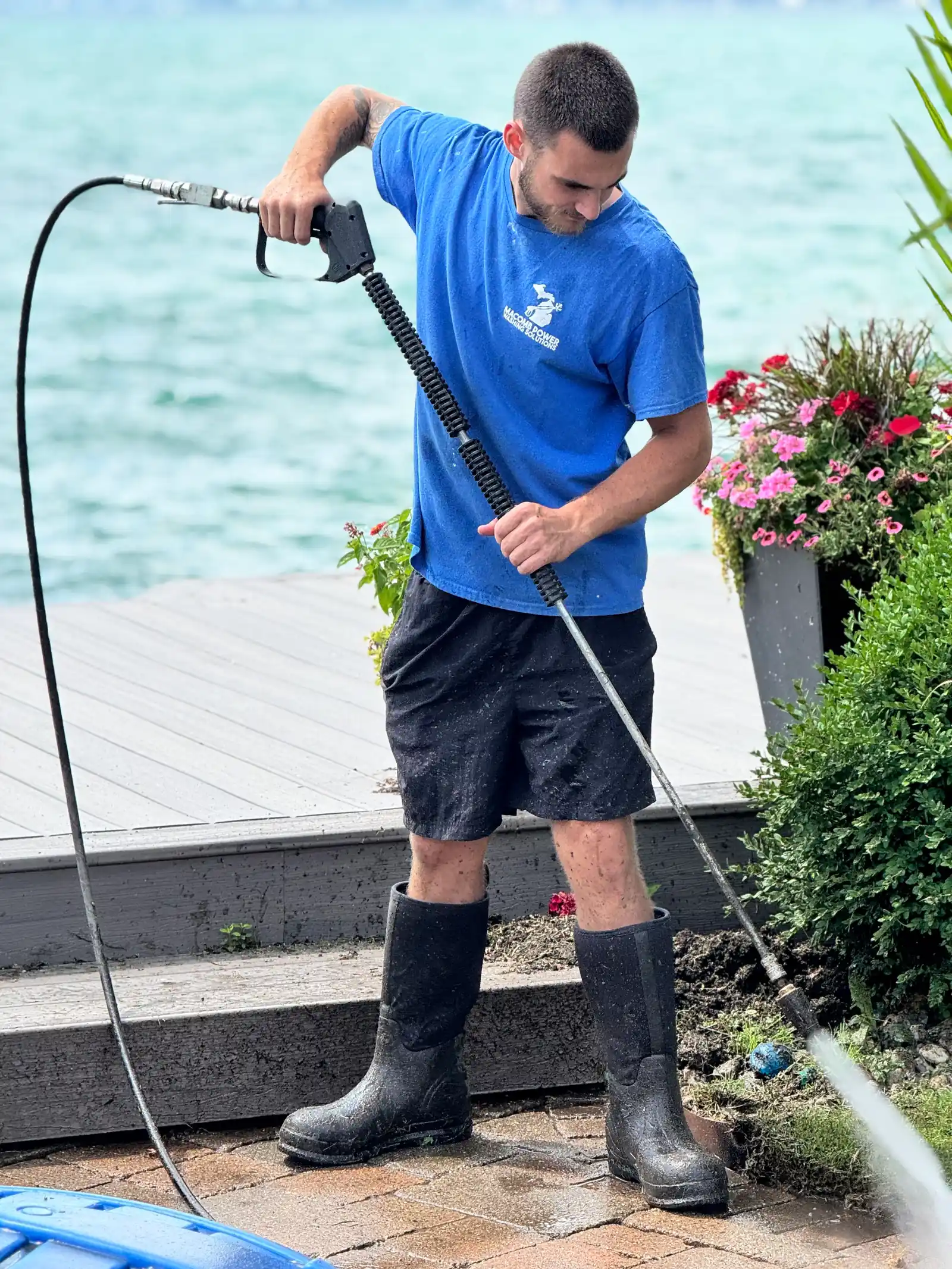
CMHA says most paver cleaning jobs should go to a professional company, and that professionals typically use a pressure washer applying cleaner and water at 1,000 to 4,000 psi and 2 to 6 gallons per minute. It adds that small residential patios and walks can be cleaned adequately by hand and rinsed with a garden hose, the method in cleaning pavers without a pressure washer. CMHA's range describes the equipment, not a dial setting for every patio. Our pressure washer PSI chart lists concrete pavers at 1,500 to 2,500 PSI and sends clay brick pavers to the much lower brick limit.
Why does a pressure washer pull sand out of paver joints?
A pressure washer pulls sand out of paver joints when the stream's force goes into the gaps instead of across the paver faces. Three habits put it there:
- A narrow tip. A zero-degree or other narrow tip packs the machine's output into a small, hard stream. Writing about activating stabilized sand, CMHA warns that a narrow spray can dislodge sand from the joints.
- A steep angle or a close wand. Spray pointed straight down drives into the joint, and the closer the tip, the harder it hits. CMHA says a low angle of attack from a wide spray reduces the risk of dislodging joint sand.
- A jet aimed along a joint. The Brick Industry Association (BIA), in Technical Note 14A on clay pavers laid in sand, says sand-filled joints generally hold up to pressure washing when the water jet is not directed along the joints. It adds that aggressive pressure washing can remove joint material in spots and can even undermine the pavers.
Unilock, a paver maker, also lists blowing joint sand out of the gaps among the results of improper pressure or nozzle settings. Polymeric joints that are already cracked or crumbling give way first.
What nozzle, angle and distance keep the joints intact?
A wide fan tip, a low angle and enough distance for the spray to land as a broad fan help keep paver joints intact, because each one keeps the stream's force on the paver faces.
- Nozzle. Use a wide fan tip on a low setting. CMHA says a wide spray prevents sand from being washed from the joints, and Unilock calls for a low setting. Our PSI chart shows how much the tip and the distance change the force.
- Angle. Tilt the wand well away from straight down. Unilock's cleaning guide says to spray "at an angle no greater than 30 degrees" to avoid washing out joint material, while its spring maintenance tips give 45 degrees. Read both as the angle between the spray and the paver surface. The pages differ, so do not split the difference: CMHA ties a lower angle of attack to a lower risk of dislodging sand, which makes 30 degrees the more cautious figure.
- Distance. CMHA says the nozzle's distance from the pavers affects how well the cleaning works, but neither CMHA nor Unilock sets a figure for concrete pavers. Start well back and move in only as far as it takes to lift the dirt.
- Direction. Sweep the spray across the joint lines, never down one.
- Rinse. Flush with volume. CMHA says the final rinse should be water only and that a large amount of water matters more to rinsing than high pressure.
Is a rotary surface cleaner safer than a wand on pavers?
A rotary surface cleaner cleans more evenly than a wand, but it is not automatically gentler on the joints. Its spray bar spins inside a hood that rides on the pavers, so the tips stay at one height instead of wandering closer. Western Interlock, a paver maker, uses a surface washer on moss-covered pavers because its two heads spread the pressure and it runs close to the ground and even, moved at a slow, steady pace. It still goes back with a wand for the edges and tops off the joints once the pavers dry, because the wash took some sand out.
- Keep it moving. Parked in one place, it spins its jets over the same small circle of joints again and again.
- Remember the angle. Its tips spray down at the pavers inside the hood instead of skimming across them, so it does not give the low angle of attack CMHA describes.
- Mind the jets. Techniseal's HP NextGel data sheet warns that "too direct and violent jets can create alterations" and suggests asking the washer's manufacturer about accessories with softer jets.
- Finish with the wand. Do edges, steps and the strips along walls with a wide tip at a low angle, then rinse with plenty of water.
In our brick paver restoration, the cleaning purges failed sand from the joints on purpose before new polymeric sand goes in. A maintenance wash is meant to leave sound joints in place.
Which pavers need a gentler wash, or no pressure washer at all?
Pavers need a gentler wash, or none, when the joints are new, unbound or wide, and when the pavers are loose or made of clay.
- New polymeric joints. The label sets the wait. Techniseal's HP NextGel sheet says joints should harden before cleaning, typically at least 7 days after installation and up to 30, and it restricts high-pressure washers during the first 30 days. Other sands set their own waits.
- Plain sand joints. No binder is added. CMHA says plain joint sand tends to firm up over time as fine dirt works in, and that stabilization benefits pavements facing aggressive, regular cleaning. Plan on sweeping fresh sand in once the surface is dry, as Unilock's spring tips advise after a wash.
- Wide joints. Tumbled pavers and circular patterns have wider joints, and CMHA says tumbled pavers may require stabilized joint sand. The BIA calls for stabilized sand once clay paver joints run wider than 3/16 inch.
- Loose, sunken or rocking pavers. The BIA's warning about undermining applies here, and Unilock's first cleaning step is to inspect for cracked or broken pavers and replace them. Our paver repair lifts them, corrects the base and resets them.
- Clay brick pavers. The BIA says sand-set clay pavers stay clean in most settings with regular sweeping, and keeps pressure washing for buildups of grease, tire marks and other stains. When they are washed, they follow the brick limit covered in cleaning clay brick pavers.
CMHA names downspouts and the drip line under the eaves as spots where stabilized joint sand better resists erosion from concentrated water, so check those joints before the wash and treat them lightly.
What should you check on the joints after washing?
After washing, check that the joints are still full and firm once the pavers have dried. Unilock's cleaning steps end the same way, by inspecting the joints and sweeping in new joint material where needed, and its spring tips put that sweeping after the surface dries.
- Look first where the spray lingered, along the edges, and at downspouts and eaves.
- Probe a few polymeric joints with a screwdriver tip. Writing about new installations, the BIA recommends probing joints to confirm the sand is stabilized to depth rather than just forming a crust; the same probe shows whether a washed joint is still firm below the top.
Low plain-sand joints are usually a top-up job, and failed polymeric joints are usually cleared and refilled. Our guide to re-sanding pavers after power washing sorts out which one you have, and the cost question below covers what we charge for each.
Sources
- Concrete Masonry and Hardscapes Association: Tech Spec 5 (PAV-TEC-005-22), Cleaning, Sealing and Joint Sand Stabilization of Interlocking Concrete Pavement
- Unilock: How to Clean Pavers
- Unilock: Seasonal Paver Maintenance Tips
- Techniseal: HP NextGel Jointing Sand, Technical Data Sheet (2020, PDF)
- Brick Industry Association: Technical Note 14A, Paving Systems Using Clay Pavers on a Sand Setting Bed (2017, PDF)
- Western Interlock: How to Clean Pavers
Want This Handled Properly?
Macomb Power Washing Solutions holds a 4.9-star rating across 177+ Google reviews, and free estimates go out within 24 hours. We carry $2M general liability plus workers' compensation.