
The short answer
You can use bleach on pavers for stains that grew or rotted there, and a paver cleaner for the rest. Bleach at the right strength removes mildew, algae, moss and leaf or wood rot stains. Oil, rust, tire marks, clay soil and efflorescence need detergents, absorbents or a cleaner made for pavers. Never mix bleach with acids or ammonia.
Can you use bleach on pavers, or do you need a paver cleaner?
You can use bleach on pavers, but treat it as a spot tool for organic stains, not as a general paver cleaner. Bleach is a solution of sodium hypochlorite, the same active compound professional crews use in soft washing, and the paver references use it mostly on things that grew or decayed on the surface: mildew, algae, moss, lichen, and stains from leaves or rotting wood.
Many patios look tired for other reasons: ground-in dirt, white mineral bloom, grease, rust and tire marks, and none of the stain-by-stain guidance below uses bleach on those. The Concrete Masonry and Hardscapes Association (CMHA) sets the order in its cleaning tech note, PAV-TEC-005: remove stains on specific areas first, then clean the entire pavement with a cleaner for dirt and efflorescence. Bleach can cover organic spots in the first step; a paver cleaner does the second, and the two never go on together.
Which paver stains does bleach remove, and which does it leave?
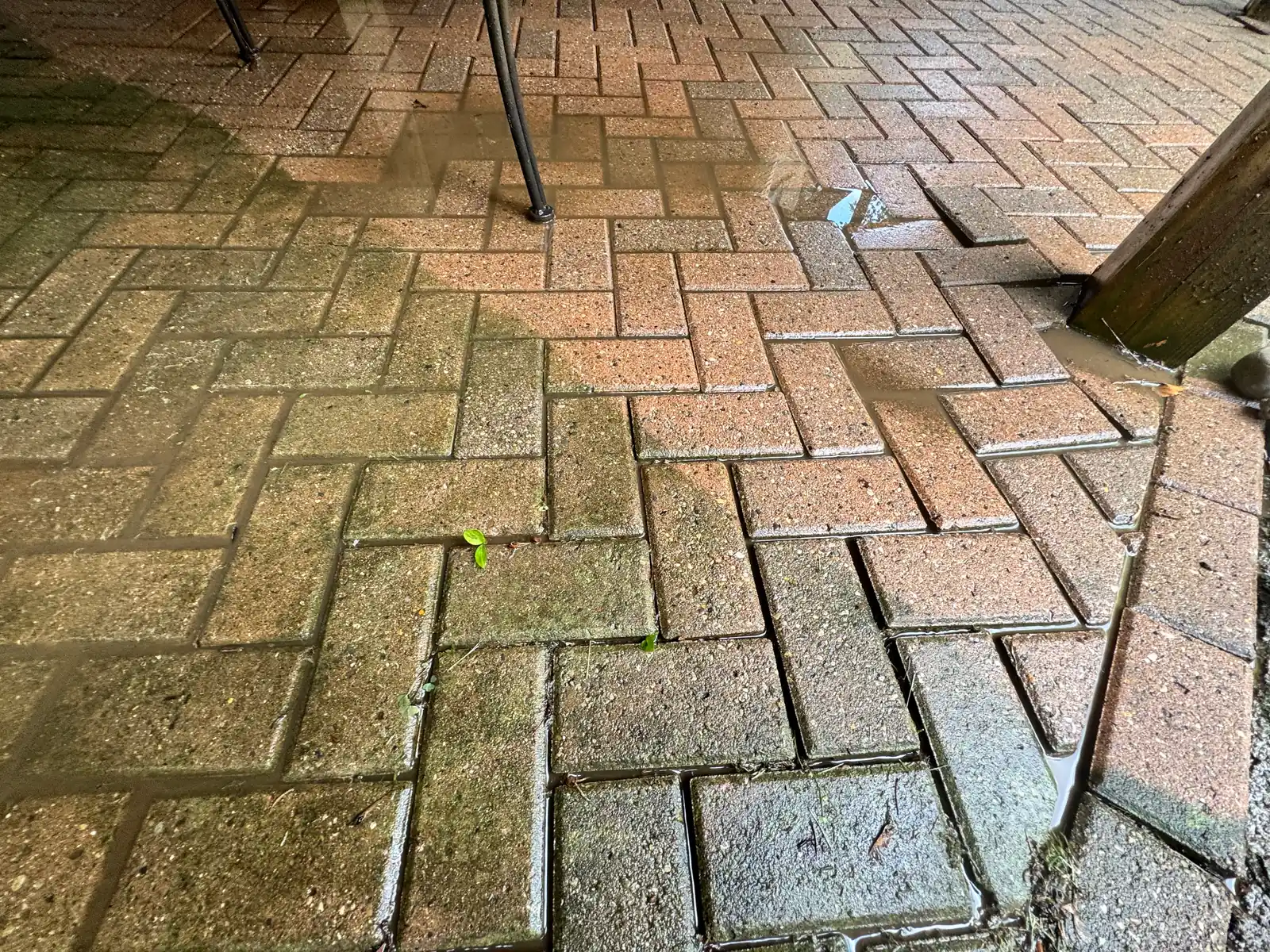
In the stain-by-stain lists, bleach appears for living growth and plant or smoke stains, not for grease, minerals or soil:
| Stain | Bleach in the guidance? | What the guidance uses |
|---|---|---|
| Leaf, wood rot or tobacco | Yes (CMHA) | Household bleach, scrubbed with a stiff bristle brush |
| Smoke | Yes (CMHA) | A talc poultice made with bleach diluted 1:5 with water, then a water rinse |
| Mildew or algae in shade | Yes (Unilock) | One part bleach to ten parts water, used sparingly |
| Moss and lichen in joints | Yes (BIA, brick paving) | Equal parts bleach and water, or a proprietary biocide |
| Oil that has soaked in | No | Rags, then kitty litter, talc, fuller's earth or diatomaceous earth left on for a day (CMHA) |
| Food grease, ketchup, mustard | No | Full-strength liquid detergent for 20 to 30 minutes, a scrub and a hot-water rinse (CMHA) |
| Tire skid marks | No | Water, detergent and scouring powder (CMHA) |
| Clay soil | No | Scrape it dry, then hot water and strong detergent (CMHA) |
| Efflorescence and built-up dirt | No | A detergent-and-acid cleaner or a proprietary efflorescence remover (CMHA) |
| Rust | No | A rust remover made for pavers; the New Jersey health department lists rust removers among acid products |
A rule of thumb from these lists: if it grew or rotted there, bleach is a reasonable choice; if it was spilled, tracked in or carried up from inside the paver, use a different product. See our guides to oil and grease, rust and efflorescence remover types. Lichen is the slow case among the organic stains: the spots can stay visible for weeks after the treatment, as our post on black spots that survive pressure washing explains.
How strong should a bleach mix be on concrete pavers?
Start mild and move up only as needed, as Unilock advises. Each published figure was written for a specific stain, so they differ rather than conflict:
- Film on the surface. For mildew or algae in shaded areas, Unilock, a paver maker, gives one part bleach to ten parts water. Keep the area wet while you work, protect nearby plants, rinse thoroughly, and use it sparingly and only when needed.
- Smoke. CMHA mixes bleach 1:5 with water into a talc poultice, scrubs, then rinses with water.
- Leaf, wood rot and tobacco stains. CMHA names household bleach and a stiff bristle brush but gives no ratio. CMHA also says to try any stain remover on a small, out-of-sight stained area first, so start there.
- Moss and lichen rooted in joints. The Brick Industry Association (BIA) gives the strongest ratio here, one part bleach to one part water, for damp or shady joints in brick pavements. Our post on weeds in polymeric sand cites the same figure. Lichen also needs contact time.
Whatever the strength, sweep first and wear glasses and gloves, as Unilock advises. Cover or tie back plants beside the pavement, turn off the sprinklers, apply the mix only to the stain, and scrub with brass or plastic bristles, never steel.
What should never be mixed with bleach or used right after it?
Never mix bleach with acids or ammonia. The New Jersey Department of Health (NJ DOH) warns that combining bleach with ammonia, drain openers or acid products such as lime, calcium and rust removers can release toxic gases, and that bleach plus an acid produces chlorine gas. Even low levels can irritate the eyes, nose and throat; higher levels can damage the lungs, and very high levels can kill. Unilock's paver instructions add vinegar to the never-mix list alongside ammonia.
On a paver job the acids are easy to miss:
- Vinegar, which Unilock suggests on its own for leaf and berry stains.
- Many efflorescence removers and overall paver cleaners, which CMHA says are often a mix of detergent and acid.
- Rust removers, which NJ DOH lists among acid products.
- Muriatic acid, which Unilock says to avoid as a routine paver cleaner.
Mixing does not only happen in a bucket. Bleach left on the pavers or in a sprayer meets the next product wherever it goes on, so rinse the bleach off the surface completely, give each product its own sprayer, and keep each one in its original labeled container, as NJ DOH advises. Our guide to what chemicals power washing companies use covers a professional kit that holds both.
Is bleach safe on clay brick and natural stone pavers?
Bleach can be used on clay brick and on many natural stones, with a test first and a lighter hand on stone. The BIA's Technical Note 20 recommends checking a cleaner's compatibility with the paver manufacturer, since most clay paver makers publish cleaning procedures. It warns that cleaning solutions can react with minerals in some brick and cause or worsen stains, so treat a small, hidden area and judge it dry. TN 20 also cautions that acid cleaners may not suit brick pavements with polymeric sand or stabilized joints. Our guide to cleaning clay brick pavers covers the rest.
For natural stone, the Natural Stone Institute (NSI) suggests flushing outdoor pool, patio and hot tub areas with clear water and using a mild bleach solution to remove algae or moss. For biological growth it gives half a cup of bleach per gallon of water, and it warns never to combine bleach with ammonia. The bigger risk on travertine and limestone is acid: NSI classes both as calcareous, sensitive to acidic solutions, and says vinegar and other acids may dull or etch them. NSI adds that outdoor leaf stains on stone generally fade in sun and rain once the leaves are gone, so sweep first and wait before reaching for chemicals. Pool decks have their own runoff concerns; see cleaning pavers around a pool.
What does a paver cleaner do that bleach can't?
A paver cleaner removes the non-living part of the grime: dirt, efflorescence and, in stain-specific products, grease or rust. CMHA says many cleaners that remove dirt and efflorescence combine detergent and acid. In proprietary efflorescence removers the acid is buffered and blended with other chemicals so it cleans without damaging the paver surface.
The label is the other advantage. CMHA notes that the containers of removers made for concrete pavers often list the stains they handle, that many are developed through lab and field testing, and that they spare you from working out the chemistry. BIA's note says proprietary cleaners are generally safer, easier to control and more consistent than homemade mixes. They still need care: CMHA says strong acids change paver color slightly, with the change depending on the acid, its concentration and its time on the surface, so test a small area and wear goggles and protective clothing. Unilock warns that muriatic acid can etch concrete pavers and change their color.
A sensible sequence is bleach on organic spots, rinsed off completely, then a paver cleaner on its own. Macomb Power Washing Solutions prices paver patios and walks as brick paver restoration, from $399 for cleaning, polymeric re-sand and sealing together; poured concrete goes under concrete cleaning, from $149. Either way, the written, line-item quote arrives within 24 hours. To do it by hand, see cleaning pavers without a pressure washer.
Sources
- Concrete Masonry & Hardscapes Association: PAV-TEC-005, Cleaning, Sealing and Joint Sand Stabilization of Interlocking Concrete Pavement
- Unilock: Removing Stains From Pavers
- New Jersey Department of Health: Hazard Alert, Mixing Bleach with Other Cleaning Products (PDF)
- Brick Industry Association: Technical Note 20, Cleaning Brickwork (PDF)
- Natural Stone Institute: Care & Cleaning of Natural Stone (PDF)
- Ask Extension (Maryland Home & Garden Information Center horticulturists): Power washing a house using bleach?
Want This Handled Properly?
Macomb Power Washing Solutions holds a 4.9-star rating across 177+ Google reviews, and free estimates go out within 24 hours. We carry $2M general liability plus workers' compensation.