
The short answer
Sweep and inspect pavers every spring and fall, and deep clean them whenever the surface shows dull color, green film, stains or dirty joints rather than on a fixed date. Spring clears winter salt and sand; fall clears leaves before they stain. Sealed pavers get resealed on their own three-to-five-year cycle.
How often should pavers be cleaned, and in which season?
Pavers should be swept and looked over every spring and fall, and deep cleaned when the surface starts to show dirt, growth or stains, not on a fixed date. The Concrete Masonry and Hardscapes Association (CMHA), the trade group behind the interlocking paver tech notes, recommends routine preventive maintenance in spring and fall, "just like any other type of pavement."
That gives pavers three rhythms:
- Routine care, twice a year. CMHA recommends a spring sweeping to remove leftover deicing chemicals and winter sand, a fall sweeping to remove dirt and leaves, and an inspection each time.
- A deep clean when the pavers show it. Unilock, a paver maker, describes a cleaning routine that runs from sweeping or blowing off loose debris to less frequent deep cleaning with cleaning products, water or both.
- Resealing on its own cycle, every three to five years, and only for pavers that are sealed.
A wash fits any mild, dry day when the pavers can dry before a freeze; re-sanding and sealing need a longer mild, dry stretch, most reliable from late spring to early fall.
What does routine paver care look like between deep cleanings?
Routine paver care between deep cleanings is mostly a broom, a leaf blower and a close look at the joints, in four habits:
- Sweep or blow off debris. CMHA says a power washer or leaf blower does this well, as long as you are careful not to remove the joint sand.
- Check the joints. If the sand has dropped more than 1/2 inch, CMHA says to top it up immediately. Unilock calls a joint check each season good practice, since sand erodes, especially through freeze-thaw. Which sand to use is covered in re-sanding pavers after power washing.
- Clean up spills quickly. CMHA says oil stains should be treated as soon as possible, because the longer they sit, the deeper they penetrate.
- Pull weeds at the root and keep sweeping, which Unilock says helps keep new seedlings from settling into the joints.
For a soap, water and brush cleaning, see cleaning pavers without a pressure washer.
What makes some pavers need cleaning more often?
Shade, standing moisture, trees, salt, cars and cooking make pavers need cleaning more often, because each one brings more dirt, growth or stains onto the surface. Unilock says mold and mildew are common on patios exposed to regular moisture or constant shade, and lists dirt, grime, algae and tannins from trees as the organic stains patio pavers are prone to. CMHA adds that foot and tire traffic carries dirt that changes the surface color.
| Condition | What it leaves on the pavers |
|---|---|
| Trees overhead or north-side shade | Leaf litter, tannin marks and damp pavers where algae, mold and mildew grow |
| A sprinkler arc that reaches the pavers | Regular moisture, which Unilock links to mold and mildew |
| Driveways and front walks | Tire dirt, oil drips, winter sand and deicer |
| Grills and outdoor kitchens | Grease spatter and food spills |
| Downspouts and lawn edges | Soil carried onto the pavers, and joint sand carried out |
CMHA names concentrated runoff, driving winds and excessive cleaning as causes of joint sand loss. It also says winter sand left on pavers year after year can cause excessive abrasion and may speed up color change, so it recommends sweeping the excess off in spring.
A sunny back patio away from trees, cars and the grill gets little of this and can go longer between deep cleans. Pool surrounds follow their own routine, covered in cleaning pavers around a pool.
Which season is the right time to deep clean pavers in Michigan?
Spring and fall are the right seasons to deep clean pavers in Michigan: spring, once the salting is over, removes what winter left, and fall removes summer grime and fallen leaves before they sit on the pavers all winter.
Spring, after the last salt. Wait until the salting is over, or the next snow brings a new coat of brine and grit. CMHA's first inspection of the year belongs here, during or right after a rain, which shows settlement, ponding and soil running on from planting beds.
Summer, for touch-ups. Unilock points out that summer brings more foot traffic, spills and stains; it advises tackling spills quickly, before they settle in as stains.
Fall, before leaves settle and nights freeze. Unilock warns that leaves, twigs and debris left on pavers over winter can cause long-lasting stains, and recommends sweeping or blowing them off regularly through fall, especially after wind or storms. CMHA adds that clearing debris before snow season can reduce scratching from snow removal. Unilock also suggests moving planters, grills and furniture under cover and padding metal legs, so they don't leave stains or rust marks over winter.
Winter, no washing. Below freezing, rinse water turns to ice on the pavers and in the joints; our post on pressure washing in winter explains where that line falls. For deicers that are easier on pavers, see which ice melt is safe for concrete and pavers.
How do cleaning, re-sanding and resealing fit on one calendar?
Cleaning, re-sanding and resealing fit on one calendar in a fixed order: clean, dry, fill the joints, then seal. CMHA says sealer goes on after stain removal, efflorescence removal and overall surface cleaning, and Unilock says to let fresh polymeric sand cure before sealing.
- Polymeric re-sanding needs dry pavers and the temperature on the bag. Alliance Gator, a polymeric sand maker, says pavers must be completely dry before its sand goes in, and that its polymeric sand is engineered to be installed above 32°F. Other brands set their own limits; re-sanding after power washing covers the late-fall cases.
- Sealing needs dry weather on both sides. Unilock's fall guide asks for pavers clean and dry for at least 24 to 48 hours before sealing, depending on the weather, plus at least 48 hours of dry weather after. It suggests sealing earlier in the season, since cool weather slows drying and curing.
- Resealing keeps its own clock. Unilock expects a fresh seal every 3 to 5 years on sealed pavers, and we plan on the same cycle. Whether a patio needs sealer at all is weighed in is sealing pavers worth it.
Late in the fall, a wash still fits on a mild, dry day, while re-sanding and sealing depend on the forecast staying dry and within the product's limits; if it won't, they move to late spring. Put the cure on the calendar too: after we seal pavers, foot traffic and furniture wait 48 hours and vehicles 72 hours, longer if the label or cold, damp weather calls for it.
What signs say your pavers are due for a cleaning?
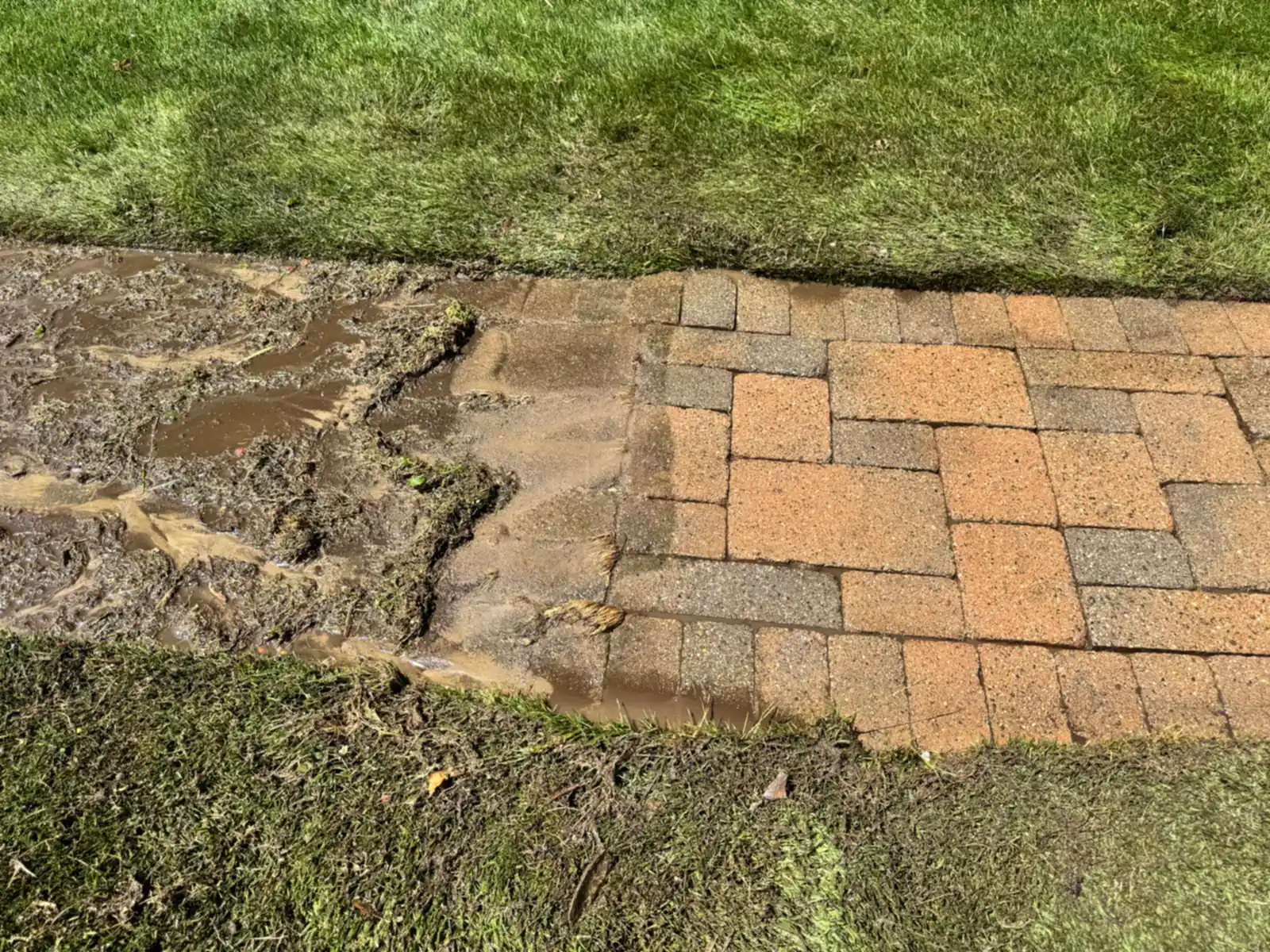
Your pavers are due for a cleaning when the color looks flat, the surface turns green or slick, stains stay after a rain, or soil and weeds start filling the joints and edges. CMHA notes that cleaning can lift fine particles lodged in the paver's pores and bring the color back. Watch for:
- Color that looks gray or flat next to a spare paver from the original job.
- Green film or dark patches in shade, explained in why pavers turn green.
- Leaf prints and brown tannin marks; see leaf and walnut stains.
- Oil drips where the car parks or grease by the grill; see oil and grease stains on pavers.
- A white haze, often efflorescence; see removing efflorescence from pavers.
- Soil, mulch or turf creeping over the edges, and joints that are dirty, low or sprouting weeds.
Some signs need more than a cleaning. CMHA links low spots that hold puddles to a settled base, and joints that widen along the outer edge, with edge pavers tipping, to lost edge restraint. CMHA also says units sitting more than 1/8 inch above their neighbors should be repaired before winter, because plows can chip raised edges. Those go to paver repair and re-sanding, quoted from photos or in person.
When the surface is due, our brick paver restoration starts at $399 for the clean, polymeric re-sand and seal together. A poured driveway or walk beside the pavers falls under concrete cleaning, from $149. Every quote is written, itemized and sent within 24 hours.
Sources
Want This Handled Properly?
Macomb Power Washing Solutions holds a 4.9-star rating across 177+ Google reviews, and free estimates go out within 24 hours. We carry $2M general liability plus workers' compensation.