
The short answer
Round black spots that survive pressure washing are usually lichen, a fungus-and-alga crust anchored in the pores of the concrete or paver. Pressure shears off the top and leaves the living anchor. Sodium hypochlorite applied with dwell time kills it, and the spots fade over weeks. Macomb Power Washing Solutions prices concrete cleaning from $149 in Macomb and Oakland County.
What are the black spots on a concrete or paver patio?
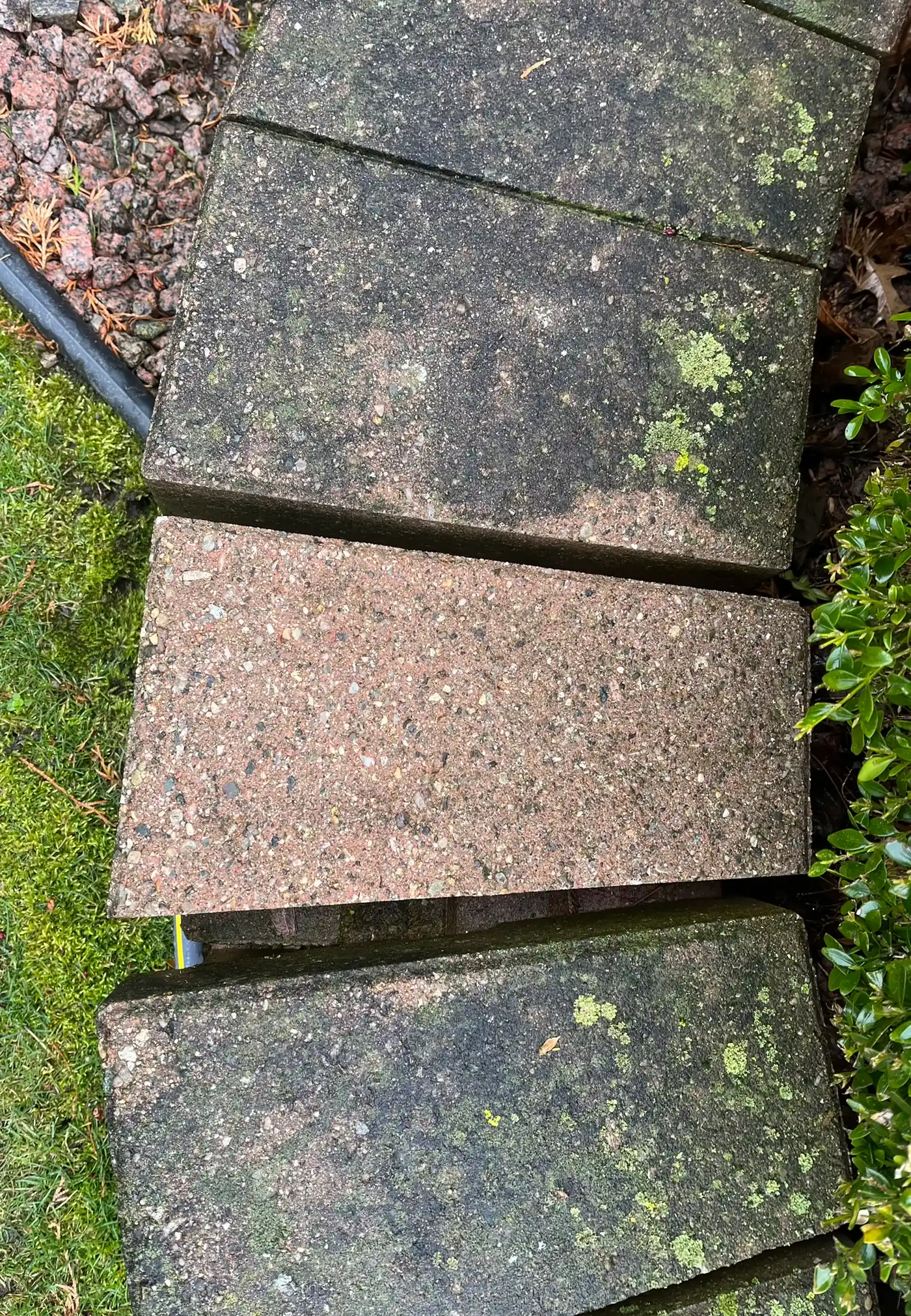
Round black spots on a patio that stay put after pressure washing are usually lichen. Lichen is a partnership between a fungus and an alga, and the crustose kind that grows on flatwork forms a flat crust fused to the surface. Each spot starts about the size of a pinhead and widens slowly over several seasons. Neighboring spots eventually merge into dark patches.
Patio lichen shows up as scattered dots rather than an even film. The dots are round, flat and hard, with no raised edge to catch with a fingernail. They cluster where the surface stays damp longest: the shaded half of the patio, the strip along the foundation, the area under a tree. Algae and mildew on the same patio read as a green or gray wash and come off with the dirt, while the lichen dots stay in place.
Why won't pressure washing remove lichen from concrete?
Pressure washing removes lichen only down to the surface line of the concrete. The visible crust sits on top, but the fungal partner grows fine threads down into the pores of the concrete or paver. Those threads work into the cement paste and between the sand grains. A pressure wand or surface cleaner shears the crust off at the surface and leaves the anchor behind.
The lichen anchor left in the pores after pressure washing is still alive and still dark. A freshly washed patio often shows the same pattern of spots, a shade lighter, as soon as it dries. The lichen then regrows from those same anchor points, in the same positions, over the next season or two.
How does repeated pressure washing make patio lichen worse?
Repeated high-pressure blasting wears away the top layer of cement paste on concrete and the smooth face on many pavers. Under that layer is sand and stone, which is rougher and more open. A rougher surface holds more water after each rain and dries more slowly. It also gives new lichen more places to anchor.
Chasing lichen with more pressure each spring leaves a patio that grows spots faster than before. In Michigan a surface opened up by heavy pressure also soaks up more water ahead of each freeze. Freeze-thaw cycles already cause scaling and pitting on bare concrete, and a roughened surface gives them more to work with.
How do you kill lichen on concrete and pavers?
Lichen on concrete and pavers is killed with sodium hypochlorite, the active ingredient in bleach, mixed at a strength suited to the growth and the surface. The solution has to soak down into the pores to reach the anchor. Dwell time matters as much as strength, so the mix stays on the surface and is kept wet while it works. A spray followed by an immediate rinse kills very little. Heavy, old growth gets a second application before the rinse.
Landscaping around the patio is protected by water before and after the treatment. We soak the lawn edge and planting beds before any solution goes down and rinse them again at the end. Wet plants shed the solution. Dry plants on a warm afternoon absorb it and burn.
Colored pavers, stamped concrete and stained concrete get a small test patch first. A strong mix can lighten some pigments and some older sealers. The test patch shows how the surface reacts before the full patio is treated. Sealed stamped concrete has its own routine, covered in our guide to cleaning sealed stamped concrete.
The ordinary dirt film comes off with a rotary surface cleaner at controlled pressure. The spinning jets under the shroud hold a fixed height, which gives an even finish without striping or etching the concrete.
How long do the black spots take to fade after treatment?
Treated lichen spots fade over the weeks after the visit rather than rinsing away the same day. Dead lichen stays attached until weather breaks it down. Rain, sun and foot traffic loosen the dead tissue, and each spot turns from black to gray to a faint outline before it clears. Old, thick spots take longer, and a light rinse a few weeks later helps clear what remains.
A patio that still shows spots on the afternoon of the treatment is on schedule. The useful check comes about a month later, when the spots should be clearly lighter and shrinking. Spots that look unchanged after several weeks are usually something other than lichen.
Is it lichen, mold, gum or tar on my patio?
Black spots on a patio can come from several sources, and each one responds differently to pressure and to chemistry. A drop of household bleach on a single spot is a quick test. A lichen spot usually starts to lighten within a day, while tar, gum and paint do not change. Dark leaf-shaped outlines under oaks, maples and walnuts are tannin stains rather than spots, and our guide to leaf and walnut stains on concrete covers them.
| Spot | What it looks like | After pressure washing | What removes it |
|---|---|---|---|
| Lichen | Round, flat, hard dots in shaded areas that widen slowly | A shade lighter, still there | Sodium hypochlorite with dwell time, then weeks of fading |
| Mold, mildew or algae | An even gray, green or black film, slick when wet | Mostly gone, returns sooner on shaded slabs | The same chemistry, rinsed off the same day |
| Chewing gum | Flat black circles near entries and front walks | Little change | Hot water or steam on each spot |
| Tar or asphalt sealer | Irregular drips or tracked footprints near the driveway | Little change, sometimes smeared | A solvent cleaner on each spot |
| Artillery fungus | Tiny hard black specks near wood mulch beds | Little change | Spot work, plus changing the mulch near the patio |
Why do shaded patios in Macomb and Oakland County grow lichen?
Lichen grows where a patio stays damp for long stretches and gets little direct sun. Wooded lots in places like Washington Township, Shelby Township, Rochester Hills and Clarkston put a lot of backyard concrete under mature oaks and maples. The canopy keeps morning dew from burning off. Fallen leaves and seed pods hold moisture against the surface through spring and fall.
Humidity near water adds to the damp that shade holds on a patio. Homes near Lake St. Clair and around the inland lakes of Oakland County see more damp mornings, and a shaded patio in those spots can stay wet into the afternoon. North-facing patios and the strip along a north foundation wall grow spots first, for the same reason the north side of a house turns green before the other walls.
Does sealing a patio stop lichen from coming back?
Sealing slows lichen regrowth but does not stop it. A penetrating sealer lines the pores below the surface, so rain beads and runs off instead of soaking in. The surface dries faster and offers fewer open pores for new lichen to anchor in. The same sealer cuts down the water that freezes inside the slab each winter.
We plan on a fresh coat of penetrating sealer every three to five years on a Michigan patio. The sealer goes down after the lichen treatment and a full dry-out, not over live growth. Trimming low branches and raking leaves off the patio in fall shortens the damp hours and stretches the time between treatments.
Paver patios need the joints handled along with the lichen. Cleaning pulls some joint sand out, and open joints hold water and grow weeds and moss. A paver restoration cleans the faces, refills the joints with polymeric sand and seals the field, as laid out in our guide to restoring faded brick pavers.
What does patio lichen treatment cost in Macomb and Oakland County?
Lichen treatment on a concrete patio is priced as part of concrete cleaning, which starts from $149 at Macomb Power Washing Solutions. Patio size, heavy growth that needs a second application, and added walks or steps move the number up from there.
Paver patios are priced as a brick paver restoration, which starts from $399 and covers the cleaning, the polymeric re-sand and the seal. On poured concrete, concrete sealing starts from $299 and is the follow-up that slows regrowth.
Quotes come back in writing, line by line, within 24 hours, with no travel fee in any of the communities we serve across Macomb County, Oakland County, Grosse Pointe and Harper Woods. A photo of the spots and a rough size of the patio are enough to start, and the photo helps tell lichen from tar or gum before anyone arrives.
Sources
Want This Handled Properly?
Macomb Power Washing Solutions holds a 4.9-star rating across 177+ Google reviews, and free estimates go out within 24 hours. We carry $2M general liability plus workers' compensation.