
The short answer
Rust stains on pavers come from iron: fertilizer granules that contain it, steel furniture feet, planters and tools, worn snowplow shoes, steel-bristle brushes or dripping rusty water. Find the source first. Then use a paver rust remover labeled for your pavers: test a hidden spot, scrub, rinse, repeat as needed, and clean every paver afterward for even color.
What causes rust stains on pavers, and how do you remove them?
Rust stains on pavers are caused by iron that reaches the surface from fertilizer, steel or water, and you remove them in two steps: find that source, then dissolve the stain with a rust remover made for your pavers. Skip the first step and whatever left the iron keeps leaving more.
The job in order:
- Read the stain's shape and location: scattered dots, rings, long streaks or a spray pattern.
- Remove or change whatever left the iron behind.
- Test a paver rust remover on one small, hidden stain, following its label.
- Treat each stain, scrub with a nonmetallic brush and rinse.
- Clean all of the pavers afterward so the treated spots blend in.
Rust on poured concrete is a separate job, since at least one paver rust remover rules it out; see removing oil and rust stains from a driveway.
Where do the orange spots on pavers come from?
The orange spots on pavers come from whatever iron or steel touched them, and the pattern of the stain is the clue. Techniseal's data sheet names steel, rusted metal objects, dripping rusted water and fertilizer granules; Alliance Gator's names steel, water buildup and fertilizer. Match what you see:
- Small dots scattered over pavers next to a fertilized lawn: granules that contain iron, which an Arapahoe County Extension responder called a common issue. If the bag lists iron, start there.
- Rings, squares or short bars: metal feet on chairs and tables, a steel planter, a grill stand, or a tool left out through a few rains.
- Long scratches and streaks down a drive or walk: snow equipment. The Concrete Masonry and Hardscapes Association (CMHA) explains in its maintenance guide, PAV-TEC-006, that snowplows and snow blowers can ride on shoes that skid across the pavers. With heavy plowing and blowing, worn shoes can embed metal filings in the paver surface, and those can lead to rust stains.
- Fine specks where someone scrubbed: a steel brush. CMHA's cleaning guide, PAV-TEC-005, does not recommend steel bristles on concrete pavers, because bristles that break off rust and leave stains. It accepts brass or plastic.
- An arc or fan that follows a sprinkler head: the water. Our guide to sprinkler rust and hard water stains covers why some irrigation water leaves orange behind; it does the same to vinyl siding and fences in its path.
Will fertilizer rust spots fade on their own?
Fertilizer rust spots can fade on their own, but slowly. When a homeowner asked Ask Extension in late May about iron fertilizer stains on a concrete driveway and walk, the Arapahoe County responder said no research-based information on it was available online. Then came a personal note: the responder's own stains faded in time, "maybe by late summer."
Waiting can work for faint speckles if no new iron lands on them. The Extension's prevention is simple: sweep the pellets off the concrete after you fertilize.
If you would rather not wait, the same answer points to iron removal products sold at hardware stores, and says to read the instructions so the chemicals cause no harm to the lawn or garden beside the paving. Techniseal's label adds that for fertilizer stains across a large surface, it recommends its Pre-Seal Cleaner over the rust remover.
How do you use a paver rust remover safely?
You use a paver rust remover safely by following its label to the letter, testing it first and rinsing it off before it dries. CMHA notes that some paver cleaners are made only for rust stains, and that stain removers made for concrete pavers lower the risk of discoloring or damaging them. Two makers' labels differ in the details:
| Label item | Gator Rust Remover | Techniseal Rust Remover for Pavers |
|---|---|---|
| Made for | Concrete pavers, wetcast and natural stone | Concrete pavers and slabs, bare or previously sealed |
| Do not use on | None listed on the data sheet | Natural stone that is not acid-resistant, wet-cast pavers, poured or stamped concrete |
| Method | Apply to the stain, let it soak 2 to 3 minutes, scrub with a hard bristle brush, rinse thoroughly | Wet the stain, cover it generously, scrub with a small nylon brush until it dissolves, rinse immediately |
| If rust remains | Repeat until the stain dissolves | Repeat the operation |
| Cautions | Never let it dry on the paver; wear goggles and rubber gloves | Always test on a small hidden stain first; wear rubber gloves and safety goggles |
Both labels say the product contains no muriatic acid. That does not make them mild: Techniseal's 2018 safety data sheet for its paver rust remover lists phosphoric acid, carries the signal word Danger and warns that it causes severe skin burns and eye damage. Read the current safety data sheet for the bottle you buy. Around either one:
- Shut off the sprinklers. CMHA says to turn off automatic sprinkler systems during cleaning, sealing and drying.
- Protect the plants. CMHA advises soaking nearby plants with water before a strong acidic stain remover goes on, so they absorb less of the rinse. Keep runoff off the beds and out of storm drains.
- Work up the slope. CMHA's method starts at the bottom of the pavement and moves uphill in sections, so used cleaner drains down and rinses away evenly.
- Use the right brush. Nylon, plastic or brass bristles, never steel.
For clay pavers, read the label twice. Neither sheet above lists fired clay brick, and "brick pavers" can mean clay or concrete made in a brick shape. Ask the paver maker which rust cleaner it allows, and see how to clean clay brick pavers.
Why do pavers look spotted after rust removal?
Pavers look spotted after rust removal because each treated spot is now cleaner than the weathered pavers around it. Techniseal's data sheet warns that pavers may appear spotted after its rust remover and calls the result a "clean stain." For uniform results, it says to clean the entire surface with its Pre-Seal Cleaner. Alliance Gator gives the same instruction: after treating spots, clean the entire paver surface for an overall uniform color.
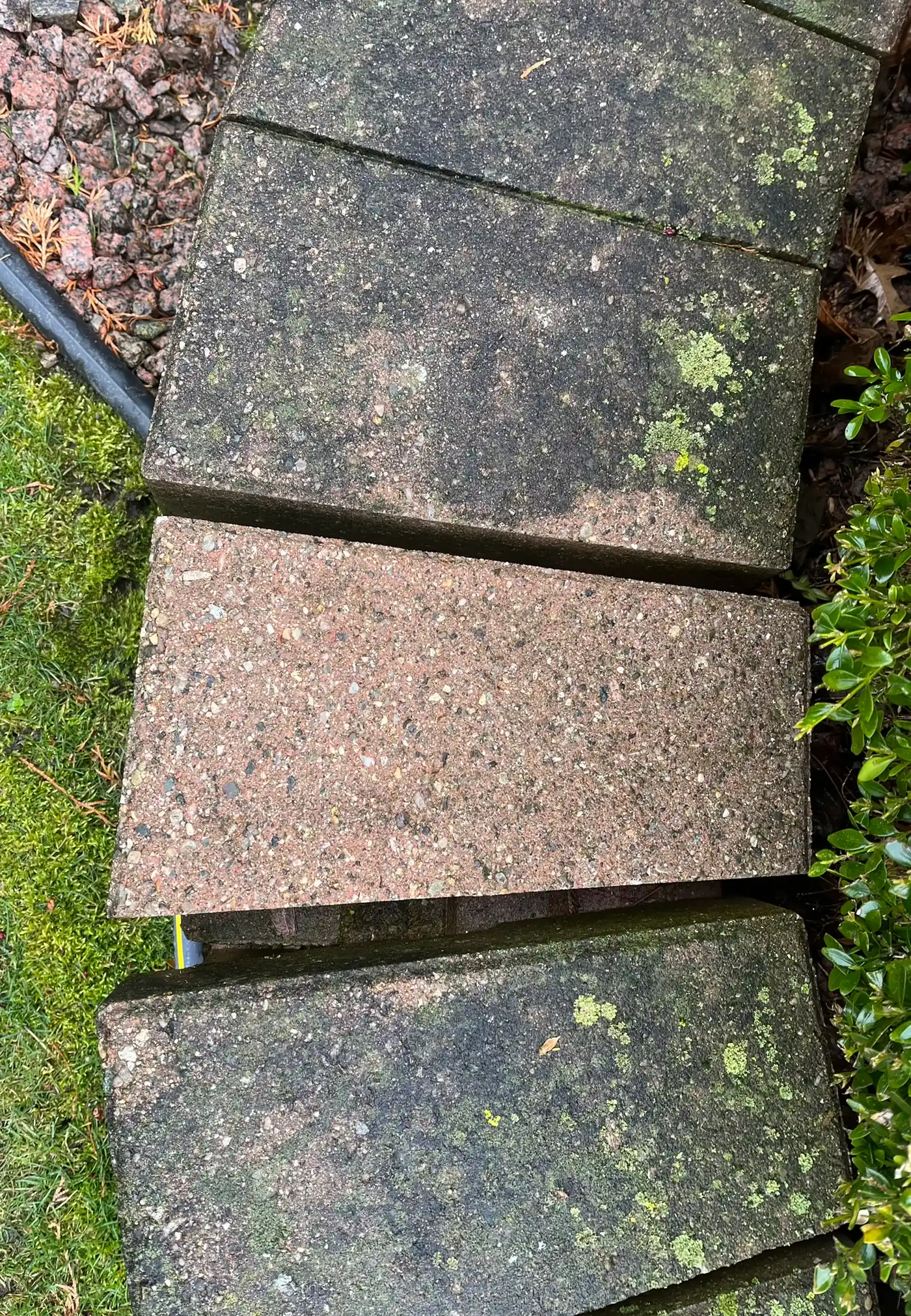
The photo shows the same effect on a larger scale: one cleaned stepping stone, speckled pinkish tan, between grimy, lichen-spotted stones. A rust spot treated on a dull patio leaves a smaller version of that contrast.
CMHA's cleaning guide puts the steps in the same order: remove stains on specific areas first, then use a cleaner to take efflorescence and dirt off the entire pavement. For the overall clean, see cleaning pavers without a pressure washer or pressure washing pavers with polymeric sand. If the pavers will be sealed, this clean comes first; CMHA says concrete pavers should be cleaned before a sealer goes on.
How do you keep rust stains from coming back?
You keep rust stains from coming back by keeping iron off pavers that get wet:
- Fertilizer: sweep or blow granules back onto the grass right after spreading.
- Furniture, planters and tools: put plastic or rubber pads under metal feet, set steel planters on non-metal stands, and put tools away.
- Sprinklers: aim heads so the spray lands on lawn and beds, not on the pavers.
- Snow equipment: CMHA notes that synthetic shoes are available that prevent rust staining from shoe wear. With plow season ahead, ask your contractor what the plow rides on.
- Sealer: CMHA says cleaning and sealing concrete pavers makes stains easier to remove, since sealer keeps them from soaking into the surface, and that sealer may need reapplying with wear and weather. Whether it pays off on your patio is weighed in is sealing pavers worth it.
When we clean pavers, rust spots get their own spot treatment along with the overall wash, though we can't promise every rust stain comes out completely. On pavers, that wash is part of brick paver restoration, from $399 for the clean, polymeric re-sand and seal together; on a poured drive or walk it is concrete cleaning, from $149. Rust removal has no separate set price; it goes on the same written, itemized quote, sent within 24 hours. After we seal, keep foot traffic and furniture off for 48 hours and vehicles off for 72 hours.
Sources
- Concrete Masonry & Hardscapes Association: PAV-TEC-006-22, Operation and Maintenance Guide for Interlocking Concrete Pavement
- Concrete Masonry & Hardscapes Association: PAV-TEC-005-22, Cleaning, Sealing and Joint Sand Stabilization of Interlocking Concrete Pavement
- Techniseal: Rust Remover for Pavers, Technical Data Sheet (PDF)
- Techniseal: Rust Remover for Pavers, Safety Data Sheet, 2018 (PDF)
- Alliance Gator: Gator Rust Remover, Technical Data Sheet (PDF)
- Ask Extension #457146 (Arapahoe County Extension): Iron stains from fertilizer in concrete
Want This Handled Properly?
Macomb Power Washing Solutions holds a 4.9-star rating across 177+ Google reviews, and free estimates go out within 24 hours. We carry $2M general liability plus workers' compensation.