
The short answer
Rock salt (sodium chloride) is the least damaging common ice melt for concrete and concrete pavers, according to the Concrete Masonry and Hardscapes Association. Use calcium chloride sparingly, avoid magnesium chloride and ammonium products, and put no deicer on concrete under a year old. For clay brick pavers, the Brick Industry Association prefers calcium magnesium acetate (CMA).
What ice melt is safe for concrete, stamped concrete and pavers?
The ice melt that is safest for concrete, stamped concrete and concrete pavers is plain rock salt, used in moderation, on concrete that is more than a year old. An ice melt, or deicer, is a salt or other chemical that lowers the freezing point of water so ice turns to slush. The Concrete Masonry and Hardscapes Association (CMHA) calls rock salt the least damaging deicer for concrete materials. The Pennsylvania Aggregates and Concrete Association (PACA) calls sodium chloride and calcium chloride generally acceptable on good-quality, dense concrete.
The answer changes with the surface. Clay brick pavers are a different material, and the Brick Industry Association steers owners away from rock salt on them. Concrete poured in the last twelve months should get no deicer at all. The sections below compare the chemicals and then give the advice by surface.
How does ice melt damage concrete?
Ice melt damages concrete in two ways: it adds to the physical stress of freezing water, and some deicers attack the concrete chemically. Scaling is the flaking and pitting of a concrete surface, and PACA says deicers can start it and make it worse by amplifying freeze-thaw damage. How salty water soaks in and breaks the surface apart over a winter is covered in what Michigan winters do to unsealed concrete.
The chemical side depends on the deicer. CMHA's maintenance guide for interlocking concrete pavement says magnesium chloride and CMA "can chemically degrade all types of concrete," and that the risk from CMA rises with the amount of magnesium in the blend. The product you spread, and how much of it, decide which of these processes your driveway faces.
How do rock salt, calcium chloride, magnesium chloride and CMA compare?
Rock salt, calcium chloride, magnesium chloride and CMA compare on two measures: the lowest temperature at which each still melts ice at a useful rate, and how hard each is on concrete. The temperatures in the table come from the Minnesota Pollution Control Agency (MPCA) Smart Salting manual, which notes that published values vary. Treat them as approximate, since sun, the blend and the amount spread all change the result.
| Deicer | Lowest practical melting temperature (MPCA) | Concrete and concrete pavers | Clay brick pavers (BIA) |
|---|---|---|---|
| Rock salt (sodium chloride) | About 15°F | Least damaging (CMHA); generally acceptable on dense concrete (PACA) | Not recommended; BIA says it can cause efflorescence |
| Calcium chloride | About -20°F | Use judiciously (CMHA); generally acceptable on dense concrete (PACA) | BIA links it to efflorescence, its reason for ruling out rock salt |
| Magnesium chloride | About -10°F | Not recommended (CMHA); much higher deterioration (PACA) | No specific guidance |
| Calcium magnesium acetate (CMA) | About 20°F | Not recommended (CMHA); much higher deterioration (PACA) | Preferred |
| Ammonium sulfate or ammonium nitrate | Not listed | Never use (PACA) | No specific guidance |
| Sand or grit | Does not melt; traction only | No chemical harm; sweep up in spring | Sweep up after the freeze |
The 15°F line for rock salt matters in Southeast Michigan. NOAA daily records for Detroit Metropolitan Airport show overnight lows below 15°F in each of the last ten winters, from 8 to 36 such nights a winter, and on those nights rock salt slows down. MPCA bases deicer choice on pavement temperature, which it notes can differ greatly from the air temperature, so treat the overnight air low as a rough guide. That is when homeowners in Macomb and Oakland County tend to reach for a calcium or magnesium blend. CMA, which MPCA rates as very high in cost, stops working at a useful rate near 20°F, before rock salt does.
Why do concrete and hardscape groups disagree about calcium chloride?
Concrete and hardscape groups disagree about calcium chloride because they weigh its speed against its risk differently. CMHA calls rock salt the least damaging deicer for concrete materials and suggests judicious use of calcium chloride only when a quicker, more effective deicer is needed. Its separate guide for permeable interlocking concrete pavement lists calcium chloride, with sodium chloride and potassium chloride, as acceptable on those surfaces.
PACA, a concrete industry association, groups calcium chloride with rock salt as generally acceptable on good-quality, dense concrete. The Brick Industry Association, writing about clay pavers, links calcium chloride to efflorescence, and MPCA lists it as corrosive. The fair reading of this split is that calcium chloride is a tool for the coldest days on sound, sealed concrete, used in small amounts and not as the default all winter.
Which deicers should never be used on concrete?
The deicers that should never be used on concrete are those containing ammonium sulfate or ammonium nitrate. PACA says these chemicals are too aggressive and will easily destroy a concrete surface. Both are common fertilizer ingredients, so read the bag of any ice melt sold as safe for lawns or plants before spreading it on a driveway.
Magnesium chloride sits close behind. CMHA does not recommend it, and PACA lists it with potassium chloride, CMA, urea and nitrogen salts as deicers shown to cause much higher rates of deterioration. PACA notes that many bags say "safe" in large letters on the front while the fine print on the back lists conditions, so check the ingredient list, not only the front label.
Can any ice melt go on concrete less than a year old?
No ice melt should go on concrete less than a year old, according to PACA. PACA adds that deicers should never touch concrete that has not reached enough strength to resist freezing and thawing, which it puts at 4,000 psi or more, and that deicers can play havoc with freshly placed concrete. A driveway, walk or patio poured in fall in Michigan can meet its first freeze within weeks of the pour, so the first winter is the one to plan for.
On new concrete, use sand for traction and shovel early, before snow is packed into ice by tires and feet. Sweep the sand off in spring. Remember that the road salt on your car still drips onto the apron and the garage approach, so a gentle rinse of those areas on a mild winter day keeps salty slush from sitting on the new slab.
Which ice melt suits clay brick pavers and stamped concrete?
Clay brick pavers suit calcium magnesium acetate or urea, according to the Brick Industry Association's Technical Note 14. BIA says these products perform well and reduce staining of pavers, prefers CMA because it is more effective than urea at lower temperatures, and does not recommend rock salt because it can cause efflorescence. Efflorescence is a white, powdery deposit left when water carries dissolved salts to the surface and evaporates. Removal is covered in how to clear efflorescence from brick and block.
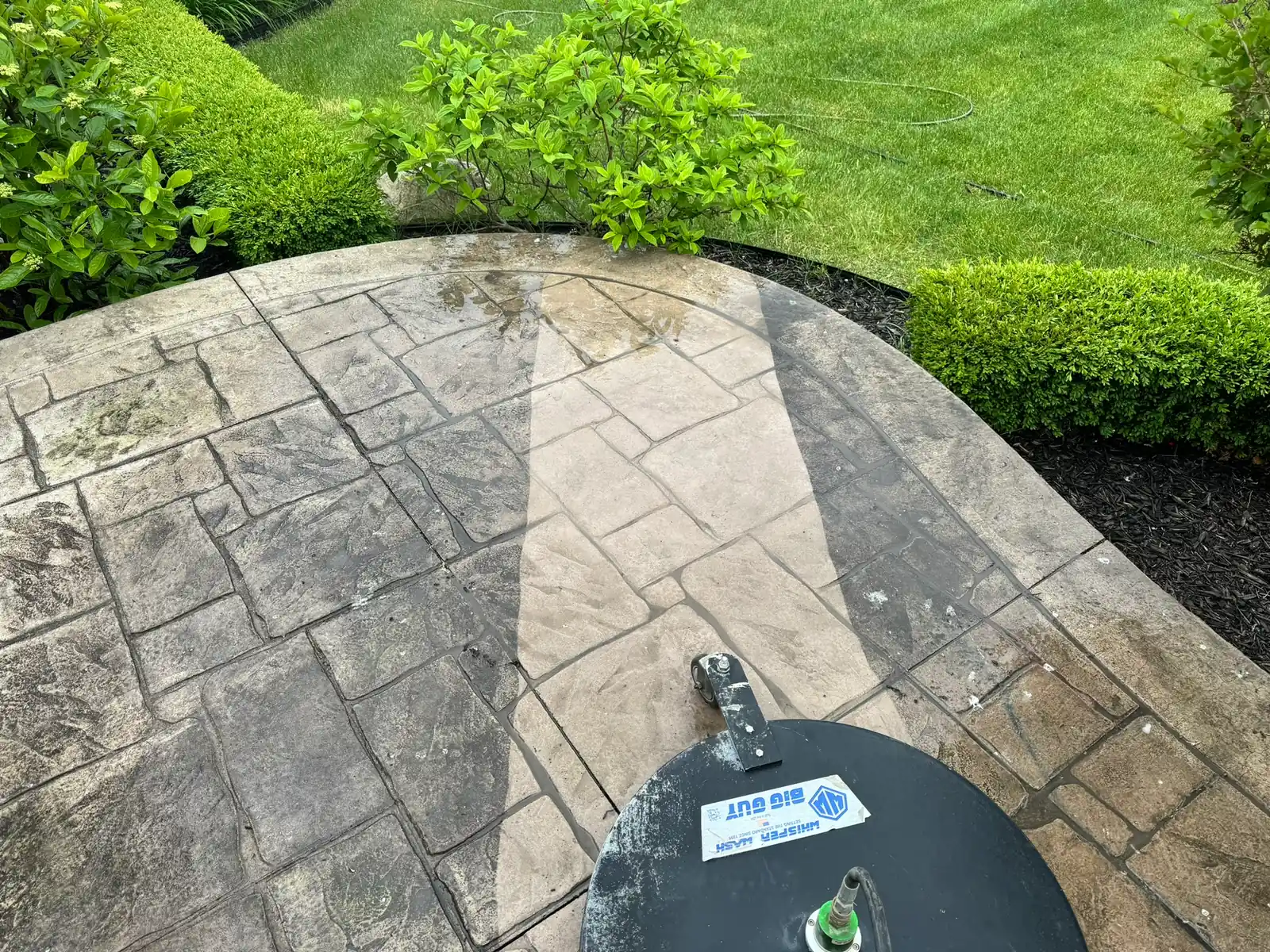
The advice for clay pavers is close to the reverse of the advice for concrete pavers, so it pays to know which you have. Concrete pavers are cast from cement, sand and aggregate and follow the CMHA and PACA guidance. Clay pavers are fired brick. CMHA does not recommend winter sand on permeable interlocking concrete pavements, whose open joints are meant to drain water.
Stamped concrete is concrete, so the concrete guidance applies: rock salt in moderation, calcium chloride sparingly, no magnesium chloride. Its protection is usually a film-forming acrylic sealer on top rather than a penetrating one, and the American Society of Concrete Contractors' homeowner guide puts new sealer on high-traffic, sun-exposed areas about every two to three years. Washing that film without harming it is covered in how to clean sealed stamped concrete. When that sealer wears thin, salt and water reach the color layer, and the signs are listed in when stamped concrete needs resealing.
How do sealing and a spring wash limit salt damage in Michigan?
Sealing and a spring wash limit salt damage by keeping salty water out of the slab in winter and getting the leftover salt off it once the season ends. PACA says silane or siloxane penetrating sealers give the highest level of resistance to deicers and freeze-thaw. A penetrating sealer soaks into the pores and makes them repel water, so less brine is inside the concrete when it freezes. On plain broom-finished Michigan driveways, plan on a fresh coat of penetrating sealer every three to five years; sealed stamped concrete follows its acrylic sealer's shorter schedule, described above.
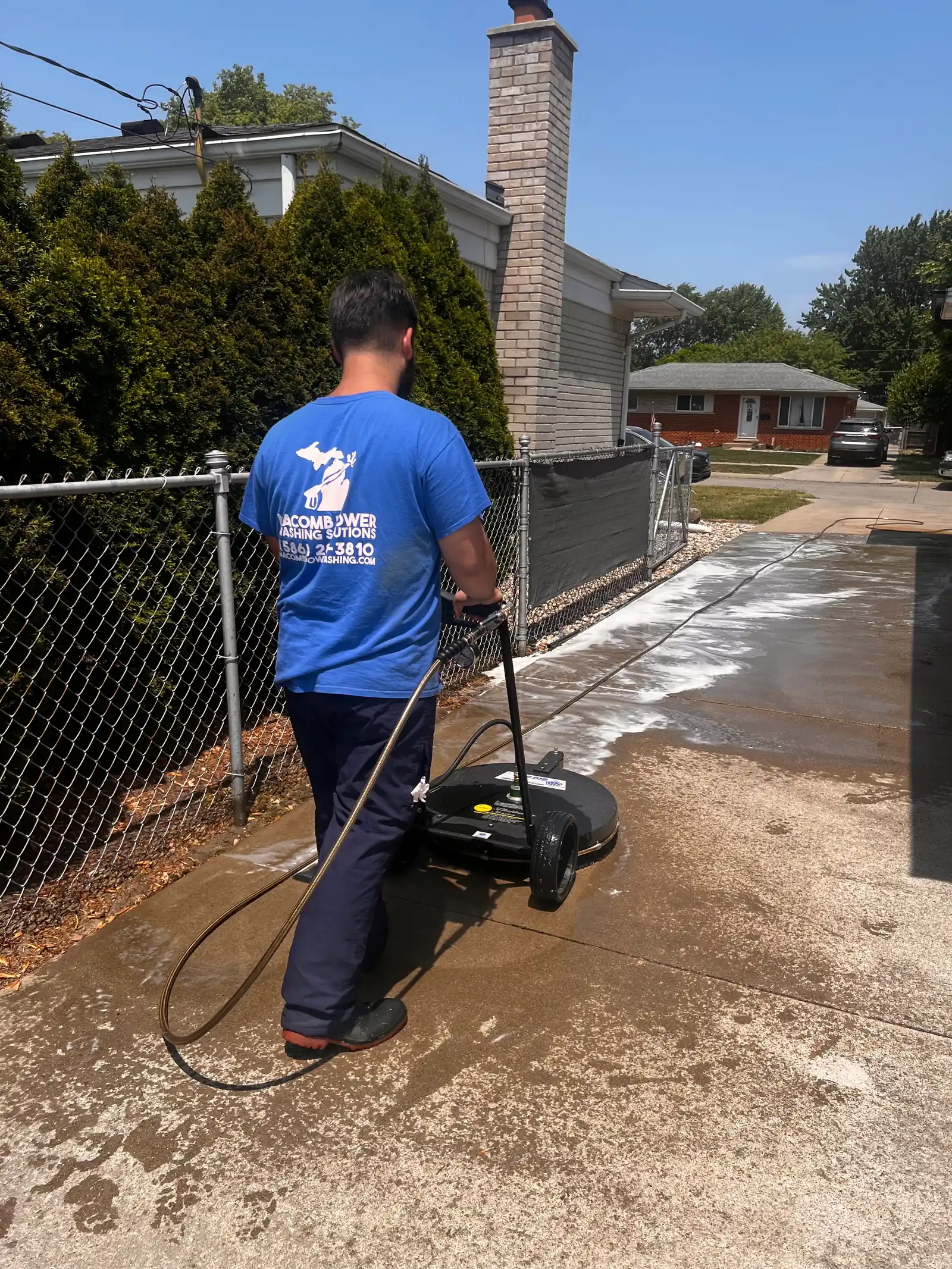
A spring wash removes the salt film left by what you spread and what cars track in from treated roads. CMHA recommends a spring sweeping of paver surfaces to clear leftover deicing chemicals and winter sand, and BIA notes that salts absorbed from deicers can cause efflorescence on clay pavers. Garage floors collect the same residue and benefit from a rinse at the same time.
At Macomb Power Washing Solutions, starting prices are $149 for concrete cleaning, $299 for concrete sealing and $399 for paver restoration. Sealing goes on after cleaning and a full dry-out, on a warm day before the first freeze, and quotes arrive in writing within 24 hours. What drives the sealing price is laid out in concrete sealing cost in Macomb County.
Sources
- CMHA PAV-TEC-006: Operation and Maintenance Guide for Interlocking Concrete Pavement
- CMHA PAV-TEC-023: Maintenance Guide for Permeable Interlocking Concrete Pavements
- Pennsylvania Aggregates and Concrete Association: Protecting Concrete From Deicer Damage
- Brick Industry Association Technical Note 14: Paving Systems Using Clay Pavers
- Minnesota Pollution Control Agency: Smart Salting for Parking Lots and Sidewalks Manual
- American Society of Concrete Contractors: Concrete Sealer Expectations and Maintenance Guide
Want This Handled Properly?
Macomb Power Washing Solutions holds a 4.9-star rating across 177+ Google reviews, and free estimates go out within 24 hours. We carry $2M general liability plus workers' compensation.