
The short answer
Get leaf and black walnut stains off concrete with a bleaching cleaner: oxygen bleach mixed to its label or diluted chlorine bleach, kept wet, scrubbed with a stiff nylon brush and rinsed. The stains are tannin and other plant compounds in the pores; walnut marks often need several rounds. Concrete cleaning by Macomb Power Washing Solutions starts at $149.
How do you remove leaf and walnut stains from concrete?
Leaf and walnut stains come off concrete with a bleaching cleaner, a stiff nylon brush, dwell time and a thorough rinse. Oxygen bleach is sodium percarbonate, a powder that releases hydrogen peroxide when it dissolves in water. Western Interlock, a paver maker, uses diluted chlorine bleach instead, one part bleach to four parts water, with a stronger mix for heavy staining.
The steps below work for leaf prints and walnut hull marks on bare concrete and pavers. Walnut stains usually need more than one round.
- Sweep or blow the slab clear of leaves, hulls and grit.
- Soak the concrete and any nearby plants with plain water.
- Mix the cleaner at the strength its label gives for outdoor surfaces, and never combine chlorine bleach with ammonia or acid products.
- Try the mix on a hidden corner first, especially on colored, stamped or sealed concrete.
- Spread it over the stain and do not let it dry out before the dwell time on the label is up.
- Scrub with a stiff nylon brush, then rinse with a garden hose.
- Let the slab dry completely before judging the result, and repeat on stains that remain.
Why do wet leaves leave a print on concrete and pavers?
Wet leaves leave a print on concrete because they contain tannins, water-soluble plant compounds that dissolve out of the leaf and soak into the porous surface below. Western Interlock names tannins as the cause of leaf stains on pavers. Rain or dew draws the tannin out of a leaf lying flat on the slab, and the brown liquid wicks into the pores beneath it. When the leaf blows away, its outline stays behind.
A pile that sits through several rains does the most damage, because each wetting releases more tannin into the same spot, while dry leaves cleared before a storm leave little behind. Euclid Chemical's sealer troubleshooting bulletin lists tree debris among the stains a sealer will not prevent, and its advice is to sweep debris off concrete as often as possible.
Why are black walnut hull stains darker and harder to lift?
Black walnut hull stains are darker than most leaf prints because the walnut's husk is soft and pulpy when it falls, and crushed pulp leaves a dark brown stain pressed straight into the concrete. The USDA Natural Resources Conservation Service plant guide names the nut hulls, along with buds and roots, as the largest sources of juglone, the compound that stunts many plants near a walnut.
The US Forest Service silvics guide says black walnut nuts ripen in September or October and drop shortly after the leaves fall. On a driveway or patio, feet and tires crush the hulls, and the pulp sits against the surface for days. That concentrated stain is harder to lift than a leaf print, so walnut marks often lighten over two or three cleanings instead of clearing in one, and old hull stains may never clear completely.
The Forest Service puts black walnut's natural range as far north as central Michigan, so southeast Michigan, including Macomb and Oakland County, sits well inside it.
How do you tell a leaf stain from mildew, lichen or rust on concrete?
A leaf stain is a flat brown or tan print in the shape of a leaf, while mildew is a green, gray or black film, lichen forms round, crusty spots and rust is orange. Telling them apart matters because each one needs a different cleaner.
| Mark | What it looks like | Where it shows up | What removes it |
|---|---|---|---|
| Leaf print | Brown or tan outline in a leaf shape | Under trees, after leaves lie wet | Bleaching cleaner |
| Walnut hull | Dark brown to black blotches and smears | Under or near a black walnut in fall | Bleaching cleaner, several rounds |
| Mildew or algae | Green, gray or black film over an area | Shaded spots that stay damp | Diluted bleach |
| Lichen | Round, crusty gray to black dots | Shaded patios that stay damp for long stretches | Sodium hypochlorite with dwell time |
| Rust | Orange to brown spots or streaks | Near metal furniture, tools or sprinkler spray | A rust remover, not bleach |
Round dark dots that outlast a cleaning tend to be lichen; our guide to black patio spots that pressure washing leaves behind explains why. Rust is an iron stain, so it calls for a rust remover rather than the bleaching cleaners that work on tannin.
Which cleaners lift tannin stains, and how should you test them first?
Bleaching cleaners lift tannin stains, since oxygen bleach and diluted chlorine bleach both work by oxidizing the stain, while acids are better kept off bare concrete. Acids react with the cement paste at the surface. Sealed stamped concrete is a separate case, covered in our guide to cleaning sealed stamped concrete, and CLR's own label rules out colored, stamped, sealed and coated concrete and concrete less than a year old.
| Cleaner | How it works on tannin | Where it fits | Caution |
|---|---|---|---|
| Oxygen bleach (sodium percarbonate) | Releases hydrogen peroxide, an oxidizer | Bare concrete and pavers after a test spot | Mix and dwell per the label; rinse well |
| Chlorine bleach, diluted | Oxidizes the stain; Western Interlock uses 1 part to 4 parts water on pavers | Bare concrete and pavers | Protect plants; test colored surfaces; never mix with ammonia or acids |
| Acidic cleaners (vinegar, CLR) | Not a bleach, so a poor match for tannin | Not a first choice on concrete | Acids react with bare cement paste; CLR's label rules out colored, stamped, sealed and new concrete |
| Hot water | Western Interlock lists heat for organic stains from leaves | Pavers and bare concrete | Low pressure; keep the wand moving |
A test spot answers two questions before the full slab is treated: whether the cleaner lifts the stain, and whether it changes the color of the concrete or sealer. Pick a corner that shows the same stain, follow the label for strength and dwell, rinse, and let it dry overnight before deciding.
Why can a pressure washer leave the concrete looking worse than the stain?
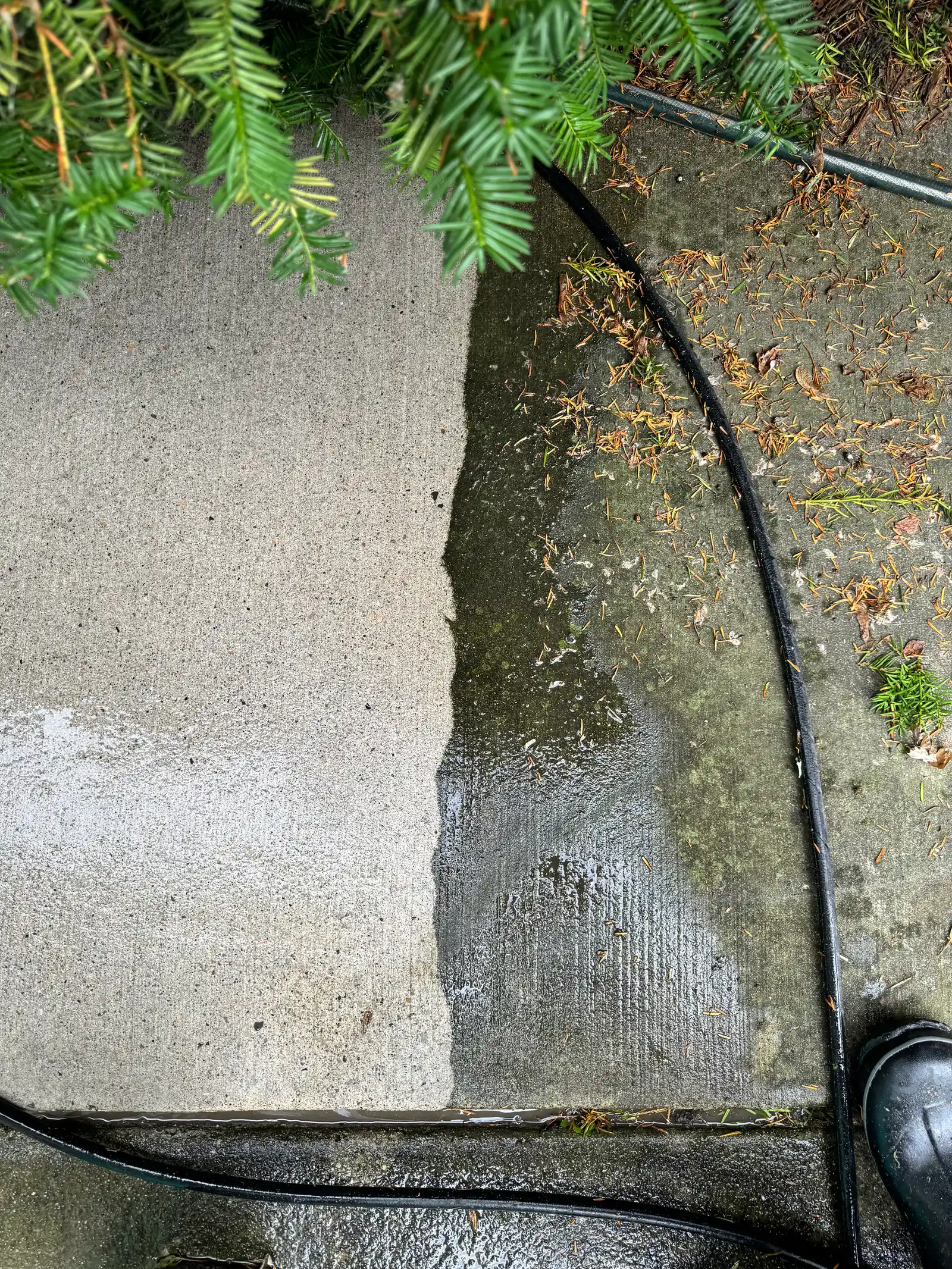
A pressure washer can leave concrete looking worse than a leaf stain because a close, narrow stream erodes the surface, and that erosion shows as lighter streaks, wand marks and exposed sand that do not wash away. The tannin sits in the pores, and cutting down to it means cutting into the cement paste around it. The usual result is a cleaner surface with a fainter stain still in it, framed by stripes.
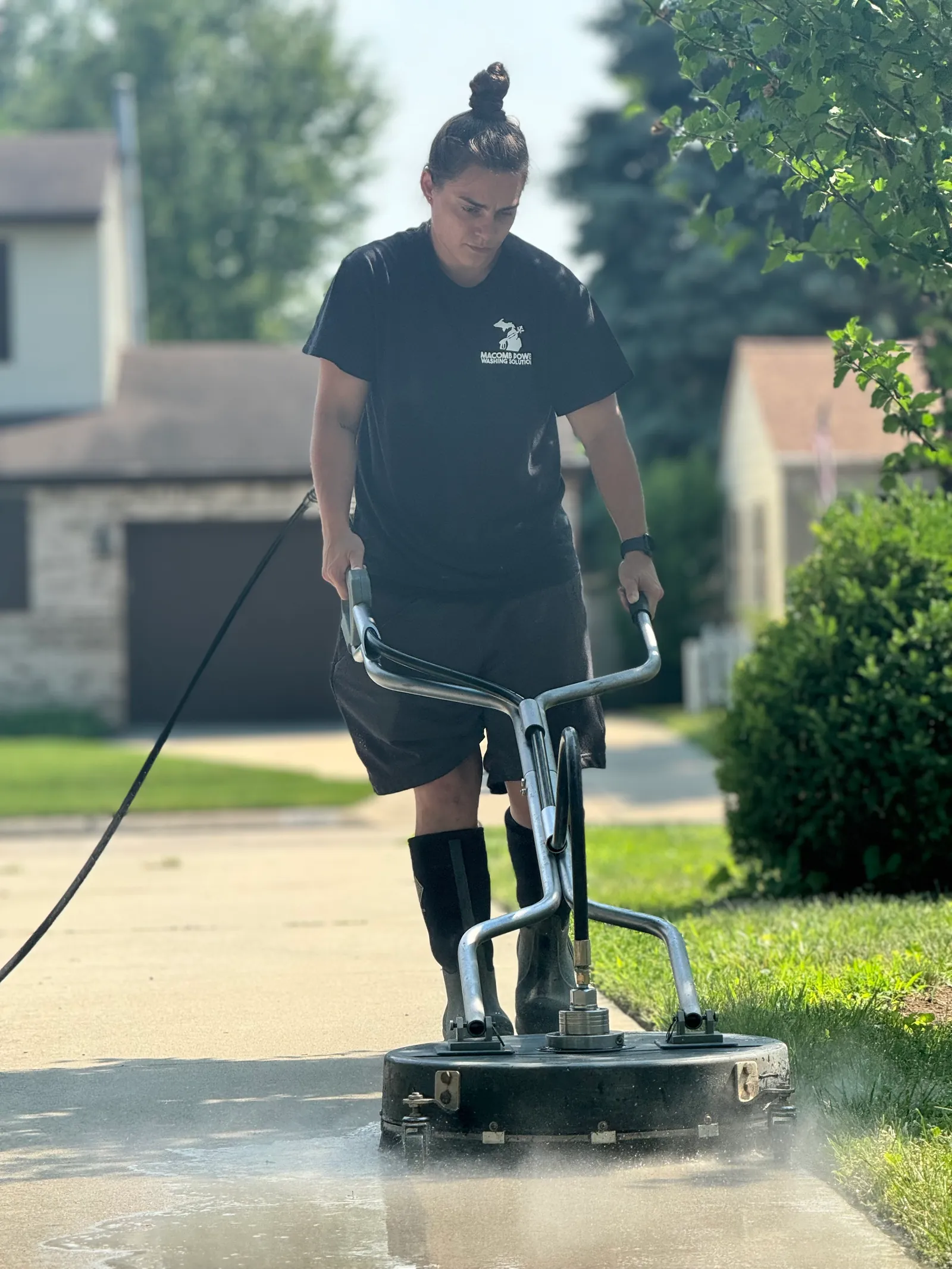
The safer order is chemistry first and controlled water second. A cleaner breaks down the stain in the pores, and a low-pressure rinse or an evenly run rotary surface cleaner removes what it loosened. Heat helps as well, and Western Interlock lists hot water as a way to remove organic stains left by sitting leaves. Our concrete cleaning service (from $149) applies a pre-treatment first, then works the stain out using rotary surface cleaners and hot water.
How is cleaning tannin off pavers different from cleaning a plain slab?
Cleaning tannin off pavers differs from a plain slab because pavers have colored faces that need a test spot before any bleach goes on, and sand joints that strong water can wash out. Each paver gets the same cleaner and brush, but the rinse stays gentle and runs along the joints rather than into them. Leaves also pack into joints, where they break down into organic matter that weeds and moss can root in, as our post on weeds in polymeric sand joints explains.
Joint sand pulled out during cleaning has to be replaced, or the pavers can shift and weeds take hold in the gaps. On a heavily stained paver patio, stain removal is usually one step in a brick paver restoration: a deep clean, new polymeric sand in the joints and a sealer coat. Macomb Power Washing Solutions prices paver restoration from $399.
How do you keep leaf stains from forming every Michigan fall?
Leaf stains are kept from forming by getting leaves and walnut hulls off concrete before rain wets them, and by keeping a sealer on the slab so tannin soaks in more slowly. A leaf blower pass after each heavy drop, ahead of a rainy forecast, prevents most prints. Walnut hulls need picking up as they fall, before tires and shoes crush them.
A sealer slows staining but does not stop it. The American Society of Concrete Contractors credits sealer with decreasing water penetration and improving stain resistance, and calls sealed surfaces stain resistant, not stain proof. In a Michigan winter, less water in the pores also means less water to freeze. For the rest of the work trees bring to a house, see our calendar for homes under mature trees and our guide to tannin, sap and pollen on siding.
Sources
- Black Walnut, Silvics of North America (USDA Forest Service)
- Black Walnut Plant Guide (USDA NRCS)
- Effective Cleaning Solutions for Stubborn Stains on Pavers (Western Interlock)
- Concrete Sealer Troubleshooting, Technical Bulletin CP-05 (Euclid Chemical)
- Concrete Sealer Expectations & Maintenance Guide (ASCC Decorative Concrete Council)
Want This Handled Properly?
Macomb Power Washing Solutions holds a 4.9-star rating across 177+ Google reviews, and free estimates go out within 24 hours. We carry $2M general liability plus workers' compensation.