
The short answer
Weeds grow through polymeric sand when joints are filled too shallow, never compacted, washed out by pressure or opened by freeze-thaw, or when seeds root in debris sitting on top of the sand. Fix it by pulling weeds, clearing failed joints at least 1.5 inches deep and re-sanding. Macomb Power Washing Solutions' paver restoration starts from $399.
Why do weeds grow through polymeric sand?
Weeds grow through polymeric sand when the joint is too weak or too dirty to keep seeds from rooting. Polymeric sand reduces weed growth; it does not make a joint weed-proof. Unilock describes activated polymeric sand as creating a nearly airtight seal that significantly reduces the risk of weeds, and Techniseal's data sheet for its RG+ sand says it inhibits weed growth. Both makers spell out the conditions in their installation steps: the joint has to be filled to full depth, compacted and wetted correctly. The surface also has to be kept clear of debris.
When weeds show up, the pattern in the patio usually points to one of five causes:
| Cause | What you see | Fix |
|---|---|---|
| Shallow fill | Joints sit low, and a screwdriver sinks past a thin crust | Remove to full depth or at least 1.5 inches, then re-sand |
| No compaction | Joints stay weak and break down early | Re-sand with a plate compactor run over the field |
| Debris on top | Weeds pull out with a mat of dirt, and the joint below is firm | Pull, sweep and blow the joints clear on a schedule |
| Shade and damp | Green moss or gray lichen fills joints in shaded areas | Kill with 1:1 bleach and water or a biocide |
| Washout or frost movement | Empty joints at downspouts, edges and where a wand was aimed | Remove and re-sand the failed sections |
How does polymeric sand hold weeds back when it is installed correctly?
Polymeric sand holds weeds back by setting into a dense, firm joint that leaves seeds no loose soil to root in. Polymeric sand is a blend of graded sand and a binding agent. Swept into the joints dry and wetted, the binder sets and locks the grains together, and the hardened joint resists washout and gives roots little to grip.
The fill height matters as much as the sand. Unilock calls for filling joints to roughly 1/8 inch below the rounded or beveled edge of each paver, and Sika's Evolution Pro data sheet sets the same 1/8 inch below the chamfer. A joint filled to that line is full from the bedding sand up, with a small recess left at the top.
Why do shallow or uncompacted joints fail?
Shallow or uncompacted joints fail because the binder needs depth and density to form a solid joint. Techniseal's RG+ data sheet lists a minimum joint depth of 1.5 inches and says that without mechanical compaction, joints remain weak and fail quickly. Compaction means running a plate compactor over the pavers so the sand settles down into the joints, then topping up and running it again until the joints are packed.
A common shortcut is to sweep a thin layer of polymeric sand over old, loose joint sand. The new sand sets into a crust a fraction of an inch thick, with loose sand underneath. Freeze-thaw and foot traffic can crack that crust, and the cracks fill with grit that seeds can root in. Sika's instructions rule out this approach: for touch-ups or reinstallation, remove the existing sand to full joint depth or at least 1.5 inches, and do not partially fill a joint with other material.
Water depth during activation decides how deep the joint sets. Techniseal's sheet sets a target of joints wet 1.5 inches deep, checked with a small screwdriver. A quick spray that wets only the top can leave a hard skin over unset sand.
How do seeds root on top of the joint instead of through it?
Seeds root on top of polymeric sand joints when organic debris collects in the small recess above the sand and breaks down into a thin layer of soil. Leaves, seed pods, pollen, grass clippings and wind-blown dust settle into that recess. Rain keeps the layer damp, and seeds that land in it sprout without ever reaching the sand.
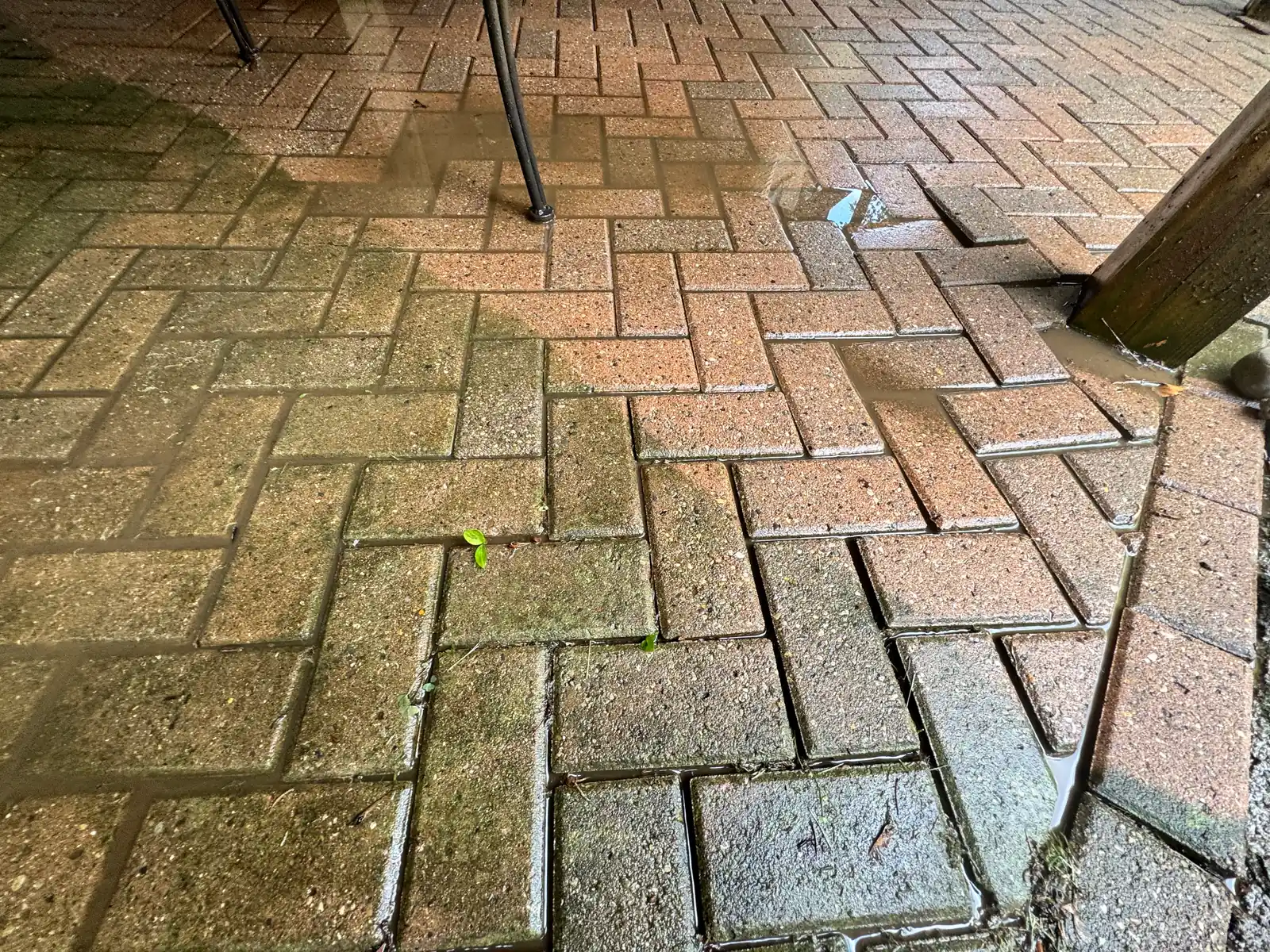
A weed rooted on top of the joint pulls out easily with a mat of dirt attached, and the joint underneath is still firm. That result means the sand is doing its job and the patio needs regular sweeping or a leaf blower pass. Some owners add a joint-stabilizing sealer over the sand, a trade-off covered in our paver sealing cost-and-benefit post. Michigan yards drop a lot of debris into paver joints, from tree seeds and cottonwood fluff to the heavy leaf fall from mature trees in autumn.
Why do shaded patios grow moss and lichen in the joints?
Shaded patios grow moss and lichen in the joints because the joints stay damp longer than the paver faces. A joint is a narrow channel that holds water after rain, and on a patio that gets little direct sun, it may never dry out between storms. Moss settles into that damp line before it can take hold on the drier faces.
The Brick Industry Association's Technical Note 20 (August 2018) says moss and lichens growing in the joints of damp or shady pavements can be killed with bleach and water mixed one to one, or with a proprietary biocide. The BIA also warns that cleaning chemicals can damage plants and grass, so keep the solution and its runoff off nearby beds and lawn. Lichen on the paver faces themselves is a separate problem, covered in our guide to black spots on a patio that pressure washing won't remove.
On Michigan lots, joint moss usually starts on the north side of the house or under mature trees, where the patio gets the least direct sun. Thinning low branches lets in more sun and air, so the joints dry sooner after rain.
How do pressure washing and freeze-thaw open the joints?
Pressure washing and freeze-thaw open polymeric sand joints by breaking or carrying away the set sand, which leaves room for debris and roots. The BIA notes that stabilized sand joints generally resist pressure washing if the nozzle is kept clear of the surface and the jet is not aimed along the joints, and that aggressive pressure washing can cause localized loss of joint sand. A wand dragged along a joint line to dig out weeds empties that joint.
Freeze-thaw cycles in a Michigan winter work on the joints from the other direction. Water in the joints and base freezes and expands, the pavers shift slightly, and a joint that was thin, cracked or poorly bonded opens further each season. Techniseal markets its RG+ sand as resisting joint erosion from water, frost heaving, wind and power washing, the same forces a joint has to survive here. Joints beside a downspout outlet carry the heaviest flow of water, so they tend to empty out before the rest of the field.
How do you clear weeds without ruining the joints?
You clear weeds from polymeric sand joints by pulling them by hand or with a joint knife, then rinsing the surface at low pressure while aiming the spray away from the joint lines. A steady routine keeps a sound joint sound:
- Pull each weed by its base, or lift it out with a narrow joint knife, so the root comes with it.
- Treat moss and lichen in the joints with 1:1 bleach and water or a biocide, keeping it off nearby plants.
- Sweep or blow out the loose debris left in the recess above the sand.
- Rinse at low pressure, holding the spray off the joints, or use a surface cleaner with the jets kept clear of the surface.
- Probe a few joints with a small screwdriver, the tool Techniseal uses to check wetting depth. A tip that stops at a hard surface means the joint is sound, and a tip that sinks through loose grains marks it for repair.
Our guide to restoring faded brick pavers shows where joint cleaning fits in a full clean, re-sand and seal. If more than a few joints fail the screwdriver test, the patio is past routine care and needs new joint sand.
When do the joints need to be removed and re-sanded?
Paver joints need to be removed and re-sanded when the sand crumbles, sits well below the paver edge, or has loose sand under a hard crust. Weeds that return in the same joints after pulling, or patches of empty joints at the edges and downspouts, mean the joint itself has failed, and sweeping alone will not fix it.
Re-sanding starts with digging out the old sand to full depth, or at least 1.5 inches, then cleaning the pavers and letting them dry completely. New polymeric sand is swept in dry, compacted, topped up and wetted to depth. Sika's data sheet asks for at least 24 hours without rain, or 48 hours for joints wider than half an inch, and the sand needs mild temperatures to cure, as our guide to polymeric sand haze explains, so a dry spell between late spring and early fall is the time to plan it in Southeast Michigan.
The polymeric re-sand is part of brick paver restoration from Macomb Power Washing Solutions, which starts at $399. Each estimate is itemized, put in writing and sent within 24 hours.
Sources
Want This Handled Properly?
Macomb Power Washing Solutions holds a 4.9-star rating across 177+ Google reviews, and free estimates go out within 24 hours. We carry $2M general liability plus workers' compensation.