
The short answer
Efflorescence is usually a powdery, white, crystalline salt deposit; mold may look like furry growth or specks of white, black, green, orange or brown. Looks can mislead, so put a few drops of water on it; most efflorescence dissolves. If water fails, try vinegar, which dissolves carbonate deposits. If neither works, NDSU Extension says it may be mold.
Efflorescence vs mold: how can you tell them apart?
Telling efflorescence vs mold apart takes three checks: look closely at the deposit, put a few drops of water on it, and if water does nothing, try a few drops of vinegar. Efflorescence is salt that water carried out of the masonry and left on the surface when it evaporated; our efflorescence explainer covers where those salts come from. Mold is a living growth. Both need water, so whichever one you find, the brick, block or slab is pointing you toward a moisture source.
Check outside on a dry day, on a patch that has had time to dry. Efflorescence is left behind as water evaporates, so a wall still wet from rain or a sprinkler may not show it yet, and a wet surface makes every test harder to read.
What does efflorescence look like up close?
The Brick Industry Association (BIA) describes efflorescence as a powdery, white, crystalline deposit. It may sit only on the mortar joints, show up in a few limited areas, or in extreme cases cover the entire brick surface.
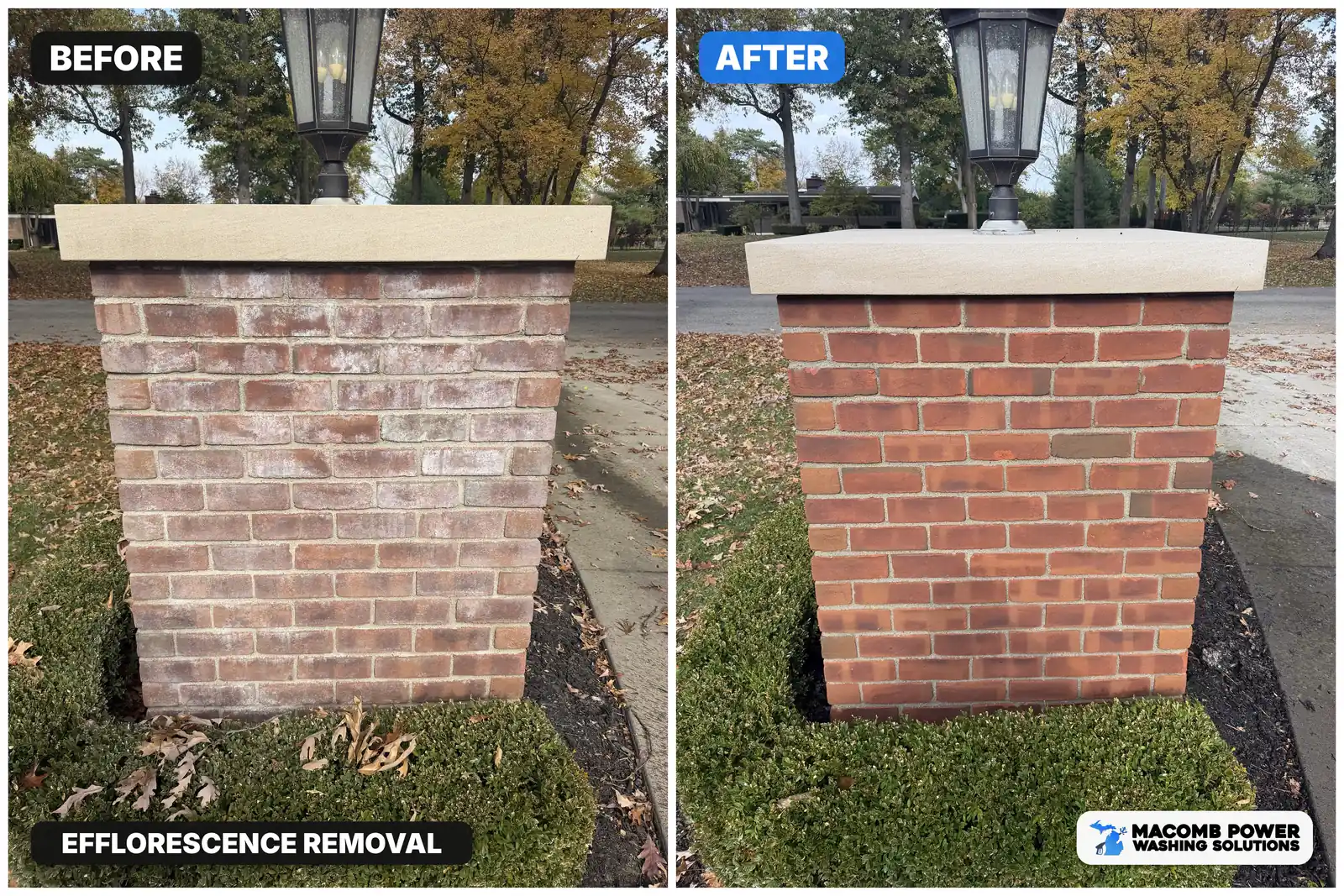
Where it sits is the second clue. Salt is left wherever water reaches the surface and evaporates, so the pattern traces the water: patches below a point where water gets in higher up, deposits along cracks, or a band low on a wall that soaks up ground moisture.
Looks alone are not proof, though. NDSU Extension notes that sulfate salts deposited in cracks in basement walls and floors "often take on a white, fluffy or moldy appearance." A fluffy white patch in a crack can still be salt, which is why the drop tests below carry more weight than the eye test.
What does mold or mildew look like on masonry?
University of Minnesota Extension says molds may look like furry growth, black stains, or specks of black, white, orange, green or brown, and EPA's mold guide says molds come in many colors, white and black among them. White by itself proves nothing either way. Specks of black, green or orange in or around the white fit that description better than they fit efflorescence, which is usually white.
The setting tells you more. BIA's stain guide links biological growth on brick to masonry that stays damp or sits in little sunlight: stains isolated to the north side, or concentrated where water lands often, such as caps and the brick under window sills. EPA describes molds outdoors as breaking down dead organic matter such as fallen leaves, and its guide shows mold growing on a plastic lawn chair where dripping rainwater left organic material behind. A shaded, damp ledge where dirt and leaf litter settle can offer the same conditions on masonry.
Smell is the last hint, mostly indoors. Minnesota Extension says a musty smell is sometimes the only clue that you have a mold problem.
How do the water and vinegar tests work?
NDSU Extension wrote this test for white deposits on basement walls and floors. The same logic holds on outside brick, because BIA draws the same line there: efflorescence is water soluble, while lime run, a crusty calcium carbonate deposit, does not dissolve in water once it fully carbonates.
- Water first. Put a few drops of water on a dry patch of the deposit. NDSU says sodium and magnesium sulfate deposits are dissolved easily by water, so the white should disappear into the drop. That result means soluble salt, the material efflorescence is made of. Watch the deposit itself, not only the color: crystals or fluff that break down into the drop are salt, while a crust or a growth stays where it was.
- Vinegar second. If water leaves it unchanged, put a few drops of household vinegar on it. NDSU explains that calcium and magnesium carbonates are relatively insoluble in water but can be removed with a dilute acid such as vinegar. On brick, a crusty white or gray carbonate deposit is what BIA calls lime run. On concrete block and mortar, the Concrete Masonry & Hardscapes Association (CMHA) treats calcium carbonate as a form of efflorescence that usually appears as a flat white deposit and, at worst, a hard white crust. Either way it is a mineral, not mold. Put the vinegar on the brick, block or concrete, not on a limestone or marble cap or sill: the National Park Service warns that acidic cleaners can etch and dissolve those stones.
- Neither one. If the deposit dissolves in neither water nor vinegar, NDSU says it may be mold. Note the word "may": a deposit that resists both could also be one of the white look-alikes in the next section.
The vinegar drop is an identification test, not a cleaning plan. Whether vinegar or any acid belongs on your wall is a separate question, answered in does vinegar remove efflorescence.
What if the white is neither efflorescence nor mold?
Several other white deposits pass for one or the other, and each has its own guide:
- A hard white or gray crust running down from a weep hole or crack, or a haze that appeared after an acid wash: lime run and white scum.
- Chalky white film or drip marks that match the reach of a sprinkler head: hard water scale from irrigation.
- A white film on pavers next to polymeric sand joints: polymeric sand haze.
- A milky white cloud in the sealer on a sealed driveway or patio: sealer blushing.
- A green film on the shaded side of the house: algae, explained in why one side of a house stays green.
What should you do once you know which it is?
If it dissolved in water, it is efflorescence. NDSU calls soluble salt deposits on basement walls and floors "harmless from a human health standpoint," so the white itself is not the hazard; the water feeding it is the real problem. CMHA's order of work is to establish why the efflorescence formed and repair the water problem before removing it. Most efflorescence then comes off with dry brushing followed by a flush of clean water, and CMHA lists commercial cleaners among the options when brushing falls short, with the maker's information deciding whether one suits your surface. The explainer above covers BIA's brick-specific steps. If the white keeps returning, work through why efflorescence keeps coming back.
If only vinegar dissolved it, the deposit is a carbonate. On brick, a hard crust like that is often lime run or, within a sprinkler's reach, hard water scale, both covered in the guides linked above. On block, it is the hard calcium carbonate form of efflorescence CMHA describes, and removing it raises the acid questions covered in our vinegar and muriatic acid post.
If it may be mold, EPA's guidance starts with one line: "The key to mold control is moisture control." Its basics for a home:
- Scrub mold off hard surfaces with detergent and water, then dry them completely.
- A moldy area under about 10 square feet, roughly a 3 ft by 3 ft patch, is in most cases a job you can handle yourself. Larger growth, or a lot of water damage, calls for EPA's remediation guide and, if you hire help, a contractor experienced in mold cleanup.
- EPA's protective gear for cleanup is gloves, goggles without ventilation holes and an N-95 respirator.
- Do not paint or caulk moldy surfaces. EPA warns that paint applied over mold is likely to peel.
- Fix the water problem as well, or EPA says the mold will most likely come back.
EPA says molds have the potential to cause health problems, and it advises anyone with health concerns to consult a health professional before starting cleanup.
On the outside of the house, a shaded wall covered in growth is where soft washing fits: a cleaning solution applied at low pressure that kills the growth instead of blasting at it, from $349 with Macomb Power Washing Solutions. Salt on the brick is cleaned as part of house washing. Either way, you get a written, line-item quote within 24 hours.
Sources
- Is it Mold or isn't it? (NDSU Extension)
- A Brief Guide to Mold, Moisture and Your Home (U.S. EPA)
- Dealing with and preventing mold in your home (University of Minnesota Extension)
- Technical Note 23, Stains: Identification and Prevention (Brick Industry Association, 2019)
- TEK 08-03A, Control and Removal of Efflorescence (Concrete Masonry & Hardscapes Association)
- Preservation Brief 1: Assessing Cleaning and Water-Repellent Treatments for Historic Masonry Buildings (National Park Service)
Want This Handled Properly?
Macomb Power Washing Solutions holds a 4.9-star rating across 177+ Google reviews, and free estimates go out within 24 hours. We carry $2M general liability plus workers' compensation.