
The short answer
Efflorescence on brick pillars and mailboxes comes from water reaching salts in the brick, mortar, cap stone or soil and carrying them to the face. Freestanding masonry can take on that water from every side: through a flat, cracked or drip-less cap, up from damp soil and mulch, from sprinklers, and through open seams around lamps and mailbox openings.
What causes efflorescence on brick pillars and mailboxes?
Efflorescence on brick pillars has the same cause as on a house wall: water dissolves salts in or against the masonry, carries them to the face and leaves them behind as it evaporates (the chemistry is in our efflorescence explainer). What changes is exposure. A house wall has a roof and gutters above it. An entry pillar, brick column, gate pier, lamp post or mailbox has only its own cap, takes rain on every face, stands in soil or a planting bed, and may sit in a sprinkler's reach. Writing about garden walls, the Brick Industry Association (BIA) says most face the extremes of exposure and that any defect may lead to deterioration.
One step in BIA's troubleshooting list is noting where the deposit sits, because its location can show where water enters. On a pillar, start with these leads:
- Heaviest in the courses just under the cap: water coming through or around the cap, or salts from the cap stone.
- A band across the bottom courses, sometimes with a tide line: ground moisture rising into the brick.
- One face only: check whether a sprinkler reaches that side.
- Around a mailbox door, house numbers or a lamp base: check the seal at that opening.
A light, even haze on a pillar less than a year old may be new building bloom, which BIA says in most cases fades as the masonry dries and weathers; see whether efflorescence goes away on its own.
How does the cap keep water out of a pillar?
The cap is the pillar's roof. BIA's caps-and-copings note says the primary function of these pieces is to channel water away. (BIA's term for the covering on top of a wall is coping; this post uses the everyday word, cap.) The table below sets out what BIA asks of it.
| Detail | What BIA recommends | What goes wrong without it |
|---|---|---|
| Slope | A top surface at least 15 degrees from horizontal (TN 36A) | Water ponds on top instead of shedding off (TN 23A) |
| Overhang and drip | A projection past the brick with a drip underneath, its inner lip at least 1 in. from the wall face (TN 36A); for garden walls, at least 1/2 in. of projection on both sides with a positive drip (TN 29A) | Water runs off the edge and down the brick face |
| Joints | As few as possible; stone, cast stone and precast pieces need fewer than brick (TN 36A, TN 23A) | Each joint is another path for water into the pillar |
| Flashing | Generally, through-wall flashing directly under the coping of garden walls (TN 29A) | Water that gets past the cap saturates the brick below (TN 23A) |
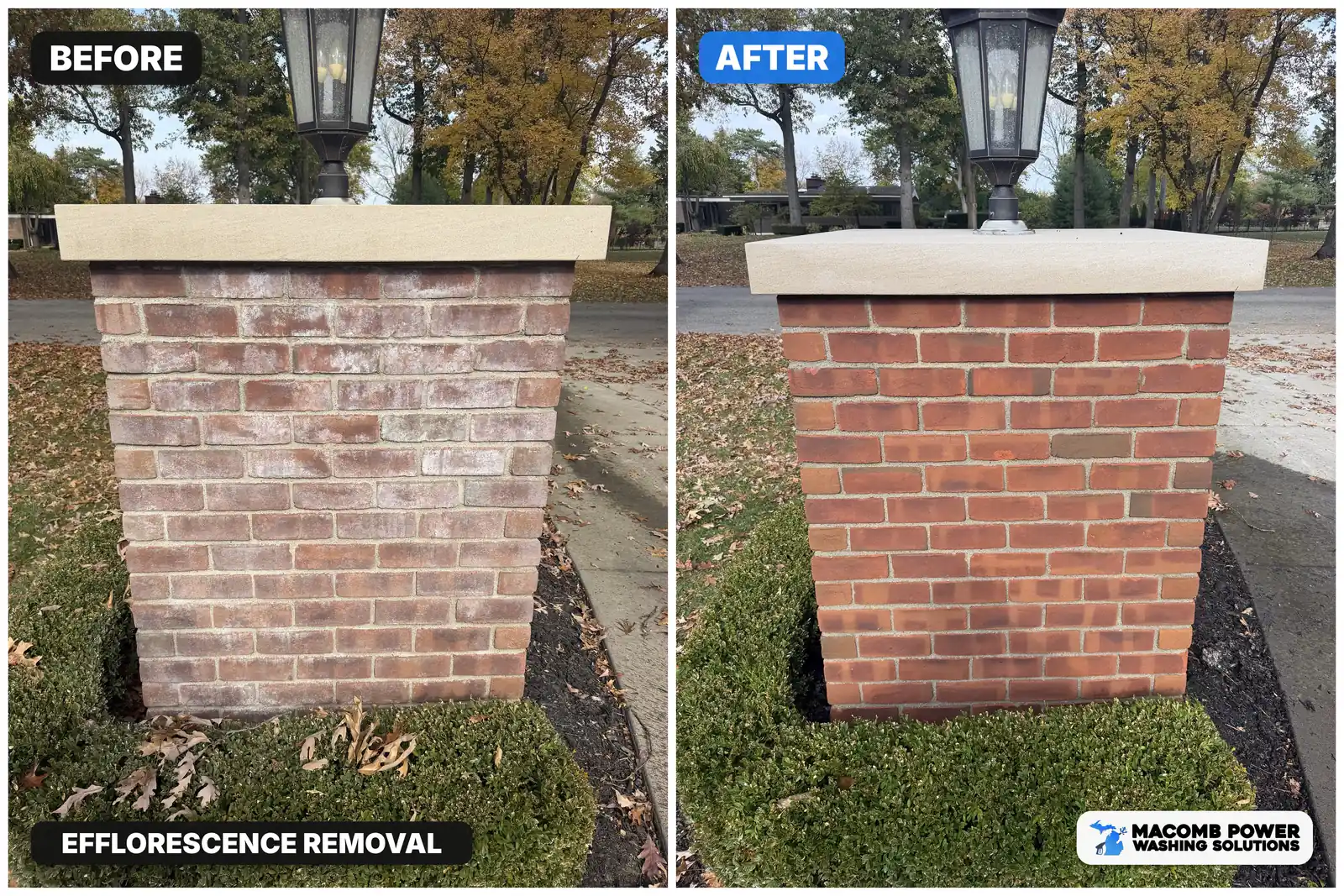
From the ground, use BIA's maintenance checklist for caps and copings: inadequate slope, cracked units, cracked or open mortar joints, loose pieces and missing drips. Look hardest at the joint where the cap sits on the brick, since an open joint there feeds the top courses directly. In the photo, the haze was heaviest in the upper courses and thinner near the base. Cleaning brought the red back, but cleaning alone does not change how water reaches the brick.
How does water reach a pillar from the ground and the lawn?
BIA explains that water percolating through soil dissolves soluble salts, so most groundwater holds a high concentration of them, and that masonry in direct contact with the earth can absorb it and draw it upward by capillary action several feet above the ground. On a pillar four or five feet tall, that can be most of its height. BIA's maintenance note calls this rising damp and says it shows as a "tide mark" left by the salts in the groundwater.
BIA lists poorly directed landscape sprinklers among the less obvious sources to check. Soil and mulch heaped against the base put more of the bottom courses in contact with damp ground. Ivy shoots, BIA notes, can work into voids in the mortar and conduct moisture into them; it advises cutting vines away, since pulling them off can damage the brick.
For masonry that extends below grade, BIA recommends a waterproof membrane on the earth side and flashing within 10 in. of grade as a capillary break; on a finished pillar, both are mason's work. What an owner controls is the surface: soil and mulch pulled back off the brick, and sprinkler heads turned to water the bed instead of the pillar.
Can the cap stone itself feed the white haze?
It can. BIA lists caps, copings and sills of natural stone, cast stone and precast concrete as trim that may contain soluble salts and may contribute significantly to efflorescence on the brick beside it. Because trim tends to sit where water penetration is most likely, BIA adds, the three conditions efflorescence needs (salts, water and a path to the surface) are met almost anywhere trim is used.
The cap is not the only possible source. BIA traces most efflorescing salts to materials touching the brick, such as mortar, grout and concrete, with the alkalies in portland cement as the main contributor in mortar and grout. A stone or precast cap is set on a mortar bed, and where a pillar has a block or concrete core, BIA cites measurements showing concrete products can contain two to seven times as much soluble material as fired clay.
BIA's answers for salty trim are a sloped top, fewer joints, and flashing or another capillary break under the trim, which stops salts migrating and sends water that gets through the trim back out. On an existing pillar, those are choices for when a mason resets or replaces the cap.
How are pillars cleaned without harming the cap or fixtures?
The water comes first. BIA says to repair sources of moisture and let the brickwork dry before removing efflorescence, and warns that otherwise it will return. Then start gently: dry brushing, or a stiff fiber brush and water, often removes white efflorescence, and heavy deposits may need a proprietary cleaner, used exactly as its maker directs and with protective gear.
Most of a pillar's other materials are on BIA's list of things to mask or protect from cleaning solutions, from limestone and cast stone to metal, glass and sealants. Cover the cap, lamp, mailbox door and metal house numbers before any cleaner goes on; our vinegar and acid post explains what acid does to stone and metal, and cleaning limestone sills and trim covers a stone cap's own care. BIA also warns that cleaning chemicals can damage plants and grass, so the shrubs at the base need protecting. Keep any pressurized rinse at or below BIA's 400 psi at the nozzle unless the brick maker allows more, and keep spray off the lamp head and wiring. BIA asks for a trial in an inconspicuous area first; on a pillar, that is the face least seen from the street.
Our crew removed the efflorescence on the pillar in the photo. We clean it as part of house washing (from $349) and hardscape restoration, and we point out where water is likely getting into the pillar.
What keeps a pillar from blooming again?
- Have the cap checked. A mason can repoint open joints, reset a loose cap, or replace a cracked or flat one with a sloped piece that overhangs every side and has a drip. BIA notes that copings and other severely exposed parts may need repairs sooner than ordinary walls.
- Seal the openings. BIA names sealant joints, the caulked seams where brick meets other materials, as the most frequent sources of water penetration into a wall assembly. Check the seams around a lamp's base plate and conduit and around a mailbox insert, and leave the wiring to an electrician.
- Clear the base of soil and mulch, and aim sprinklers at the bed.
- Cut back vines instead of tearing them off.
- Look again each season. If the pillar blooms again, work through the walk-around checklist for efflorescence that keeps coming back.
Sources
- Brick Industry Association: Technical Note 36A, Brick Masonry Details: Caps and Copings, Corbels and Racking (PDF)
- Brick Industry Association: Technical Note 29A, Brick in Landscape Architecture: Garden Walls (PDF)
- Brick Industry Association: Technical Note 23A, Efflorescence: Causes and Prevention (PDF)
- Brick Industry Association: Technical Note 20, Cleaning Brickwork (PDF)
- Brick Industry Association: Technical Note 46, Maintenance of Brick Masonry (PDF)
Want This Handled Properly?
Macomb Power Washing Solutions holds a 4.9-star rating across 177+ Google reviews, and free estimates go out within 24 hours. We carry $2M general liability plus workers' compensation.