
The short answer
A white crust on brick that won't brush or wash off is usually lime run or white scum, not efflorescence. Lime run is calcium carbonate left where water carrying calcium from mortar and other cement-bearing materials seeps out. White scum is a silicate film from harsh acid cleaning. Neither dissolves in water, so identify the deposit before cleaning.
What is the white crust on brick that won't wash off?
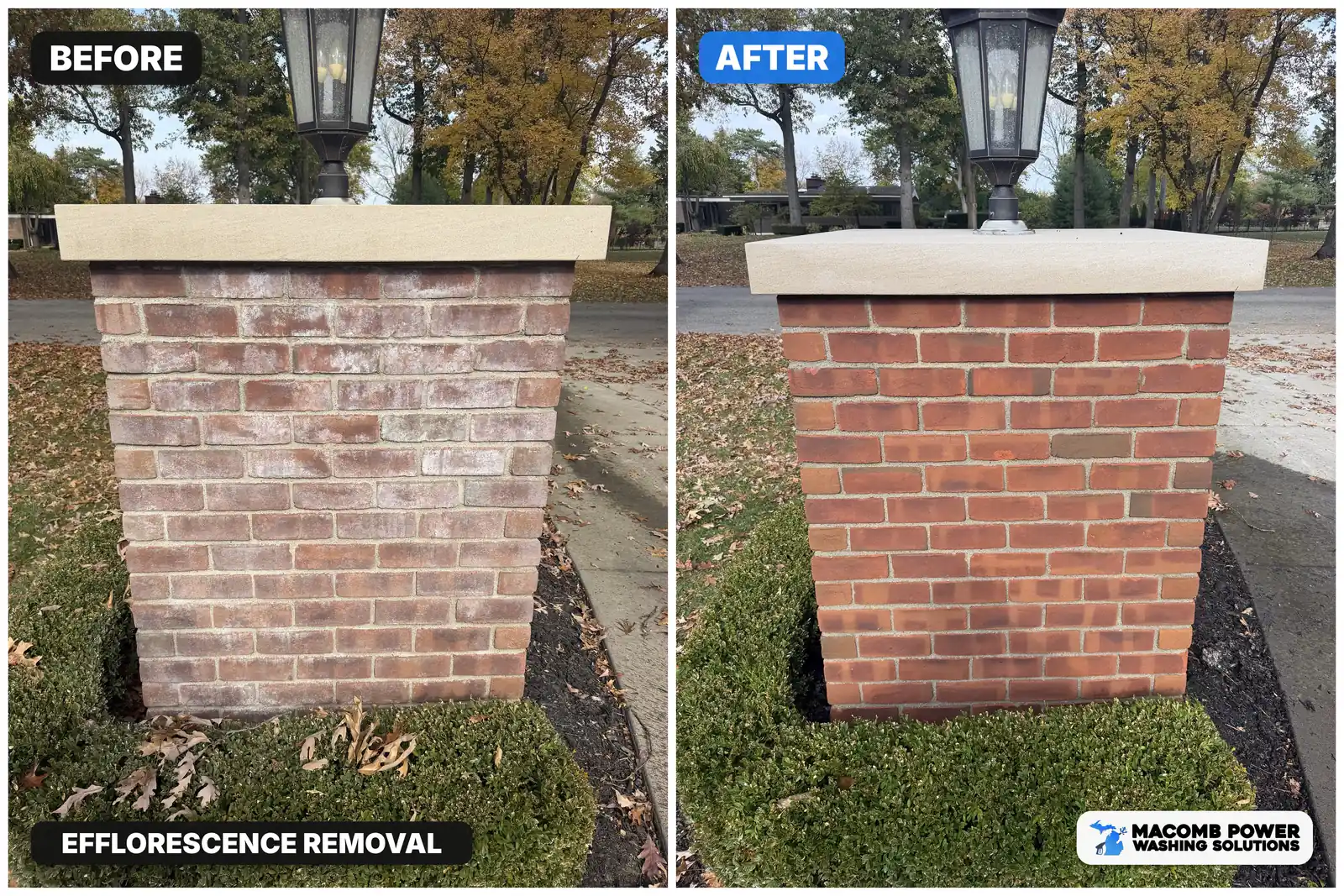
The white crust on brick that won't wash off is usually one of two deposits the Brick Industry Association (BIA) says people mistake for efflorescence: lime run and white scum. Efflorescence is a powdery bloom of water-soluble salts that dissolves in water and brushes off a dry wall. Lime run and white scum are insoluble in water, so rain, a garden hose and a scrub brush leave them where they are.
A two-step test sorts them at home. Brush a dry patch with a stiff nylon brush, then wet it and scrub again. Efflorescence fades under the brush, while a hard crust or gray-white film that survives both steps is one of the insoluble deposits. BIA recommends having an uncertain stain confirmed by experienced brick professionals, or by a lab, because the wrong cleaner can leave a second stain.
How is lime run different from efflorescence and sprinkler scale?
Lime run differs from efflorescence and sprinkler scale in its shape, its location and what removes it. Lime run builds as a white or gray crusty formation that starts at a weep hole or a fine crack between brick and mortar and runs down the face in a streak. Efflorescence spreads as a powder over faces or joints. Sprinkler scale follows the arc of an irrigation head. White scum, the fourth white deposit, covers brick faces as an even or patchy haze after acid cleaning.
| White deposit | What it looks like | Where it shows | Dissolves in plain water? |
|---|---|---|---|
| Efflorescence | Powdery white crystals | Faces or joints wherever water leaves the wall | Yes |
| Sprinkler scale | Chalky haze or drip lines | Inside the spray pattern of an irrigation head | No, it needs a mineral scale cleaner |
| Lime run | Hard white or gray crust in a downward streak | Below weep holes and fine cracks | No, once it has hardened |
| White scum | White or gray haze, overall or in irregular patches | Brick cleaned with acid, often beside trim, precast concrete or large glass | No |
Where does lime run come from, and why does it keep growing?
Lime run comes from calcium compounds in cement-bearing materials, such as mortar, concrete backing and masonry trim, dissolved by a large volume of water moving through the wall. The water carries the calcium out through the easiest opening, usually a weep hole or a hairline crack. At the surface the dissolved calcium reacts with carbon dioxide in the air and hardens into calcium carbonate, the main mineral in limestone.
Lime run keeps growing because the water keeps using the same path. BIA compares the pattern to stalactites forming in a limestone cave, with each wet spell adding a layer to the crust already there. Its guidance is that once lime run begins, it is likely to continue until the water source is stopped. The name misleads, too: the deposit is not a direct result of the lime in the mortar, and BIA notes that hydrated lime can help reduce the risk.
Cement is part of the wall itself, so the calcium source often cannot be removed. The water is the part an owner can control, and BIA says lime run is reduced by eliminating excess water or disrupting its path.
What is white scum, and how does acid cleaning cause it?
White scum is a silicate deposit that forms when brick is cleaned with unbuffered hydrofluoric acid, hydrochloric (muriatic) acid or another improper acidic cleaner. The acid dissolves parts of the brick and mortar, which then settle on the face as an insoluble white or gray film. BIA notes that white scum can also form with some acidic solutions when too little water is used to prewet the wall or to rinse it afterward.
White scum usually follows a cleaning job aimed at something else, such as mortar smears or sprinkler rust. A dry wall soaks up the cleaner, so the reaction happens in the surface instead of on it. BIA's cleaning note calls for saturating the wall and the brick below before any cleaner goes on, flushing with large amounts of clean water, and checking that the runoff and the wall return to a neutral pH of 6.5 to 7.5, then checking the dry wall again 48 hours later.
How are lime run and white scum removed safely?
Lime run and white scum are removed with proprietary masonry cleaners made for each deposit, tested on a hidden area before the visible wall. BIA lists lime run among the stains proprietary cleaners remove, and prefers those products over site-mixed or homemade solutions because they are generally safer, easier to control and more consistent. For white scum, BIA calls for specialty cleaning solutions recommended by the manufacturer.
Calcium carbonate dissolves in acid rather than water, which is what draws people to a jug of muriatic acid. BIA's guidance is to keep unbuffered muriatic and hydrofluoric acid off brickwork entirely, because high-strength acid tends to cause further stains and damage mortar joints. On a wall with lime run, raw acid can leave white scum beside the crust it was meant to remove. The safer order of work looks like this:
- Find the water source and stop it, so the deposit stops growing.
- Confirm which deposit it is, with a lab test if the answer is unclear.
- Choose a cleaner labeled for that deposit and suited to the brick color.
- Trial clean a hidden area of about 20 square feet and let it dry before judging the result.
- Saturate the area and the brick below with water, apply the cleaner by the label, never let it dry on the wall, and rinse thoroughly at low pressure.
- Wear the protection the label lists, at minimum chemical-resistant gloves and eye protection.
Why doesn't pressure washing remove these deposits?
Pressure washing doesn't remove lime run or white scum because both deposits are insoluble in water, and adding force to water does not change what it dissolves. Water takes efflorescence into solution. It does not dissolve hardened calcium carbonate or a silicate film, so any change that pressure makes comes from abrasion, and abrasion works on the brick and mortar around the deposit as much as on the deposit.
BIA sets the limits for pressurized water on brick: a 25 to 50 degree fan tip held at least 12 inches from the face, and no more than 400 psi at the nozzle unless the brick manufacturer permits it. It describes pressure above 800 psi as not appropriate for brick. Our guide to how pressure washing damages brick covers what happens to joints and faces past those limits. Water forced into weep holes and cracks also adds to the moisture that lime run needs.
How do you stop the water that feeds lime run?
The water that feeds lime run is stopped by finding where water enters the wall above the deposit and closing that path. Lime run at a weep hole means water is moving through the cavity behind the brick and picking up calcium on the way out. A streak from a crack under a window points to the sill, the flashing or the joints above it. Common sources on a house are gutters spilling over the edge, downspouts emptying at the foundation, failed caulk or flashing around windows, open joints at caps and chimneys, and sprinklers aimed at the wall.
Gutters are a sensible first check, because clean gutters carry roof water to the downspouts instead of over the edge and down the brick. Macomb Power Washing Solutions prices gutter cleaning starting at $149, and when a run spills because it has sagged or lost its pitch, we can rehang it. Flashing, sill and cavity repairs belong to a mason or roofer. Keep weep holes open while that work is done, since they exist to let water out of the wall, and a cleaned wall with its water source fixed has a far better chance of staying clean.
Why does lime run show up on Michigan brick after wet winters and springs?
Lime run shows up on Michigan brick after wet winters and springs because those seasons supply the large, repeated volumes of water the deposit needs. Snowmelt, spring rain and gutters that freeze solid or overflow can soak the same stretch of brick again and again. Ice dams at the eaves can also send meltwater over the gutter and down the face of the wall.
On older brick houses, caulk, flashing and sill joints that have opened up over the decades give that water more ways into the wall. Freeze-thaw cycles add a second problem, since a wall that stays saturated into a freeze can spall brick faces and crack joints, which opens new paths for water. Cleaning itself waits for the frost-free months, for the cold-weather reasons set out in our guide to green and yellow stains on tan brick.
A house washing visit, from $349 with Macomb Power Washing Solutions, removes the algae and dirt film on brick. Lime run and white scum are separate, deposit-specific jobs, so name them when you ask for a quote.
Sources
Want This Handled Properly?
Macomb Power Washing Solutions holds a 4.9-star rating across 177+ Google reviews, and free estimates go out within 24 hours. We carry $2M general liability plus workers' compensation.