
The short answer
Clean limestone sills and trim with water, mild clear detergent and a soft bristle brush, then a pH-neutral stone cleaner if needed. Never use acid, bleach or wire brushes. If pressure is needed, the National Park Service starts at 100 psi or below on older masonry; Polycor's 1,200 psi limit is a ceiling for sound, newer stone.
How do you clean limestone sills and trim without damaging them?
Limestone sills and trim are cleaned without damage by starting with the gentlest method and stepping up only when it fails. The Limestone Care and Maintenance Guide from Polycor, a natural stone company, starts with a mild, clear detergent in water, a soft bristle brush and a clean-water rinse. Stubborn soiling moves up to an approved stone cleaner or a pH-neutral cleaner made for limestone. The same guide rules out wire brushes, acidic cleaners, bleach, paint remover and concrete cleaners of any kind.
- Wet the sill and the brick below it with clean water.
- Scrub with mild clear detergent and a soft fiber brush.
- Rinse with clean water until no suds remain.
- For stubborn soiling, use a pH-neutral cleaner labeled for limestone, tested on a hidden spot first.
- Use a pressure washer only for old, heavy buildup, and keep it inside the limits in the table below.
For outdoor limestone, Polycor's guide recommends hosing the stone down with clean water at periodic intervals, about once a year depending on conditions, so dirt does not build up to the point of needing more.
Why is limestone easier to damage than the brick around it?
Limestone is easier to damage than the brick around it because it is acid-sensitive and softer. Limestone is mostly calcium carbonate, which acid dissolves. The National Park Service (NPS) warns in Preservation Brief 1 that acidic cleaners can be extremely damaging to acid-sensitive stones such as limestone and marble, causing etching and dissolution. NPS lists unglazed brick, cast stone and concrete among the materials that are not acid-sensitive, which is why acid-based cleaners are sold for brick.
Pressure is the second risk. NPS notes that water at too high a pressure is very abrasive and can easily etch marble and other soft stones, and it shows a limestone facade marred by high-pressure washing held too close. A sill also sits flat or nearly flat, so a stream aimed down at it hits the surface square on. For the brick and mortar on the same wall, see our guide to pressure damage on brick and mortar.
What water pressure is safe on limestone trim?
Safe water pressure on limestone trim is the lowest pressure that removes the soiling, and the published ceilings differ by source. Polycor allows up to 1,200 psi from a 45-degree fan nozzle held no closer than 12 inches. NPS, writing about historic masonry, recommends beginning at 100 psi or below, even with a garden hose, and going generally no higher than 300 to 400 psi.
| Source | Where to start | Upper limit | Nozzle and distance |
|---|---|---|---|
| Polycor Limestone Care and Maintenance Guide | Detergent and soft brush first | 1,200 psi | 45-degree fan, at least 12 inches |
| NPS Preservation Brief 1 (historic masonry) | 100 psi or below, even a garden hose | Generally 300 to 400 psi | Natural or synthetic bristle brushes, never metal |
| BIA Technical Note 20 (brick, for comparison) | Under 100 psi to prewet | 400 psi, measured at the nozzle, unless the brick maker allows more | 25 to 50 degree fan, at least 12 inches |
The two limestone figures answer different questions. Polycor's ceiling is written for its own stone with long-built-up dirt, while NPS is guarding weathered historic masonry. On a sill that is decades old, pitted or crumbling at the surface, the NPS range is the safer one, and Polycor itself notes that even high-pressure water can cause damage. Polycor's separate hardscapes version of the guide allows the tip as close as 6 inches; the 12 inches here comes from its main limestone guide.
Which cleaners should never touch limestone?
The cleaners that should never touch limestone are acids, bleach, paint removers and concrete cleaners, the products Polycor's care guide rules out. That list catches many products sold for brick and concrete, because BIA notes that many proprietary masonry cleaners contain acid. Muriatic acid, rust removers, efflorescence removers and mortar-haze cleaners are all worth checking on the label before they go anywhere near a sill.
NPS points to alkaline cleaners as the chemical option for acid-sensitive masonry such as limestone, applied to prewet stone, left to dwell and rinsed off, with extra steps that a crew should follow from the product instructions. Polycor advises keeping limestone away from metals prone to staining, such as iron, copper and bronze, and says efflorescence on new limestone should be brushed or blown off without water. If a white residue will not wash off limestone, Polycor's advice is to apply no chemicals to the stone.
How do you protect limestone when the brick beside it is cleaned with acid or soft wash?
Limestone is protected during brick cleaning by masking it and keeping the brick cleaner off it. BIA's Technical Note 20 tells crews to mask or otherwise protect limestone, cast stone, concrete masonry and ornamental trim before cleaning brick, and warns that acid solutions can stain trim materials such as limestone and cast stone. Cast stone is less acid-sensitive than limestone by the NPS list, but BIA still includes it among the materials acid can stain. Acid on light brick nearby carries its own risk, covered in our guide to green and yellow stains on tan brick.
A soft wash needs the same thought. Soft washing uses a sodium hypochlorite solution to kill algae on siding and brick, and Polycor rules out bleach on limestone. It follows that a soft-wash mix should be kept off limestone sills and trim, or rinsed off them thoroughly with clean water where overspray reaches them. Tell whoever washes your house where the limestone and cast stone are before the work starts, and read our soft washing page for how the method works on the rest of the house.
What are the black streaks on limestone sills, and how do they come off?
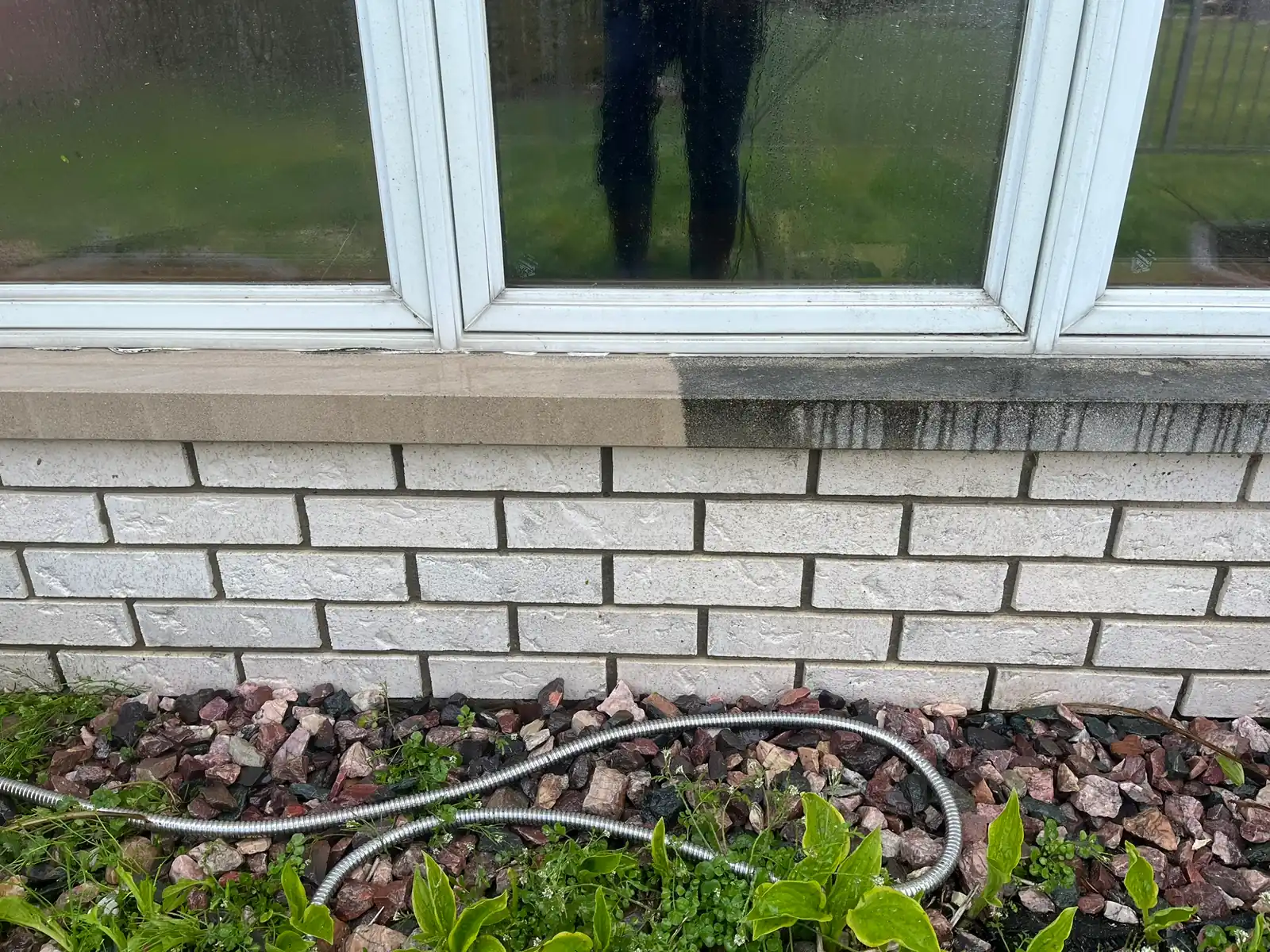
Black streaks on limestone sills are usually soiling or biological growth that follows the path of water across the stone. In BIA's stain guide, biological growth favors north-facing facades and frequently wetted areas such as parapet caps and the masonry under window sills. Polycor describes algae on limestone as looking like an accumulation of dirt affected by water flowing over the surface. NPS adds that soot and sulfate or gypsum crusts form in sheltered areas that rain does not regularly wash.
| Streak | Where it forms | Gentle removal from the sources |
|---|---|---|
| Algae or biological growth | Damp, shaded, north-facing sills and drip lines | Diluted hydrogen peroxide, 1/2 cup per gallon of water, or scrubbing the wetted stone with a soft brush (Polycor) |
| Soot or sulfate crusts | Sheltered areas rain does not reach | Prolonged water soaking or misting, or low-pressure steam (NPS) |
| Metal runoff | Below copper, bronze or rusting iron | Remove the source, after which sun and rain clear most stains (Polycor); NPS shows a poultice lifting bronze runoff from a limestone base |
NPS cautions that some gypsum crusts have become integral with the stone, and that when cleaning would remove some of the stone surface it may be better not to clean. Test any method on a small, inconspicuous area first.
When in the Michigan year should masonry be water cleaned?
Masonry in Michigan should be water cleaned between late spring and early fall, finishing well before the first frost. NPS says a masonry wall may take over a week to dry after cleaning, so no water cleaning should be done for several days before the average first frost date, or earlier if forecasts call for cold. Water left inside the stone can freeze, causing spalling and cracking. The National Weather Service office for Detroit/Pontiac maps the median first 32°F freeze across most of Southeast Michigan between October 11 and 20 (1981 to 2010 data), so water cleaning of limestone is best finished by early October. Chemical cleaners need warmer days still. NPS says chemical cleaning should never be done below 40°F and generally not below 50°F, because many chemical cleaners do not work in the cold, and BIA likewise finds them more effective at 50°F or above. Paint and graffiti removers have cold limits of their own, covered in our graffiti removal guide.
Shaded, north-facing sills dry slowest after rain, so they tend to carry the heaviest algae into the cleaning season. Water quality matters too. NPS notes that iron and copper in a water supply can discolor light masonry, and that adding a chelating agent such as EDTA helps prevent it. If the house runs on a private well, where iron causes the orange stains in our sprinkler rust guide, that is worth asking about.
How does cleaning limestone compare with cleaning brick?
Cleaning limestone differs from cleaning brick mainly in acid tolerance, pressure and the cleaners allowed. The table sets the published guidance side by side.
| Factor | Limestone trim | Brick wall |
|---|---|---|
| Acid | Acid-sensitive; acid etches and dissolves it (NPS) | Unglazed brick is not acid-sensitive (NPS), but unbuffered muriatic acid is still ruled out (BIA) |
| Bleach | Ruled out (Polycor) | Listed for organic growth (BIA) |
| Pressure | Up to 1,200 psi (Polycor); start at 100 psi or below (NPS) | Up to 400 psi measured at the tip, more only with the maker's approval (BIA) |
| Brushes | Soft fiber, never wire | Stiff fiber, never metal |
A house with both materials needs two methods on one wall, which is the same idea behind our guide to washing a house built before 1930. House washing with Macomb Power Washing Solutions begins at $349. Mention limestone or cast-stone trim in the quote request so the written quote accounts for it.
Sources
- Polycor, Limestone Care and Maintenance Guide
- National Park Service, Preservation Brief 1: Cleaning and Water-Repellent Treatments for Historic Masonry Buildings
- Brick Industry Association, Technical Note 20: Cleaning Brickwork
- Brick Industry Association, Technical Note 23: Stains, Identification and Prevention
- National Weather Service Detroit/Pontiac, Average Dates for First Fall Freeze in Southeast Michigan
Want This Handled Properly?
Macomb Power Washing Solutions holds a 4.9-star rating across 177+ Google reviews, and free estimates go out within 24 hours. We carry $2M general liability plus workers' compensation.