
The short answer
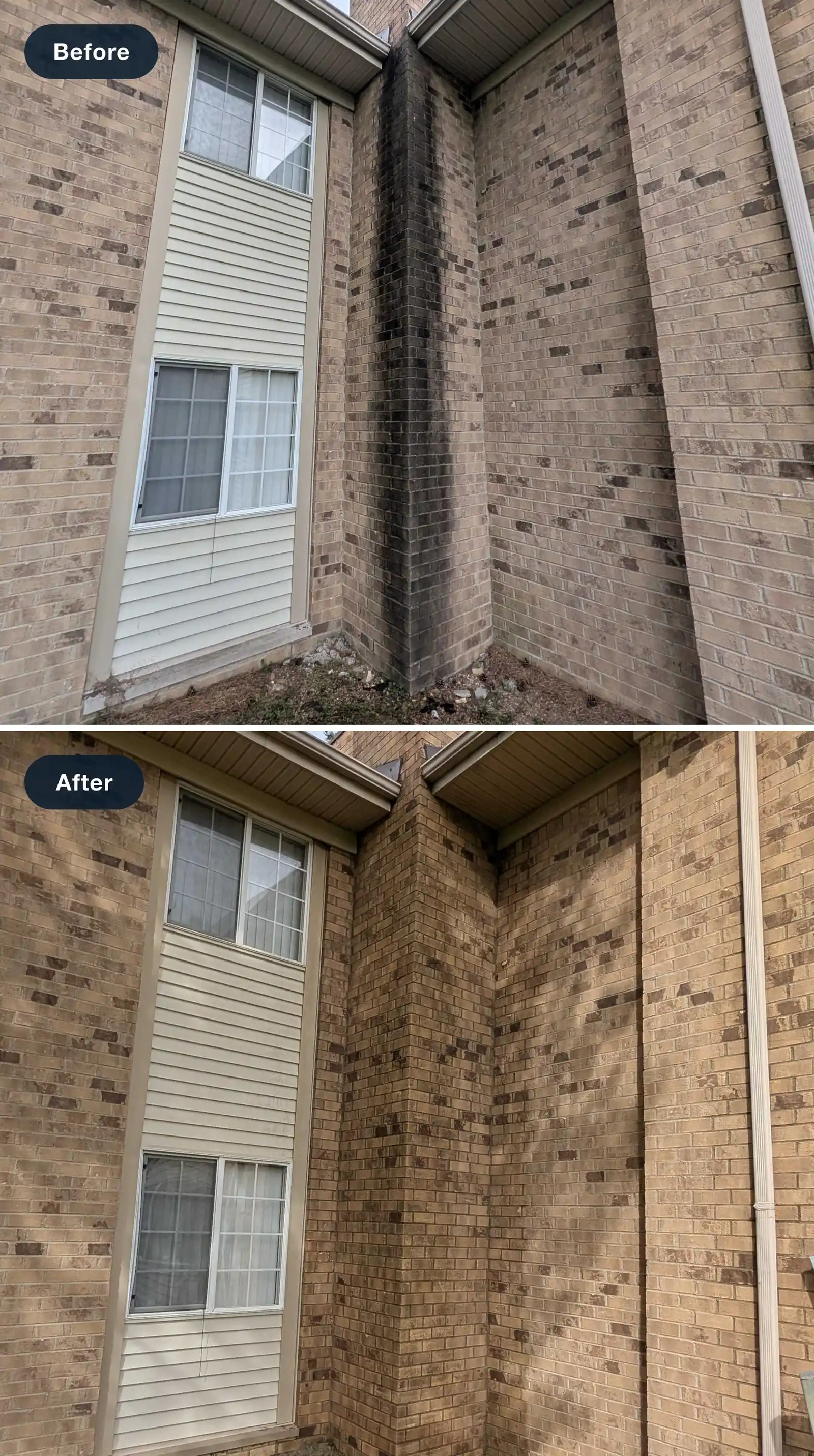
A fuzzy green film on a shaded wall is usually algae. Yellow, green or purple stains in the face of tan, buff or white brick, often after an acid wash or on new brick, are vanadium salts, and brown mortar joints point to manganese. Macomb Power Washing Solutions advises identifying the stain first, because the wrong cleaner can worsen it.
What causes green, yellow or brown stains on light-colored brick?
Green, yellow or brown stains on light-colored brick are usually caused by acid reacting with metals that are part of the brick itself. The Brick Industry Association (BIA) describes two in Technical Note 23: vanadium stains, which are yellow, green or purple salts on tan, buff or white brick, and manganese stains, which are tan, brown or gray deposits on the mortar joints of tan, brown, black or gray brick. Both usually form when an acidic solution reaches the brick, most often an unbuffered hydrofluoric or hydrochloric (muriatic) acid cleaner, and sometimes acid rain. TN 23 adds that vanadium chloride salts can also form from exposure to excessive moisture, so new light brick can stain without any acid wash.
Meridian Brick, a brick manufacturer, names improper cleaning chemicals or methods as the most common cause of vanadium staining. That is why these stains so often appear days after someone acid-washed a wall to remove mortar haze, rust or a stain they could not identify. A green wall on the shaded north side with no recent cleaning is a different problem, covered in the comparison below.
What are vanadium stains, and why do they appear after cleaning?
Vanadium stains are crystallized vanadium salts, mostly sulfates and chlorides, deposited on the faces of light-colored brick. Meridian Brick explains that many white and buff clays contain traces of vanadium, which is freed from the clay as the brick is fired. An acidic solution dissolves those salts, carries them to the surface and leaves them behind as the wall dries, much the way water carries the salts that form efflorescence. BIA notes the vanadium solution itself can be quite acidic.
Vanadium stains appear after cleaning because the cleaning is what delivered the acid. BIA's Technical Note 20 lists the usual mistakes: unbuffered acid, overly strong mixes, and failing to saturate the wall with water before and after the cleaner. A dry brick soaks up acid instead of letting it work on the surface. BIA also warns that improper attempts to remove vanadium can leave a brown, insoluble deposit that is even harder to remove than the green or yellow stain.
What are manganese stains on mortar joints and brick faces?
Manganese stains are tan, brown or occasionally gray stains on mortar joints, sometimes spreading onto brick faces, caused by acid reacting with the manganese oxide used to color tan, brown, black or gray brick. Firing leaves the manganese in compounds that do not dissolve in water but do dissolve to varying degrees in weak acids. Once dissolved, the manganese salts migrate toward the surface.
The stain lands on the joints because of the mortar. When the manganese solution reaches a joint, the cement or lime in the mortar neutralizes it and forms manganese hydroxide, which dries to brown manganese tetroxide, according to BIA. Meridian Brick calls the same problem manganese bleed and ties it to strong acidic cleaners or to skipping the prewet before cleaning.
How can you tell these stains from algae, rust or efflorescence?
Vanadium and manganese stains can be told from algae, rust and efflorescence by their color, by where they sit on the wall and by whether the wall was cleaned with acid shortly before they appeared. BIA notes that biological growth concentrates on north-facing walls and wet spots such as under window sills, the pattern explained in our guide to why north walls stay green. Iron stains follow sprinkler arcs, as covered in our sprinkler rust and hard water guide.
| Stain | Color | Where it shows | Usual trigger |
|---|---|---|---|
| Vanadium | Yellow, green or purple | Faces of tan, buff or white brick | Acid cleaning, acid rain or excess moisture |
| Manganese | Tan, brown or gray | Mortar joints, sometimes brick faces | Acid on manganese-colored brick |
| Algae or mildew | Green or black film | North walls, under sills and caps | Shade and dampness |
| Iron (rust) | Orange to red-brown | Sprinkler arcs, below metal | Iron in water or corroding steel |
| Efflorescence | White powder | Wherever water leaves the wall | Moisture carrying soluble salts |
BIA says some stains are often misidentified and recommends having an uncertain stain verified by experienced brick professionals, or sampled and lab tested, before choosing a cleaner. A white deposit that will not wash off is a different family of problems, covered in our guide to white crust on brick.
How are vanadium stains removed without making them worse?
Vanadium stains are removed with a proprietary cleaner made for vanadium or with one of three alternatives BIA lists, tested on a small hidden area first. BIA favors those proprietary products over homemade mixes for safety, control and consistency. The alternatives in BIA's Technical Note 20 are below, with the amounts exactly as published.
| Treatment | Mix | How it is used |
|---|---|---|
| Sodium hypochlorite (household bleach) | Household bleach, for mild stains; BIA gives no dilution | Spray or brush on, rinse once the stain disappears |
| Potassium or sodium hydroxide | 0.5 lb hydroxide per 1 qt of water | Leave on two or three days, wash off, hose away any white residue |
| Oxalic acid | 3 to 6 oz per 1 gal of water, preferably warm | Follow with a neutralizing wash of 15 oz washing soda (sodium carbonate) per 1 gal of water |
The neutralizing wash is not optional. BIA warns that oxalic acid applied without it can cause more severe staining. Each of these chemicals needs care. Sodium and potassium hydroxide are caustic and cause chemical burns, so wear splash goggles, chemical-resistant gloves and long sleeves, and keep the solution off glass, aluminum and plants. Oxalic acid is toxic if swallowed. Never mix bleach with acids or ammonia. Meridian Brick adds one more rule: if staining appears after cleaning, do not reclean with the same product, and test any new procedure on a sample area first.
How are manganese stains removed?
Manganese stains are removed with a proprietary cleaner made for manganese or, for new and mild stains, with one of two alternatives in BIA's Technical Note 20. The first is oxalic acid crystals mixed at 1 lb per 1 gal of water. BIA says the same washing-soda neutralizer used for vanadium should be considered when oxalic acid goes on brown or light-colored brick. The second is a solution of equal parts white vinegar, 3 percent hydrogen peroxide and distilled water.
BIA is firm that unbuffered hydrofluoric or muriatic acid must not be used on tan, brown, black or gray brick, since that is the reaction that created the stain. Test the chosen cleaner on a small stained area first, wear gloves and eye protection, and let the test area dry fully before judging it, because wet brick reads darker than dry brick.
Why does acid cleaning in cold weather raise the risk?
Acid cleaning in cold weather raises the risk because chemical cleaners react slowly below about 50°F and the wall stays wet longer, as our limestone sills guide explains with the National Park Service temperature limits.
A cleaner that seems to do nothing invites a stronger mix, a longer dwell or a second pass, and each of those puts more acid into light brick. Cold walls also dry slowly, and BIA warns that cleaning in freezing weather can harm masonry and raise the risk of efflorescence. In Michigan, where outdoor work stretches into cool spring and fall weeks, a cleaning job scheduled for a 45°F morning is already below the 50°F at which BIA says chemical cleaners work best.
How do you keep these stains from coming back?
Keeping vanadium and manganese stains from coming back starts with keeping strong acid off light and manganese-colored brick. Use cleaners labeled for sensitive brick, which Meridian Brick specifies for white, tan, buff, gray, pink and brown brick, and never use unbuffered muriatic acid. Saturate the wall before any cleaner goes on, keep the brick below wet, and rinse thoroughly. Meridian says flushing all of the cleaner from the wall is what prevents acid burn, manganese bleed and vanadium stains.
Any tan, buff, white or gray brick wall in Macomb or Oakland County can stain this way once an acid wash is tried on it, whatever the age of the house. The safer habit is removing the reason for the acid wash in the first place, such as re-aiming a sprinkler that rusts the wall or rinsing mortar smears while they are fresh.
Algae and dirt film on brick come off with a low-pressure house washing. Macomb Power Washing Solutions prices it from $349, with a written quote back within 24 hours of the request. Send a photo of any colored stain with the request so it can be identified before a cleaner is chosen.
Sources
- Brick Industry Association, Technical Note 23: Stains, Identification and Prevention
- Brick Industry Association, Technical Note 20: Cleaning Brickwork
- Meridian Brick, Cleaning Masonry (03.21)
- National Park Service, Preservation Brief 1: Cleaning and Water-Repellent Treatments for Historic Masonry Buildings
Want This Handled Properly?
Macomb Power Washing Solutions holds a 4.9-star rating across 177+ Google reviews, and free estimates go out within 24 hours. We carry $2M general liability plus workers' compensation.