
Brick Paver Restoration in Bloomfield Township
Paver patios and walks on Bloomfield Township's rolling, wooded lots lose their joint sand downhill, grow moss in the shade, and fade in the sun. Restoration cleans the pavers, refills the joints with polymeric sand, and seals the surface so the pattern stays tight.
Brick paver restoration in Bloomfield Township starts at $399, with no travel fee and a written, line-by-line quote within 24 hours.
| Service | Brick Paver Restoration |
|---|---|
| Area | Bloomfield Township, Oakland County, Michigan |
| Starting price | From $399 |
| Travel fee | None |
| Written quote | Within 24 hours |
| Call or text | (586) 284-3810 |
The ground here rolls, and many lots slope toward Wing Lake, Gilbert Lake and the belt of smaller lakes. Rain moving across a paver patio or walk on a grade carries joint sand with it, starting at the downhill edge. Once the joints open, weeds and moss root in them, water gets under the pavers, and the base shifts until bricks rock and settle. Downspouts that empty onto a patio speed the washout, so the walkaround notes where each one lands. Cleaning alone makes this worse, because a wash flushes out even more sand. That is why restoration on a sloped lot always includes refilling the joints.
Shade adds its own layer. Under the oak and maple cover along Franklin Rd and Long Lake Rd, pavers stay damp and grow green film, moss in the joints and black lichen spots. On a patio facing Square Lake or Gilbert Lake, morning dew off the water keeps the joints damp even in a dry week, and that is where moss starts first. Sun-facing pavers fade instead. Brick and concrete pavers can also show a white haze called efflorescence, salts drawn up from the base as water evaporates, which our note on white haze on brick explains. Each problem takes its own product, and the walkaround sorts them before any work starts.
Iron from irrigation shows on pavers too, where sprinklers on well water leave orange bands along patio edges and walks. A rust remover lifts it before sealing, since sealer would lock it in. Pavers that rock underfoot are reset before any of this, because sand cannot hold a loose brick in place. Once the pavers are clean, the joints are refilled with polymeric sand, compacted, and set with a light mist, and a sealer goes on to hold color and slow new growth. Our guide to restoring faded brick pavers shows the full sequence. Paver restoration starts at $399.
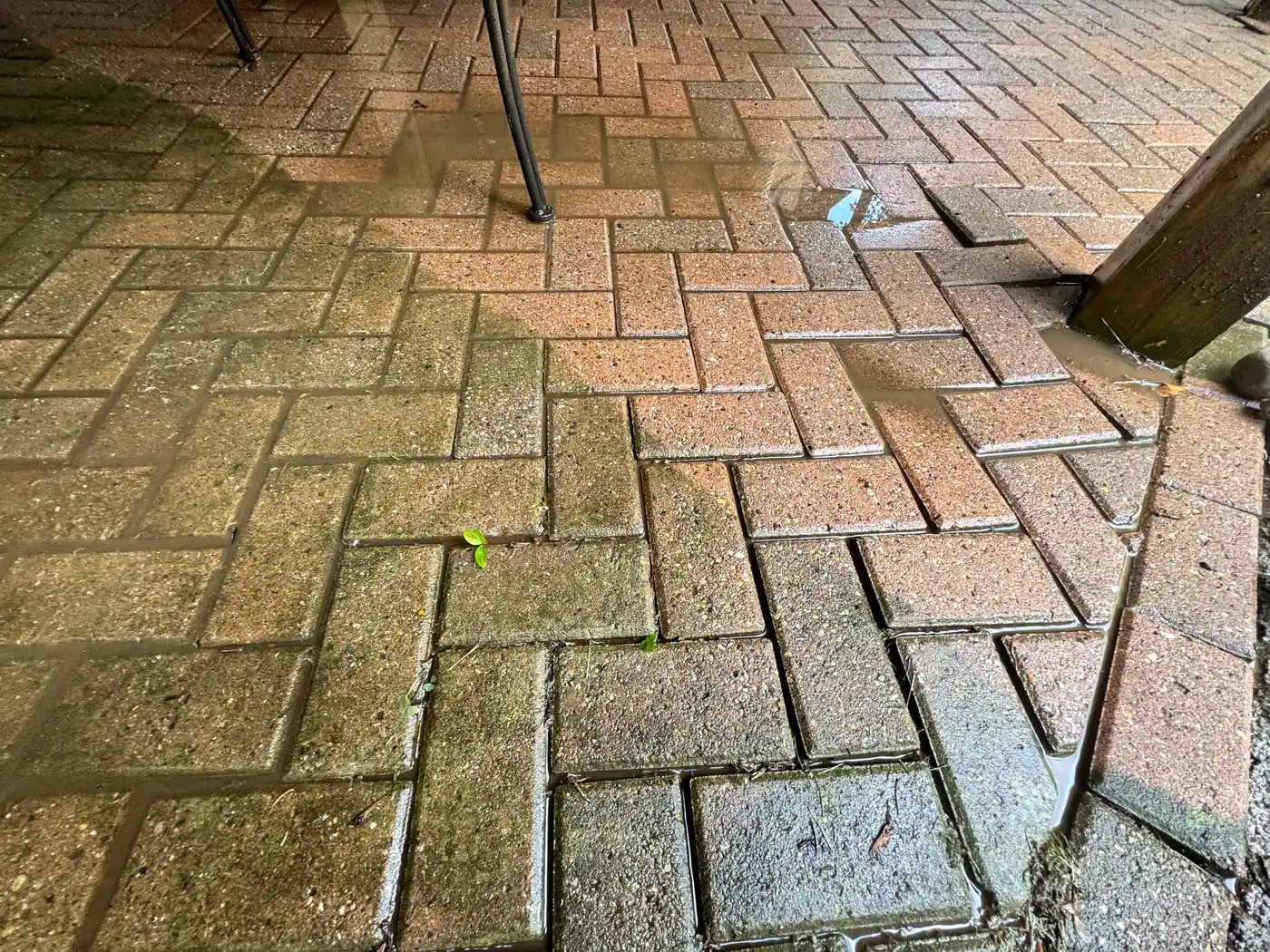
Clean, Re-Sand, Seal
The patio and walks are checked first for settled or rocking pavers, which should be reset before restoration. Organic growth, lichen spots and efflorescence each get their pre-treatment. A surface cleaner then cleans the pavers and flushes out the old, dirty joint sand. After the pavers dry completely, each joint is filled with polymeric sand, which a plate compactor settles to full depth before a top-up and a light mist to set it. Sealer follows once the sand has cured. Sloped sections get extra passes at the downhill edge, where washout starts.
How Paver Work Goes Wrong
Washing without re-sanding is the classic mistake. The pavers look bright for a week, then weeds and ants move into the empty joints and the edges start to shift. Polymeric sand swept onto damp pavers sets as a hazy film on the surface that is hard to remove. Too much water when setting the sand washes the binder out and leaves soft joints. And sealing over efflorescence or rust traps both under the finish for years.
When to Book Brick Paver Restoration in Bloomfield Township
Restoration needs dry days on both sides: pavers must dry before sand goes in, and polymeric sand needs a dry stretch to set. Late spring, after the pollen has fallen, and early fall are the best windows. Lakeside patios are best done before summer starts, so they are set and sealed before the season of heavy use. Avoid booking a week with rain in the forecast.
Price Brick Paver Restoration for Your Bloomfield Township Home
Pick your property size and condition for a real range in about twenty seconds — bundle other services to watch the visit price drop.
1 · What do you need?
2 · Home size
3 · Condition
Brick Paver Restoration in Bloomfield Township: FAQs
Our patio slopes toward the lake and the joints keep emptying. Can that be fixed?
Usually, yes. Polymeric sand compacted to full depth binds together when it sets and holds far better on a slope than loose sand, and sealing on top slows washout further. If pavers at the downhill edge have already settled, they need to be lifted and reset first. On patios facing Wing Lake or the Square Lake shoreline, check that downspouts are not emptying across the pavers.
What is the white haze on our brick pavers?
It is efflorescence, salt carried up from the base and left behind as water evaporates. It is not mold, so algae chemistry does little. A cleaner made for efflorescence dissolves it, and on newer pavers it often fades over the first few seasons. Sealing too soon traps it, so we clear it and let the surface dry before any sealer goes on.
Is sealing pavers worth it on a shaded lot?
On shaded, sloped lots it usually is. Sealer helps the joint sand resist washout, makes moss and lichen slower to return under the trees, and slows fading on the sunny sections. It needs renewing every three to five years. On a flat, sunny walk with tight joints, the case is weaker, and the quote will say so.
How much does paver restoration cost?
It starts at $399 for a typical patio and scales with square footage and condition. Resetting settled pavers, if needed, is quoted as a separate line. A patio and its walks on the same visit share one setup. The written quote arrives within 24 hours, and there is no travel fee for the 32-minute drive from our Clinton Township shop.
More in Bloomfield Township
Brick Paver Restoration in Nearby Towns
Book Brick Paver Restoration in Bloomfield Township
Request a free, no-pressure estimate today. Most quotes are delivered within 24 hours, and every job is backed by our satisfaction guarantee.
Get My Free Estimate or call (586) 284-3810 — Mon–Sat, 8am–10pm