
The short answer
Not over the salts themselves. Paint goes on only after the efflorescence is removed, the water feeding it is stopped and the masonry has dried completely. Paint laid over the deposits can lose adhesion as they keep growing, and a coating that slows drying can trap salts just under the surface, where crystal pressure can spall brick.
Can you paint over efflorescence?
You can paint masonry that has had efflorescence, but you should not paint over efflorescence itself, or over a wall that is still producing it. The bloom is a layer of salt crystals (our efflorescence explainer covers how it forms), so paint laid over it sits on loose crystals instead of the masonry, while the water that delivered them is still on the move.
The paint makers' own guides put the paint at the end of the job. Where excess moisture is the cause, Sherwin-Williams starts by eliminating the source, such as repairing the roof or cleaning out gutters and downspouts, and its last step reads: "Painting should be delayed if efflorescence continues." The order is: stop the water, remove the salts, rinse, let the masonry dry completely, confirm the bloom is not coming back, then prime and paint.
What happens to paint laid over salts?
Two things can go wrong, one you can see and one you can't. The visible one is adhesion. Dunn-Edwards' technical bulletin on efflorescence says the deposits "can grow and will cause adhesion problems if not properly removed before repainting," and that in most cases the salts reach a painted surface through cracks in the masonry. Its other possible contributing factors include failing to remove all previous salt deposits and painting masonry before it is fully cured. Sherwin-Williams lists both too.
The hidden one happens when a coating slows the wall's drying. The Brick Industry Association (BIA) explains in Technical Note 23A that water and dissolved salts moving toward a coated face may stop at the inner margin of the coating, usually 1/8 to 1/4 in. (3 to 6 mm) below the surface. The water leaves as vapor and the salts stay inside the masonry. BIA calls this cryptoflorescence or subflorescence, and says the crystallizing salts "can develop tremendous pressures which may result in brick spalling." Less white may show on the face, which can pass for a fix, while salt is deposited inside the masonry.
What has to happen before any paint or primer goes on?
- Stop the water. BIA's cleaning note, Technical Note 20, says moisture sources should be repaired and the brickwork allowed to dry before efflorescence is removed. BIA's troubleshooting list runs from sealant joints, flashing and blocked weeps to poorly aimed sprinklers and leaky pipes; our guide to why efflorescence keeps coming back walks through it.
- Remove the salts, dry first. Brush them off dry, add water only for what the brush leaves, and save a proprietary cleaner, used exactly as its maker directs, for heavy deposits, the order BIA's TN 20 sets out.
- Rinse thoroughly. BIA warns that cleaning solution not fully flushed off brick can leave a "white scum," which is one more layer for paint to sit on. For acid-cleaned concrete masonry that will be painted, the Concrete Masonry & Hardscapes Association (CMHA) calls in TEK 08-03A for a thorough flush with water and at least one month of weathering.
- Let it dry completely. That is Dunn-Edwards' wording. Our pre-painting wash guide treats several dry days as the starting point for masonry, and the primer's data sheet sets the moisture limit.
- Watch for a return. Dunn-Edwards says to repeat the cleaning if efflorescence still exists. BIA notes that efflorescence appearing more than a year after construction is often most severe in winter or periods of cold weather, so a few clean weeks in July prove less than a wall that stays clean through cold weather.
- Then prime and paint with the products, temperatures and recoat times the paint maker gives for masonry.
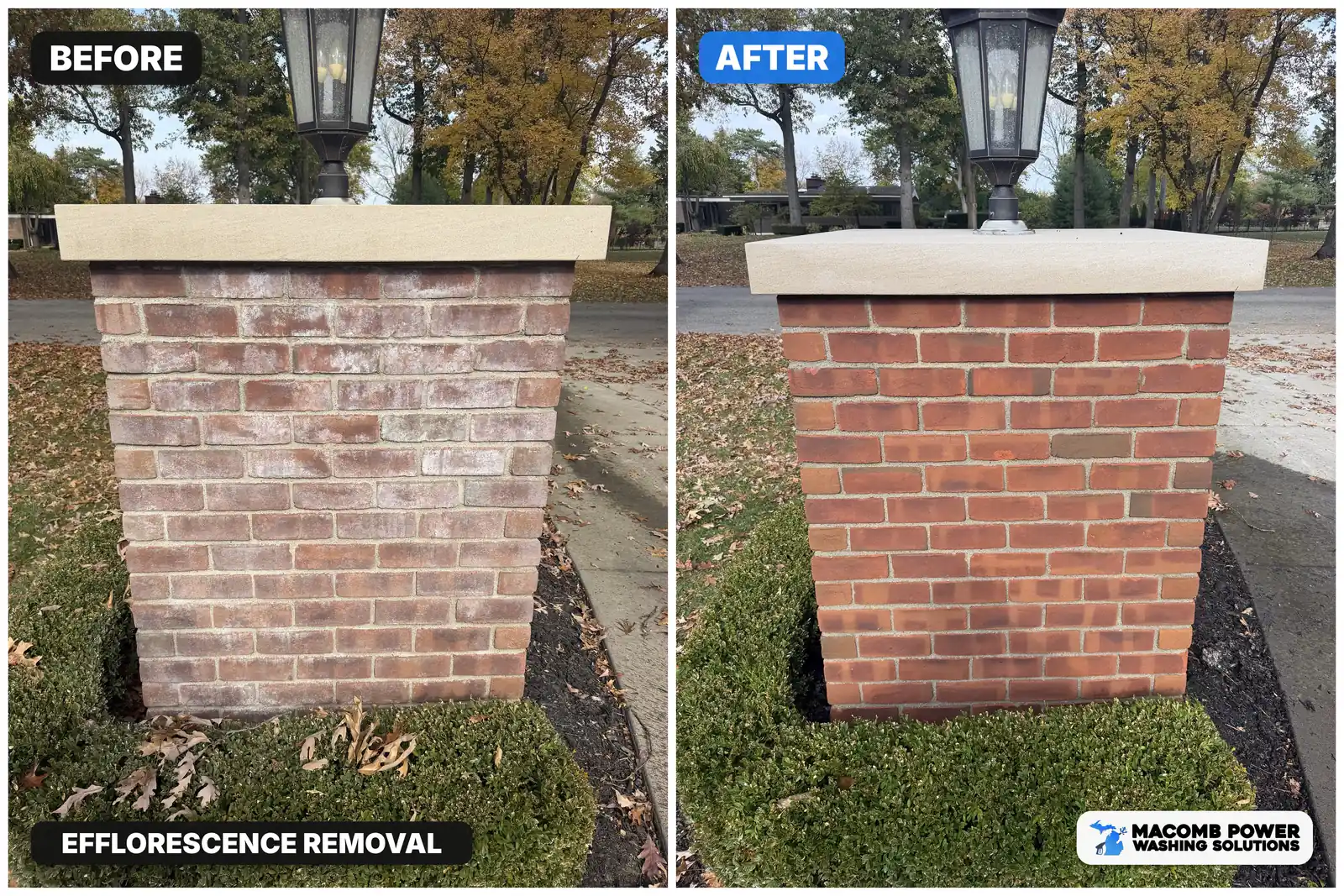
Where we fit: we clean efflorescence off brick and block as part of house washing, from $349, with rinse pressure on brick inside the BIA limit. We do not paint. The painter owns scraping, priming and coating, and the schedule needs a dry window between our visit and theirs.
Do anti-efflorescence primers and clear sealers stop it?
Paint makers sell masonry primers for this, and their own instructions put the primer after the cleanup. Dunn-Edwards reaches a primer "designed to hold back efflorescence" only after removal, an acid wash, rinsing, drying completely and repeating the cleaning if any efflorescence remains; the finish coat follows the primer. Sherwin-Williams' product list, below its moisture and removal steps, names Loxon Concrete & Masonry as the primer "if needed." The primer is the last layer of a fix, not a substitute for one.
Clear water repellents, silicone and acrylic coatings, which TN 23A says are often suggested for preventing efflorescence, run into the same limit. BIA says a coating may keep efflorescence from recurring by cutting the water an exposed surface absorbs, but putting one on brickwork that tends to effloresce, without stopping what causes it, may lead to degradation of the masonry, so coatings are not recommended as the sole treatment. CMHA gives concrete masonry the same caution: a clear coating on a wall prone to efflorescence, with the causes left in place, may lead to surface spalling of the units or deposits on the treatment. Whether a brick house should get a repellent at all is covered in should you seal the brick on your house; for patios, see whether sealing pavers is worth it.
Why do paint makers and brick guidance differ on prep?
Dunn-Edwards' bulletin covers concrete, brick, block, stucco and mortar together. Mild cases get dry brushing with a soft nylon or bristle brush. For salts that keep returning, it says to remove the efflorescence and loose material "with a wire brush, a power brush or power washer," then wash with one part phosphoric acid to seven parts water, adding the acid to the water and wearing goggles, rubber gloves, boots and protective clothing. Sherwin-Williams names a wire brush, power brush or low-pressure washing, a mild etching solution or muriatic acid if the surface is highly alkaline, and a waterproofing coating on the outside where moisture is driven through the wall.
The brick guidance is stricter. TN 20 says not to use metal brushes because they may damage mortar joints or cause further staining. CMHA says not to use a wire brush on concrete masonry either, since filings left behind could stain as the steel corrodes. TN 20 also rules out unbuffered muriatic acid on brick and caps pressurized water at 400 psi at the nozzle unless the brick maker permits more; it warns that high-pressure water cleaning can etch mortar joints and remove the outer surface of brick, resulting in permanent damage. As for a waterproofing coat, TN 23A warns that a coating that inhibits evaporation from the masonry may also lead to degradation.
On brick, take the cleaning method from the brick guidance and the coating from the paint maker: a stiff fiber brush, any washing done in warm, dry weather as TN 23A advises, pressure inside the BIA limit, and any cleaner tested on a small area first (our post on vinegar and muriatic acid covers the acid question).
What if efflorescence is already pushing through painted brick?
White salts at cracks or under lifting paint mean water is still moving through the wall behind the coating. Repainting over them repeats a cause both paint makers list: a surface not cleared of all previous salt deposits. The repair follows the same order:
- Find and fix the water source first.
- Remove loose and deteriorated paint with the salts, as Dunn-Edwards directs. That is painter's work, and on a house built before 1978, read the lead-paint section of our pre-painting guide before anyone scrapes.
- Clean gently. We soft wash painted brick, the way we treat siding, because pressure tears loose paint off in patches; our post on whether pressure washing damages brick explains.
- Let it dry, watch for a return, and clean again if salts reappear before any primer goes on.
If chips of brick face come away with the paint, salts may be crystallizing behind the coating, the spalling BIA describes. Have a mason look at the wall before anyone repaints it.
Sources
- Dunn-Edwards: Technical Bulletin, Efflorescence (PDF)
- Sherwin-Williams: How to Fix Efflorescence
- Brick Industry Association: Technical Note 23A, Efflorescence: Causes and Prevention (PDF)
- Brick Industry Association: Technical Note 20, Cleaning Brickwork (PDF)
- Concrete Masonry & Hardscapes Association: TEK 08-03A, Control and Removal of Efflorescence
Want This Handled Properly?
Macomb Power Washing Solutions holds a 4.9-star rating across 177+ Google reviews, and free estimates go out within 24 hours. We carry $2M general liability plus workers' compensation.