
The short answer
For Michigan's mix of maple seeds, oak catkins, pine needles and shingle grit, micro-mesh guards do the most: fine mesh that holds seeds, needles and grit on top while rain passes through. Screens and perforated aluminum shed large leaves but filter less fine debris; reverse-curve covers take heavy rain but can ice over; foam and brush inserts collect debris inside themselves. No type ends upkeep, stops ice dams or keeps a valley corner from overflowing in a downpour.
Judge Guards Against Michigan's Debris Mix
Leaves are the easy test. Michigan delivers a meaner mix: maple seeds whose wings slip through gaps, oak catkins that mat like felt, pine needles that thread anything coarse, shingle grit washing off every asphalt roof, and the autumn volume that buries everything. A guard that handles 'leaves' and fails the rest converts open-gutter cleaning into covered-gutter cleaning: same chore, worse access.
The Field, Ranked
Micro-mesh, a fine stainless steel or aluminum mesh on rails or a rigid frame, is the category that earns its price here: it holds seeds, needles and grit on top of the mesh while rain passes through. The trade-off is that pollen, oak tassels and seed pods collect on that surface, so it needs brushing (the limits section below covers how often). Mesh material, frame quality and installation vary from product to product.
Perforated aluminum covers shed large leaves and sticks, but their holes stop less fine debris than mesh. Gutterglove, which makes the all-aluminum LeafBlaster Pro cover we install, says it is built to carry more water and recommends it where water capacity matters more than fine-debris filtration. Screens in plastic, vinyl or steel handle leaf-heavy lots, and the plastic and vinyl ones cost less per foot than micro-mesh in Bob Vila's 2023 cost guide, but their larger openings let more needles and small seeds through.
Reverse-curve systems shed leaves and, per This Old House, work in heavy rain, but the same source says thin pine needles and small seeds can slip through and that ice dams in winter can lead to overflow. Foam and brush inserts sit down in the trough, where grit and organics collect inside them until the insert becomes the clog; This Old House adds that foam breaks down in sun and temperature swings and has to be replaced regularly.
Where the LeafBlaster Pro Versions Fit
We install LeafBlaster Pro gutter guards, made by Gutterglove, Inc. and sold only through professional contractors, in all three of its versions. Two belong to the micro-mesh category above; the third is a perforated aluminum cover. Your written quote names the version for your house and why.
Stainless Steel Micro-Mesh
The micro-mesh category in its standard form: stainless steel mesh carried on extruded aluminum rails.
- Type
- Micro-mesh
- Stops
- Leaves, pine needles, twigs and roof grit, held on top until wind, rain or a brush clears them
- Mounts
- Under the shingles where they lift freely, or on the fascia
Frame-Reinforced Micro-Mesh
The same stainless mesh on a continuous aluminum frame, which the maker calls its toughest version.
- Type
- Micro-mesh on a full frame
- Stops
- Fine debris like the standard mesh, on a frame built for the weight of branches and storm debris
- Mounts
- Under the shingles where they lift freely, or on a fascia bracket on steep roofs
All-Aluminum
A perforated aluminum cover with a stepped, sloped surface that helps debris shed. The maker says it performs best in mild climates.
- Type
- Perforated aluminum
- Stops
- Large leaves, sticks and pests, not fine debris
- Mounts
- To the fascia; comes in black, white or mill finish
The maker's own sorting: stainless micro-mesh for most homes with average tree cover; frame-reinforced for mature oaks or pines within 30 feet of the house, other large trees such as maples, or heavy snowfall; all-aluminum for young trees, for heavy-rain areas where water capacity matters more than catching fine debris, or where a color match matters. It adds that actual performance can vary with local conditions.
The Install Matters as Much as the Product
Every category fails installed badly: gaps at ends and valleys feed the gutter anyway, and fasteners driven through shingles put holes in the roof covering, trading one problem for a worse one. A guard laid over a dirty trough also seals the old debris in, so every install we do starts with a full cleaning and flow test, included in the quote.
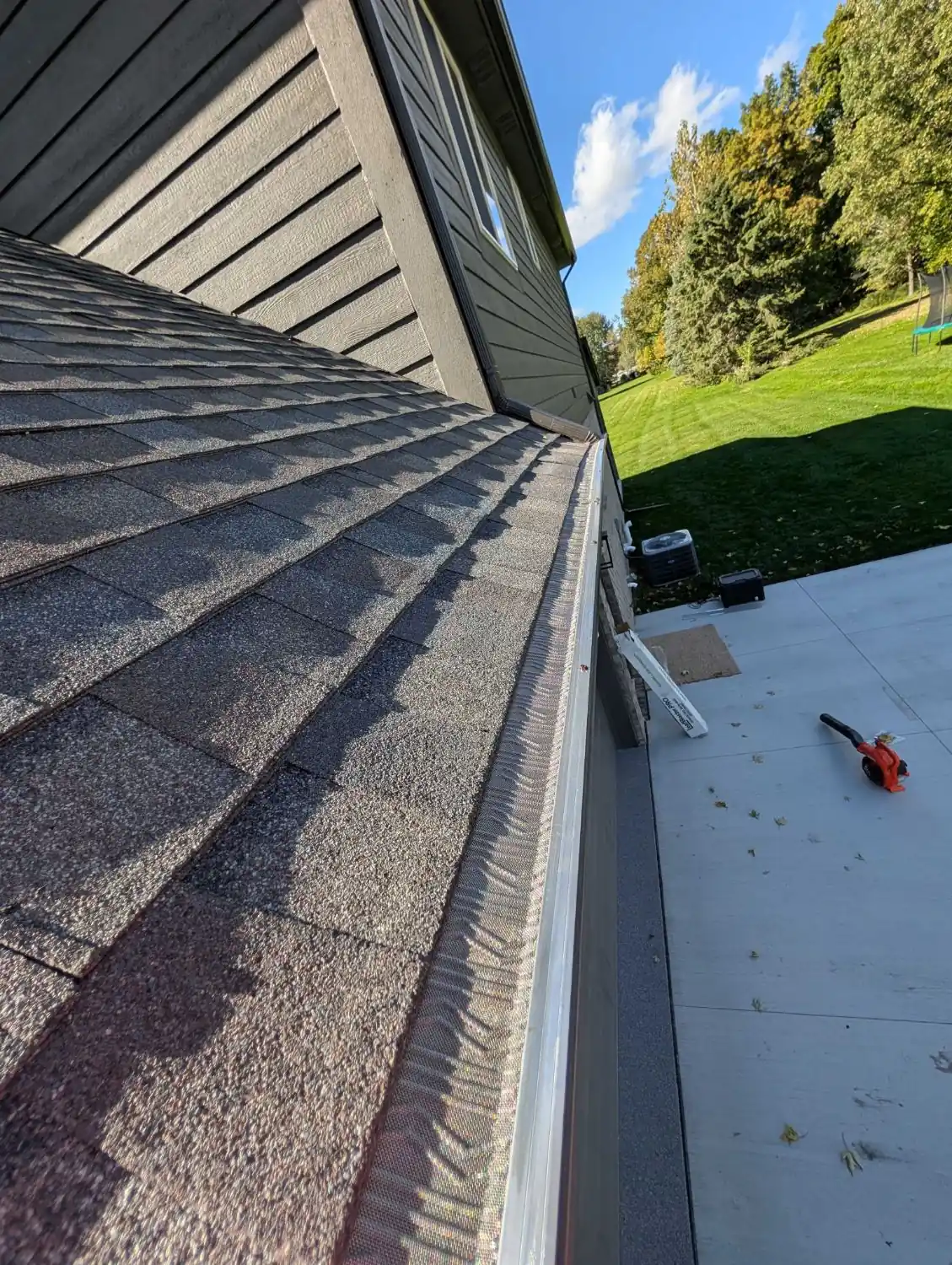
Then comes the mount. The stainless versions can slide under the first course of shingles, but only where the shingles lift freely; on stuck-down shingles, steep roofs or low-hung gutters they fasten to the fascia, and the all-aluminum version is built to fasten there. The front edge screws to the gutter lip either way. The maker's guides also warn against roof ramping: shingles pushed up by a guard send rain over its front edge instead of through it. Guard value is a product-plus-installation package, which is why our quote starts with the roofline and the trees rather than the catalog. Our gutter guard installation page shows how a LeafBlaster Pro guard goes on, step by step.
What No Guard Type Fixes
Three limits apply to every category above, micro-mesh included. First, upkeep never drops to zero: what a guard keeps out of the trough sits on top until wind, rain or a brush clears it, and with inserts it collects inside the trough instead. For the LeafBlaster Pro guards we install, the maker says most owners brush the tops once or twice a year, and inside corners below roof valleys gather grit faster.
Second, ice dams and icicles can form with any guard, LeafBlaster Pro included. They start with attic heat melting roof snow that refreezes at the colder eave, and University of Minnesota Extension puts the lasting fix in the attic: air sealing first, then insulation.
Third, a roof valley drops a downpour into one inside corner, and the maker says that corner can run over in heavy rain with any guard; its fixes are a coarser mesh, a high-flow inside miter or a perforated rain diverter.
Whether Guards Are Worth It at All
That's its own fair question (canopy weight, cleaning frequency, and payback years), and our worth-it analysis walks the real math. Short version: heavy-canopy homes usually yes, open lots usually no, and the answer should come from your trees rather than a sales calendar.
The Bottom Line
Micro-mesh for the full Michigan mix, frame-reinforced mesh where big trees meet heavy snow, perforated aluminum where large leaves and heavy rain matter more than fine debris, screens for leaf-only lots on a budget, skepticism for anything that promises 'never again,' and an installer who reads your canopy before quoting. The cost guide covers what the numbers should look like; we install LeafBlaster Pro for $9 to $16 per linear foot with the full cleaning included, and set the exact figure after we measure at your house.
Sources
- This Old House: Reverse-curve gutter guards
- Bob Vila: Gutter guard cost (2023)
- LeafBlaster Pro: For homeowners (product lines)
- LeafBlaster Pro: Frequently asked questions
- LeafBlaster Pro: Stainless Steel Micro-Mesh installation guide (PDF)
- University of Minnesota Extension: Dealing with and preventing ice dams
Want This Handled Properly?
Macomb Power Washing Solutions holds a 4.9-star rating across 179+ Google reviews, and free estimates go out within 24 hours. We carry $2M general liability plus workers' compensation.