
The short answer
A parking garage should be pressure washed at least once a year, every level including stairways, ideally in late winter or early spring, and twice a year where a deck-coating warranty calls for it. Covered decks get little rain rinse, so Michigan road salt stays put. Macomb Power Washing Solutions washes parking structures across Macomb and Oakland County.
How often should a parking garage be pressure washed?
A parking garage should be pressure washed at least once a year, and twice a year where the deck coating's maintenance manual requires it. The University of Missouri System's parking garage maintenance guidelines call for power washing every parking level at least once a year, including stairways and the bottom 2 feet of columns, parapets and walls, and they schedule the yearly in-house condition assessment for late winter or early spring. In Michigan the wash fits the same window, after salt season and before that inspection. Those guidelines point owners to ACI 362.2-21, the American Concrete Institute's guide to structural maintenance of parking structures.
Coated decks often need a second wash. FMLink, a facility management publication, reported in 2021 that deck-coating warranty manuals call for pressure washing twice a year, in early spring and early fall, with quarterly washing preferred where the budget allows. The table compares the schedules.
| Schedule | Timing | What it covers | Source |
|---|---|---|---|
| Minimum | At least once a year; in Michigan, after salt season | Every level, stairways, bottom 2 ft of columns, parapets and walls | University of Missouri System guidelines, citing ACI 362.2-21 |
| Coated deck under warranty | Twice a year, early spring and early fall | Deck surfaces named in the coating manual | Warranty manuals, as reported by FMLink |
| Preferred where affordable | Quarterly | Deck surfaces | FMLink |
| Drain checks | Weekly | Floor drains kept free of debris | FMLink |
Why do covered garage decks hold road salt longer than open lots?
Covered garage decks hold road salt longer than open lots because little rain reaches them, apart from the wind-driven rain and snow that blow into open perimeter bays. On an open surface lot, spring rain dissolves much of the winter's salt residue and carries it off. Under a roof, the salty slush that drips from every car through a Michigan winter dries where it lands, and the next car adds more. The residue stays on a covered deck until someone washes it off.
Salt on a covered deck collects where the cars go. Entry ramps, drive aisles and stalls used every day collect the most, and low spots where meltwater ponds leave a white crust as the water evaporates. The open top level of a structure behaves differently. It gets rain, but it also takes snow, plowing and freeze-thaw cycles, and BOMA Chicago notes that plows damage curbs and expansion joints. Our post on why Michigan winters destroy unsealed concrete explains how salt and freezing scale a driveway surface; a garage deck adds reinforcing steel to that problem.
How does chloride from road salt damage a parking structure?
Chloride from road salt damages a parking structure by reaching the reinforcing steel inside the concrete. Rock salt is sodium chloride, and when salty meltwater soaks into a deck, chloride moves in with the water. The Federal Highway Administration's Bridge Preservation Guide describes delaminated deck concrete as the result of reinforcement corrosion caused by chlorides and moisture in the concrete. It describes deck sealers as protecting the reinforcing steel by stopping or limiting the intrusion of water and chloride.
Delamination is a layer of concrete separating from the slab around corroding steel, and a delaminated area eventually breaks loose as a spall that exposes the bar. Chloride also complicates repairs. FHWA explains that when a delaminated area is patched with chloride-free material but a high concentration of chloride remains in the surrounding concrete, rapid corrosion follows around the patch, which it calls the halo effect.
A wash cleans the deck surface. It does not pull out chloride that has already soaked into the concrete. What it does is remove the salt crust before the next wet spell dissolves it and carries more chloride into the deck. FHWA's guide suggests that bridge owners sweep away debris and road grit first, then use hoses and pressure washers to dilute deicing chemical on the concrete. A parking deck is washed for the same reason.
What does a spring garage washdown include?
A spring garage washdown includes clearing loose sand and salt, washing every level, flushing the drainage system and inspecting for winter damage. BOMA Chicago's spring checklist for parking garages pairs the wash with drain work and an inspection of plow damage, and the University of Missouri System guidelines set the areas to wash. A typical sequence runs as follows.
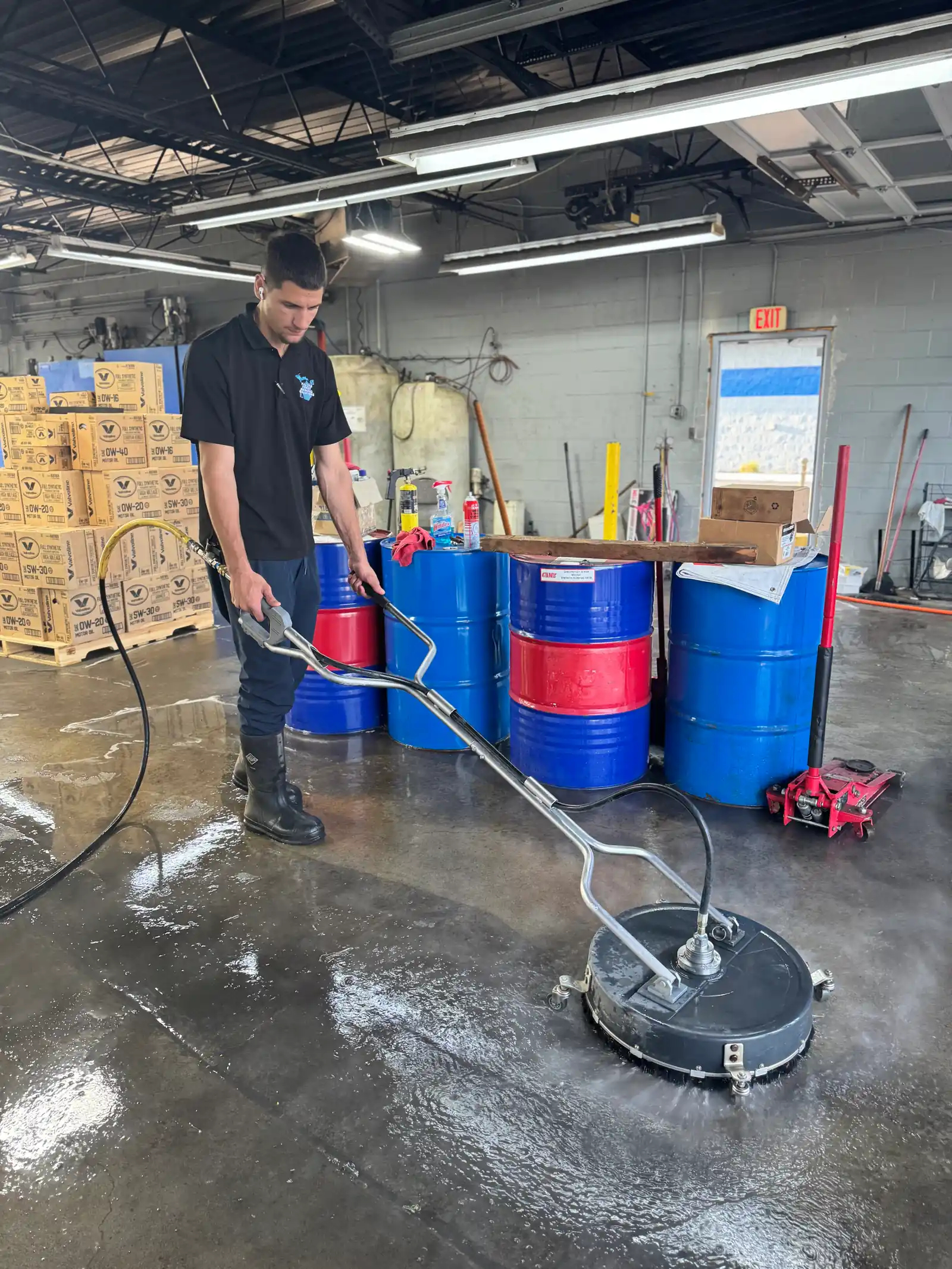
- Sweep or scrape loose sand, salt and debris from ramps, aisles and stalls so it does not wash into the drains.
- Check floor drains, piping, sand traps and oil/water separators so the wash water has a working path out.
- Pre-treat oil drips and stall stains with degreaser.
- Wash every level with surface cleaners, plus stairways and the bottom 2 feet of columns, parapets and walls. On a coated deck, stay within the pressure and chemical limits in the coating maker's maintenance manual and keep the wand off joint sealants and expansion joints.
- Rinse residue toward the floor drains in each area.
- Clean out sand traps and flush drains that collected the winter's grit.
- Walk the clean deck for damaged expansion joints, curbs, cracks, spalls and trip hazards.
Hot water speeds the degreasing step on oil drips, for the reasons set out in our comparison of hot and cold water washing. Macomb Power Washing Solutions cleans parking lots and structures as part of its commercial power washing work, with full-deck cleaning priced in a written, line-item quote.
Why do deck-coating warranties require scheduled washing?
Deck-coating warranties require scheduled washing because the warranty assumes the owner maintains the coating the way the maintenance manual describes. A traffic coating, also called a traffic membrane, is the waterproof layer applied over a parking deck to keep water and chloride out of the concrete. FMLink describes five-year deck coatings whose maintenance manuals require pressure washing, and stresses staying in compliance with those warranty requirements.
Traffic coatings wear under tires, and the University of Missouri System guidelines note that they typically need recoating every five years. A record of each wash supports a warranty claim: the date, the levels washed, photos before and after, and the drains cleared. Keep that record with the coating manual so the facilities team can show the schedule was followed when the coating is inspected.
How are floor drains, sand traps and oil separators handled during a wash?
Floor drains, sand traps and oil separators are checked before a garage wash and cleaned out after it, so wash water and sediment have a working path out of the structure. BOMA Chicago points out that the water coming into a garage in spring also has to get out, and lists drains, piping, sand traps and oil/water separators, also called triple basins, as items to examine. FMLink recommends weekly drain inspections, because a clogged drain lets water pond, and when it finally drains, the contaminants it carries attack steel drains and concrete and crack coatings.
A sand trap is a basin where grit settles out of drain water. An oil/water separator holds back oil so it does not leave with the water. A spring wash moves a winter of sand toward both, so decide before the wash who will clean the traps afterward, whether that is the garage's maintenance staff or a separate vendor.
Where should parking garage wash water go?
Parking garage wash water should go only where the structure's drainage design and the local municipality allow, and wash water carrying oil, grease or detergent should be kept out of storm drains. Where a garage's floor drains run through sand traps and oil/water separators, those must be clear and working before the wash starts. Each city and township in Macomb and Oakland County sets its own stormwater expectations, so confirm the local rule with the municipality before the wash and hold the contractor to a written runoff plan built around it. Our vendor requirements checklist lists what that plan should cover alongside the insurance paperwork.
What does a yearly garage maintenance calendar look like?
A yearly garage maintenance calendar puts the main washdown in late winter or early spring, a second wash in early fall for coated decks, and drain checks and inspections around them. The table gathers the tasks from the maintenance guides cited in this post.
| When | Task | Source |
|---|---|---|
| All year | Inspect floor drains weekly and keep them free of debris | FMLink |
| Winter | Use rubber-tipped plow blades or spacers and approach expansion joints at an angle | BOMA Chicago |
| Late winter or early spring | Wash all levels, stairways and lower walls; clear drains, traps and separators | University of Missouri System; BOMA Chicago |
| Spring, after the wash | Check joints, curbs, guardrails, lighting and trip hazards | BOMA Chicago |
| Early fall | Second wash for coated decks under warranty | FMLink |
| Every 2 years | Supplemental structural engineer inspection, recommended for garages 10 or more years into their service life | University of Missouri System |
| At least every 5 years | Structural condition assessment for garages over 10 years old, as the engineer recommends; traffic membranes typically recoated about every five years | University of Missouri System |
Covered garages are one of the few places where cold-weather washing with hot water can work, as our post on pressure washing in winter explains, but the spring wash still matters most because it removes the full season of salt at once. Faded stall lines show clearly on a clean deck, so spring is also a sensible time to schedule parking lot striping on a deck that has just been washed.
Sources
- Parking Garage Evaluations and Maintenance Guidelines (University of Missouri System)
- Bridge Preservation Guide: Maintaining a Resilient Infrastructure to Preserve Mobility (Federal Highway Administration, Spring 2018)
- Three tips to preserve your parking garage surfaces and stay under warranty (FMLink, October 29, 2021)
- 5 Steps to Spring Cleaning Your Parking Garage (BOMA/Chicago, Kyle Stanish, Klein & Hoffman)
Want This Handled Properly?
Macomb Power Washing Solutions holds a 4.9-star rating across 177+ Google reviews, and free estimates go out within 24 hours. We carry $2M general liability plus workers' compensation.