
The short answer
Commercial pressure washing is priced by scope: flatwork by the square foot, about $0.08 to $0.40 in Housecall Pro's contractor guide, storefronts by the visit, and recurring programs at lower per-visit rates. After-hours work, hot water, water recovery and lifts raise a quote. Macomb Power Washing Solutions quotes Macomb and Oakland County sites in writing, line by line.
How do commercial pressure washing companies price their work?
Commercial pressure washing companies price their work by scope: which surfaces get cleaned, how large they are, what condition they are in, and what the site demands of the crew. Flat concrete is usually measured and priced by the square foot. A storefront or a building elevation is often priced as one visit. A recurring program is priced per visit across a contract term, usually at a lower rate than a single wash.
The pricing method decides what a property manager can compare. Two bids that each list the entrance walks, the parking field, the dumpster pad and the front elevation as separate lines can be set side by side. Two lump-sum bids to "wash the property" cannot. A quote from Macomb Power Washing Solutions arrives in writing within 24 hours and gives each surface and each site its own priced line. The paperwork that goes with a quote is covered in our vendor insurance checklist for property managers.
How is commercial flatwork priced per square foot?
Commercial flatwork pricing is usually a rate per square foot. Flatwork means the horizontal concrete on a site: sidewalks, entrance pads, plazas, drive-thru lanes and parking areas. Housecall Pro's pricing guide for contractors lists commercial flatwork at roughly $0.08 to $0.40 per square foot and parking lot cleaning at roughly $0.08 to $0.25. FMLink, a facility management publication, put subcontracted parking garage washing at $0.04 to $0.15 per square foot in 2021. These are general industry figures, not a price list for any one company or market. At those published rates, a 30,000-square-foot strip-center parking lot works out to roughly $2,400 to $7,500 before extras such as gum, oil stains or after-hours work.
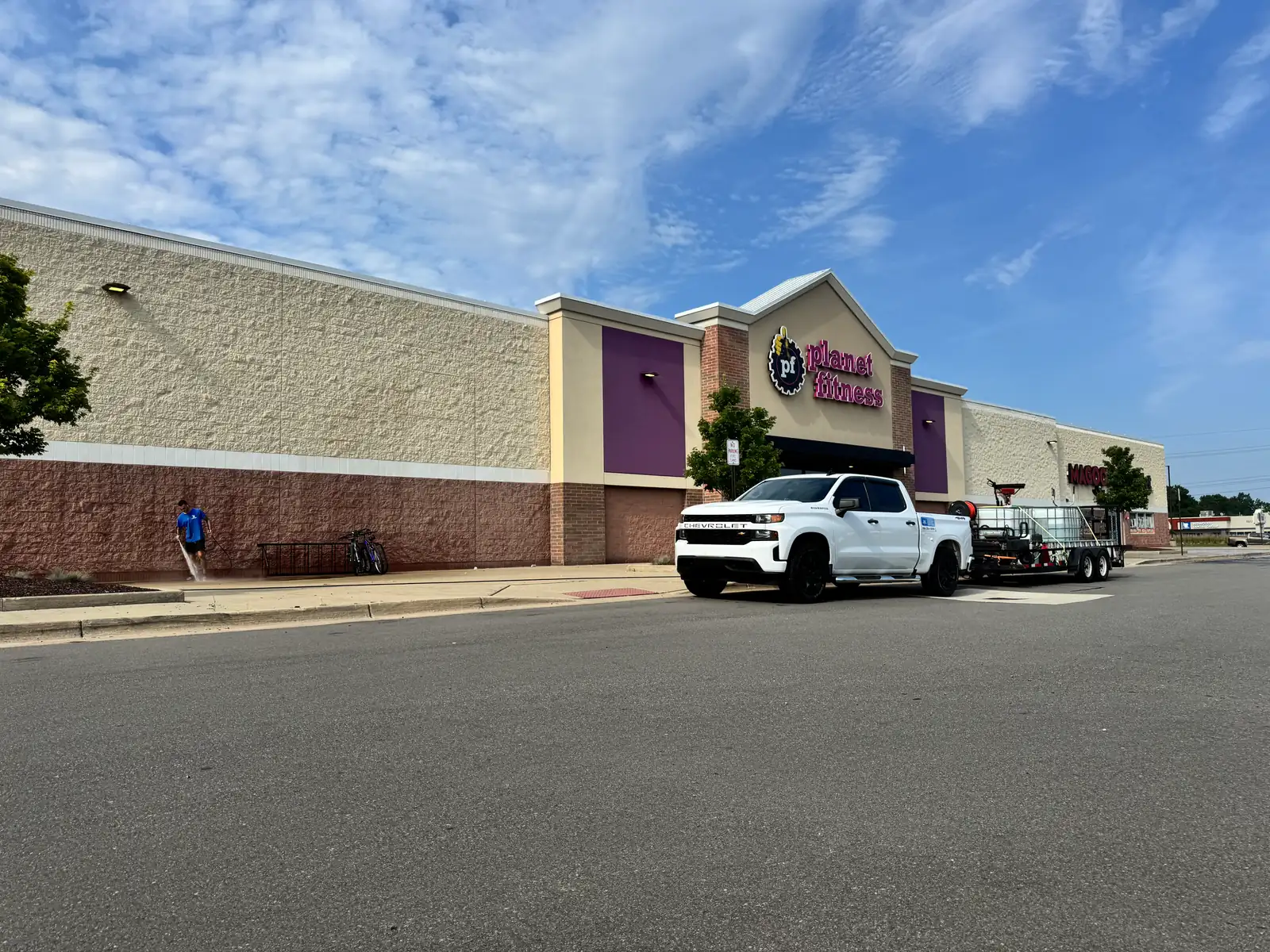
Condition and layout move a flatwork rate inside those ranges. A walk with light dirt and no gum sits near the low end. An entrance pad dotted with gum, a drive-thru lane stained with oil, or a dumpster pad coated in grease needs pre-treatment, degreaser and slower passes, which pushes the rate up. Narrow walks, curb lines and stair runs take more hand work per square foot than an open parking field, where a surface cleaner covers ground quickly.
How are storefronts and building exteriors priced?
Storefronts and building exteriors are usually priced per visit or per elevation, because a building face is measured in walls rather than slabs. A single storefront wash is a common unit, and Housecall Pro lists roughly $200 to $600 for one. Building walls are priced by material and height. A wall of EIFS, vinyl, metal panel or painted block is soft washed at low pressure, which prices differently from sound brick, where the Brick Industry Association's Technical Note 20 sets a limit of 400 psi at the nozzle unless the brick maker permits more.
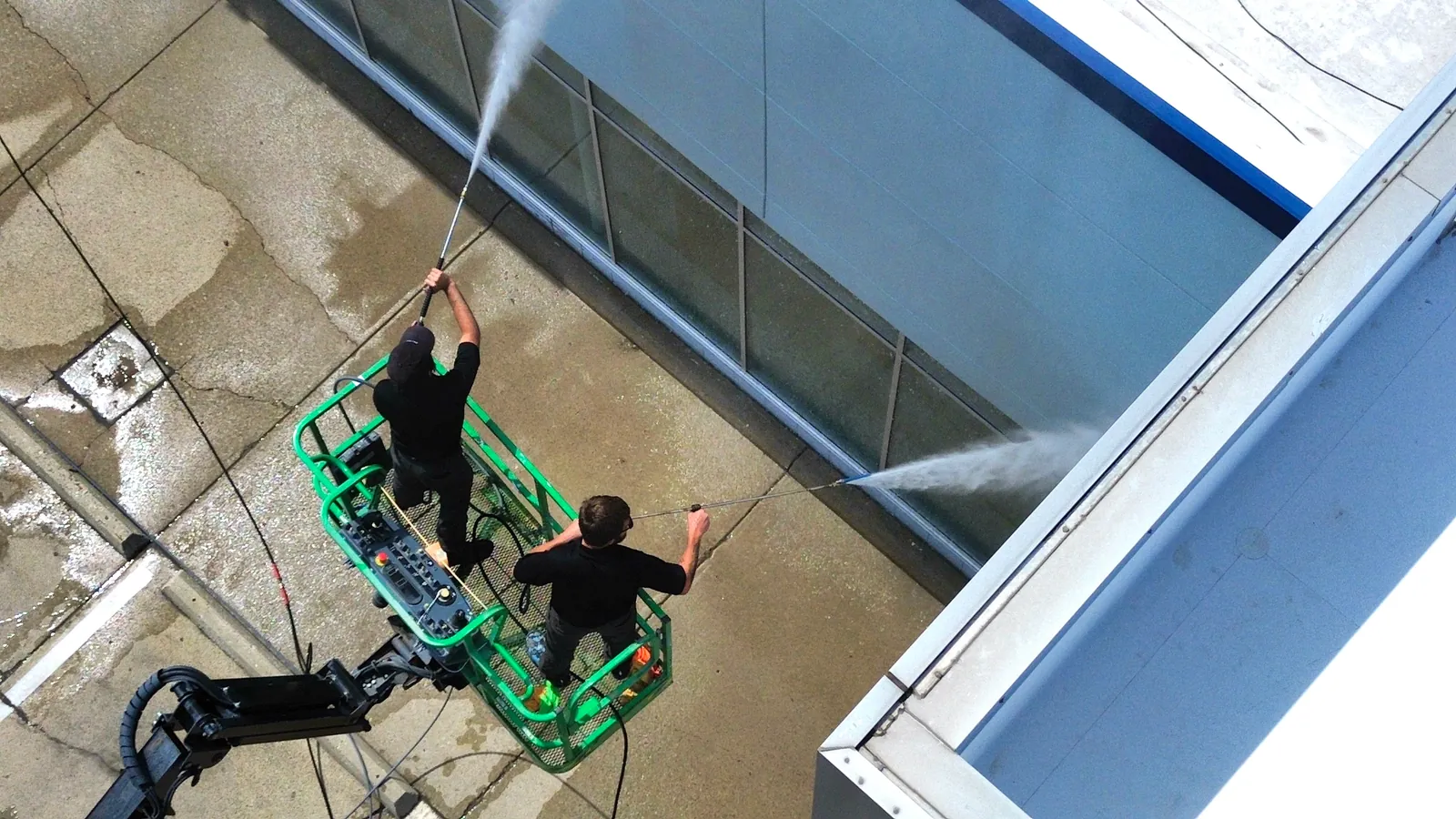
Height changes a building quote faster than wall area does. A one-story strip center can usually be washed from the ground with extension wands. A wall or canopy beyond that reach may need a lift, which adds rental cost, setup time and sometimes a sidewalk or lane closure. Multi-tenant plazas add coordination: one landlord, several tenants, and an agreed order for closing walks so that each store opens on time.
What raises a commercial pressure washing quote?
After-hours scheduling, hot water, water recovery and lift access are common conditions that raise a commercial pressure washing quote. Housecall Pro's guide names lift equipment, water recovery, traffic control and coordination with property managers as costs that belong in a commercial estimate. Each adds equipment or crew time that a daytime residential job does not need.
| Cost driver | Why it adds cost | When a site needs it |
|---|---|---|
| After-hours work | Night crew time, work lights, staged closures | Occupied plazas, restaurants and offices that cannot close walks during business hours |
| Hot water | Burner fuel, heavier equipment, more maintenance | Grease, gum, oil and colder-weather work |
| Water recovery | Recovery equipment, drain covers or berms, disposal | Greasy pads and sites where the owner or city requires wash water to be captured |
| Lift access | Equipment rental, setup and operator time | Walls, signs and canopies beyond the reach of a wand |
| Traffic control | Cones, signs, cleaning in sections | Lots and garages that stay open during the work |
| Heavy pre-treatment | Degreaser, dwell time, extra passes | Gum fields, drive-thru lanes and dumpster pads |
Hot water costs more because the machine carries a fuel burner and a heating coil, and our guide to hot water versus cold water pressure washing explains which jobs need it. Lift access and water recovery depend on the site and belong on the quote as named lines, so they are priced before the work is booked.
How do recurring programs price differently from one-time washes?
Recurring programs usually price lower per visit than one-time washes, because a surface cleaned on a schedule does not build the heavy layer that a first wash has to cut through. Housecall Pro notes that ongoing contracts often lower per-visit pricing because surfaces stay cleaner and scheduling becomes predictable. The first visit of a program often prices like a restoration wash, and the visits that follow price as maintenance.
A program also helps multi-site owners. A manager with plazas or branches across Macomb and Oakland County can put every site on one schedule and one scope format, with each site priced on its own lines. Ask whether a program rate holds for the full contract term or can change at renewal. How often each kind of business tends to schedule a wash is covered in our post on storefront cleaning and foot traffic.
What are typical commercial price ranges?
Typical commercial pressure washing price ranges in published industry guides run from a few cents per square foot for a garage deck to $10,000 or more for a large facility. The table collects those published figures with their sources. Local labor, site condition and the cost drivers above move any single job inside or outside these ranges.
| Job | How it is usually priced | General range | Source |
|---|---|---|---|
| Commercial flatwork | Per square foot | About $0.08 to $0.40 per sq ft | Housecall Pro |
| Parking lot cleaning | Per square foot | About $0.08 to $0.25 per sq ft | Housecall Pro |
| Parking garage deck | Per square foot | About $0.04 to $0.15 per sq ft (2021) | FMLink |
| Storefront wash | Per visit | About $200 to $600 | Housecall Pro |
| Large facility wash | Per project | About $2,000 to $10,000 or more | Housecall Pro |
Use these ranges to check a bid, not to set one. A bid far below a range may leave out pre-treatment, edge work or a second pass on stained areas. A bid far above it should show which cost drivers it includes. We do not publish commercial prices, so the figure comes in the written quote. Residential starting prices are listed on our pricing page.
What should a commercial quote include?
A commercial quote should list each surface or area as its own line, with the measurement, the cleaning method, the frequency and the price, so a manager can drop a line, compare two bids and check the invoice against the scope. The full checklist, from the work window to exclusions such as graffiti, oil stains and windows, is in our vendor requirements guide.
Units should match the surface: square feet for open flatwork, linear feet for curb lines, and a per-visit price for a storefront or a dumpster pad. Matching units let a manager check a remeasured invoice against the quote. The property types we handle are listed on the commercial power washing page, and commercial clients have included a Home Depot location and an Enterprise location.
How does Michigan's road-salt season shape commercial scheduling?
Michigan's road-salt season shapes commercial scheduling by putting the year's heaviest wash in spring. Salt, sand and slush residue build up on entrances, walks, curb lines and garage decks from the first snowfall to the last. The first steady stretch of weather above about 40°F, usually in late March or April, opens the window to remove it, because rinse water on a colder day can freeze on walks and lots.
Spring dates fill early because most properties want the salt gone in the same few weeks. Managers who approve the scope and vendor paperwork over the winter can hold a slot in the first warm weeks instead of waiting until May. A spring wash also readies a lot for parking lot striping, since new lines go down on clean pavement. A fall wash before freeze-up is the common second visit in a twice-a-year program, clearing summer grime and leaves before the salt trucks return. Covered parking structures are the exception, since hot-water crews can wash their decks in colder months when drains and rinse water can be managed, as our guide to parking garage washing and road salt explains.
Sources
Want This Handled Properly?
Macomb Power Washing Solutions holds a 4.9-star rating across 177+ Google reviews, and free estimates go out within 24 hours. We carry $2M general liability plus workers' compensation.