
The short answer
Before a commercial pressure washing contractor starts in Macomb or Oakland County, a property manager should collect a certificate of insurance naming property and manager as additional insured, commonly $1 million per occurrence and $2 million aggregate, workers' comp, a W-9, a line-item scope, a runoff plan and a work window. Macomb Power Washing Solutions sends certificates before work starts.
What should a property manager collect from a pressure washing contractor before work starts?
A commercial pressure washing contractor should hand a property manager seven items before the first visit: four documents, a written scope and two plans. Together they show who pays if something goes wrong, who gets a 1099 at year end, what the crew will clean, and how water and scheduling will be handled. HOA boards and small-business owners need the same vendor file as a large management company. A larger property has a longer scope, but the documents are the same.
| Item | What it shows | What to check |
|---|---|---|
| General liability COI | Coverage for damage and injury to others | Policy dates cover the work; limits meet your requirement, commonly $1M per occurrence and $2M aggregate |
| Additional insured endorsement | Owner and manager covered under the contractor's policy | The endorsement page, not only a checked box |
| Workers' comp certificate | Crew injuries fall on the contractor's policy | Active policy, same legal entity as the COI |
| W-9 | Legal name and taxpayer ID for 1099 reporting | Name matches the certificate and invoice |
| Line-item scope | What gets cleaned, how and how often | Square footage, method per surface, frequency, exclusions |
| Runoff plan | Where the wash water goes | Drain protection, recovery on greasy areas, landscape rinsing |
| Work window | When the crew is on site | Hours, tenant notice, lighting, lot closures |
What should the certificate of insurance show for a pressure washing contractor?
A certificate of insurance is a one-page summary of the contractor's policies, issued by their insurance agency. It lists the insurer, policy numbers, policy dates and limits. The certificate does not change the policy. It reports what the policy says on the day it was issued.
The common baseline in vendor compliance programs is $1 million per occurrence and $2 million aggregate for general liability. Per occurrence is the most the policy pays for one incident. Aggregate is the most it pays across the policy year. A property with a parking structure, heavy foot traffic or roof work may ask for higher limits through an umbrella policy.
Policy dates on a certificate of insurance matter as much as the limits. Ask for a current certificate before the first visit and note the expiration date. A certificate sent straight from the contractor's agency, rather than forwarded by the contractor, is a simple check that the certificate is current. Our homeowner guide to power washing company insurance walks through each line on the form.
What do additional insured, waiver of subrogation and primary and noncontributory mean?
Additional insured status extends the contractor's liability policy to the property owner and management company for claims that arise from the contractor's work. If a pedestrian slips on a wet walkway during a wash and names the property in a claim, the contractor's policy can respond for the property too. A certificate holder, by contrast, receives the paperwork and nothing more. Additional insured status comes from an endorsement to the policy, so ask for the endorsement page along with the certificate.
A waiver of subrogation stops the contractor's insurer from suing the property to recover what it paid on a claim. Without the waiver, an insurer that pays for an injured worker or a damaged car can pursue the owner if it believes the property shared the fault. Managers usually request the waiver on both the general liability and workers' compensation policies.
Primary and noncontributory wording means the contractor's policy pays first and does not ask the property's own insurance to share the loss. That helps keep a contractor's incident off the property's claims history. Vendor contracts usually request additional insured status, a waiver of subrogation and primary and noncontributory wording together, and the endorsements should match what the contract asks for.
Why does a workers' compensation certificate matter for exterior cleaning?
A workers' compensation certificate shows that the crew on the property is covered by the contractor's own policy if someone is hurt. Exterior cleaning puts technicians on ladders, on roofs and on wet concrete with hoses under pressure. Michigan requires workers' compensation only of employers with three or more employees, or with one employee working 35 or more hours a week for 13 weeks in the past year, so a small crew can legally carry none. Under MCL 418.171, an employer covered by the act that hires a contractor without the required coverage can be liable to pay compensation to that contractor's injured workers. The state's Workers' Disability Compensation Agency offers a coverage lookup by employer name.
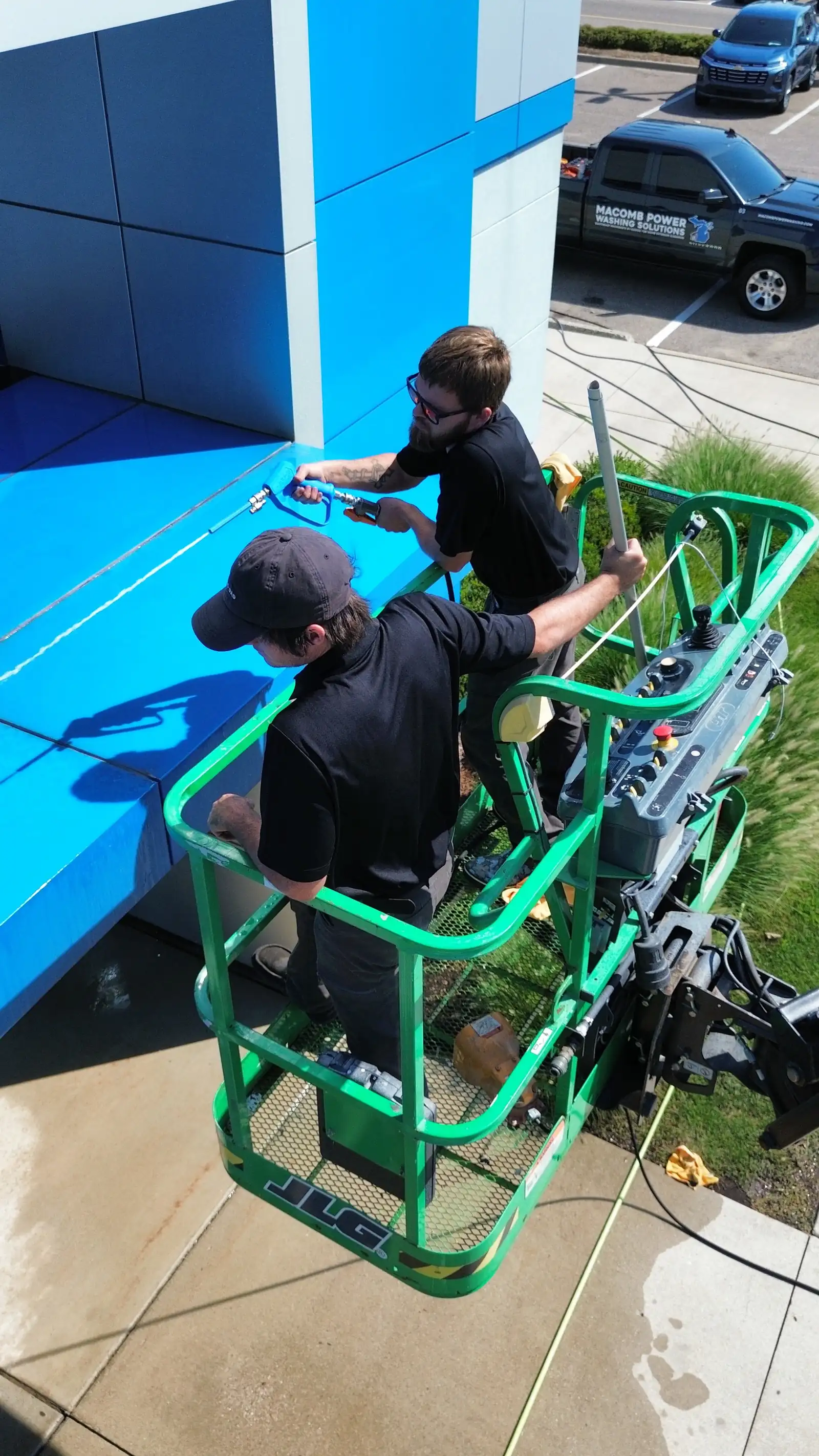
A contractor who says the crew are all subcontractors has moved the workers' compensation question to another company. Ask for each subcontractor's certificates, or require the contractor to cover everyone it brings on site.
Why ask a pressure washing contractor for a W-9?
A W-9 gives accounts payable the contractor's legal business name and taxpayer identification number for 1099 reporting. It also works as a cross-check. The legal name on the W-9 should match the named insured on the certificate and the name on the invoice. When the name on the truck differs from the entity on the paperwork, sort it out with a phone call before work starts.
What belongs in a written line-item scope for commercial pressure washing?
A written line-item scope lists every surface as its own line, with approximate square footage, cleaning method and frequency. A scope that says "wash the building and sidewalks" leaves room to disagree about what was included after the invoice arrives. Exclusions belong on the page too, since windows, gutter interiors, graffiti and oil stains are often separate items. How each line is usually priced is covered in our guide to commercial pressure washing pricing.
The cleaning method belongs on each line because surfaces differ. Concrete walks, entries and dumpster pads take surface-cleaner work with pressure, and a concrete cleaning line should say whether hot water and degreaser are included. Painted block, EIFS, metal panel and vinyl take a low-pressure soft wash with a cleaning solution.
Cleaning frequency should follow how Michigan properties get dirty. Entrances in Macomb and Oakland County carry white road salt residue by March, so a spring concrete pass is common. North-facing walls under tree canopy grow green algae faster, and buildings near Lake St. Clair and the inland lakes see more mildew from humid air. Soft-washed siding holds two to three years on shaded walls and longer in sun, which sets a reasonable building cycle.
What should a wash-water and runoff plan cover for storm drains and landscaping?
A wash-water plan should cover drain protection, water recovery on greasy areas, debris sweeping and landscape rinsing, and it should say where the water goes after it leaves the surface. Parking lot catch basins are built for rainwater, and in much of Macomb and Oakland County storm drains flow toward the Clinton River and Lake St. Clair. Grease, detergent and loose debris from a wash do not belong in them.
Stormwater rules vary by city and township, and the state adds its own layer. EGLE's mobile power washing guidance notes that storm drains usually lead straight to a stream or lake, and that wash water containing additives such as soaps, degreasers or bleach can go to the ground only under a groundwater discharge permit; otherwise it is collected for disposal or sent to a sanitary sewer with the system owner's permission. The manager should know what the municipality expects, and the contractor's written plan should match both. Common measures include berms that keep wash water away from catch basins, recovering wash water from greasy areas such as a dumpster pad, and sweeping debris before washing. EGLE does not recommend relying on storm drain covers, because a leak sends water straight into the storm sewer.
Landscaping protection belongs in a runoff plan. Soft-wash solution on a building can reach the shrubs and beds below. The standard procedure is to wet plants with plain water before application and rinse them again afterward, and the plan should say who handles that step.
When should commercial pressure washing be scheduled around tenants and Michigan weather?
An after-hours work window keeps hoses and wet pavement away from customers and staff. The agreement should list start and stop times, the order in which areas close, who places cones, and how tenants will be told. A written notice a few days ahead keeps cars out of the wash area. Retail plazas and restaurants usually want work after close.
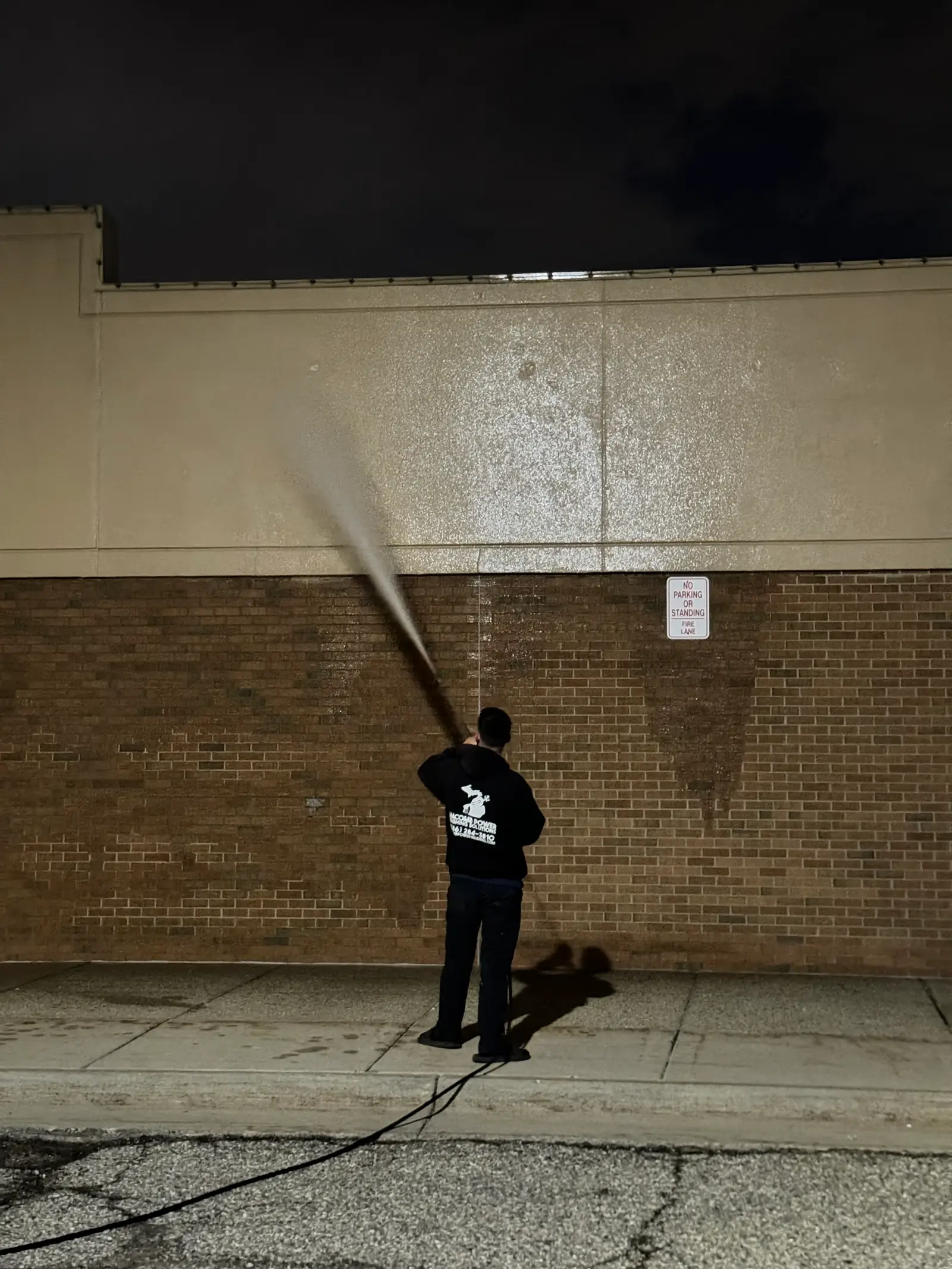
Michigan weather sets the commercial washing season. Washing concrete when overnight temperatures drop below freezing leaves water on walks that turns to ice by morning, and freeze-thaw cycles push water deeper into cracks and joints. Washing is typically scheduled from spring through late fall, with early spring set aside for salt removal. Approving vendor paperwork over the winter keeps the first spring visit from waiting on a certificate.
How does Macomb Power Washing Solutions handle vendor onboarding?
Macomb Power Washing Solutions is an insured Michigan LLC based at 21366 Hall Rd in Clinton Township. It carries $2 million in general liability coverage plus workers' compensation, and certificates go out before the first visit.
Written line-item quotes go out within 24 hours, and crews work Monday through Saturday from 8am to 10pm, which leaves room for after-close work at retail and office sites, and overnight work is offered for commercial sites that need it. Service covers 87 communities across Macomb, Oakland and St. Clair counties, Grosse Pointe and Harper Woods with zero travel fees. The commercial power washing page lists property types, or call (586) 284-3810 to set up a walkthrough.
Sources
- Michigan EGLE: Mobile Power Washing Environmental Compliance Guidance (2023)
- Michigan Legislature: MCL 418.115, employers subject to the Workers' Disability Compensation Act
- Michigan Legislature: MCL 418.171, principal liability for a contractor's workers
- Michigan Workers' Disability Compensation Agency: Employer Frequently Asked Questions
Want This Handled Properly?
Macomb Power Washing Solutions holds a 4.9-star rating across 177+ Google reviews, and free estimates go out within 24 hours. We carry $2M general liability plus workers' compensation.