
The short answer
To tell what sealer is on your concrete, test a clean, dry corner. Water beading on a glossy surface points to a film, and beading with no sheen points to a penetrant. Xylene that leaves the film tacky means solvent-based acrylic. A crosshatch tape test shows whether new sealer will bond. Macomb Power Washing Solutions seals concrete from $299.
How can you tell what sealer is already on your concrete?
You can tell what sealer is already on your concrete by working through four clues: the installer's paperwork, the way the surface looks, how water behaves on it, and whether a drop of xylene turns it tacky. A fifth check, a crosshatch tape test, tells you whether a new coat will stick to the old one.
The tests sort concrete into three groups. A film-forming sealer is a coat, usually acrylic on patios and driveways, that cures into a thin layer on top of the concrete. A penetrating sealer, such as a silane or siloxane, soaks into the pores and leaves nothing on the surface. Bare concrete has neither. Our penetrating vs. film-forming sealer guide compares the two technologies; this guide is about telling which one you have.
What does a water-bead test tell you about the existing coat?
A water-bead test tells you whether anything on the concrete still repels water, and whether that protection sits on the surface or below it. Clean a small area, let it dry, and pour on a little water. Repeat the pour on a spot that takes foot or tire traffic, because a film wears through first where it is used and a single reading can miss that.
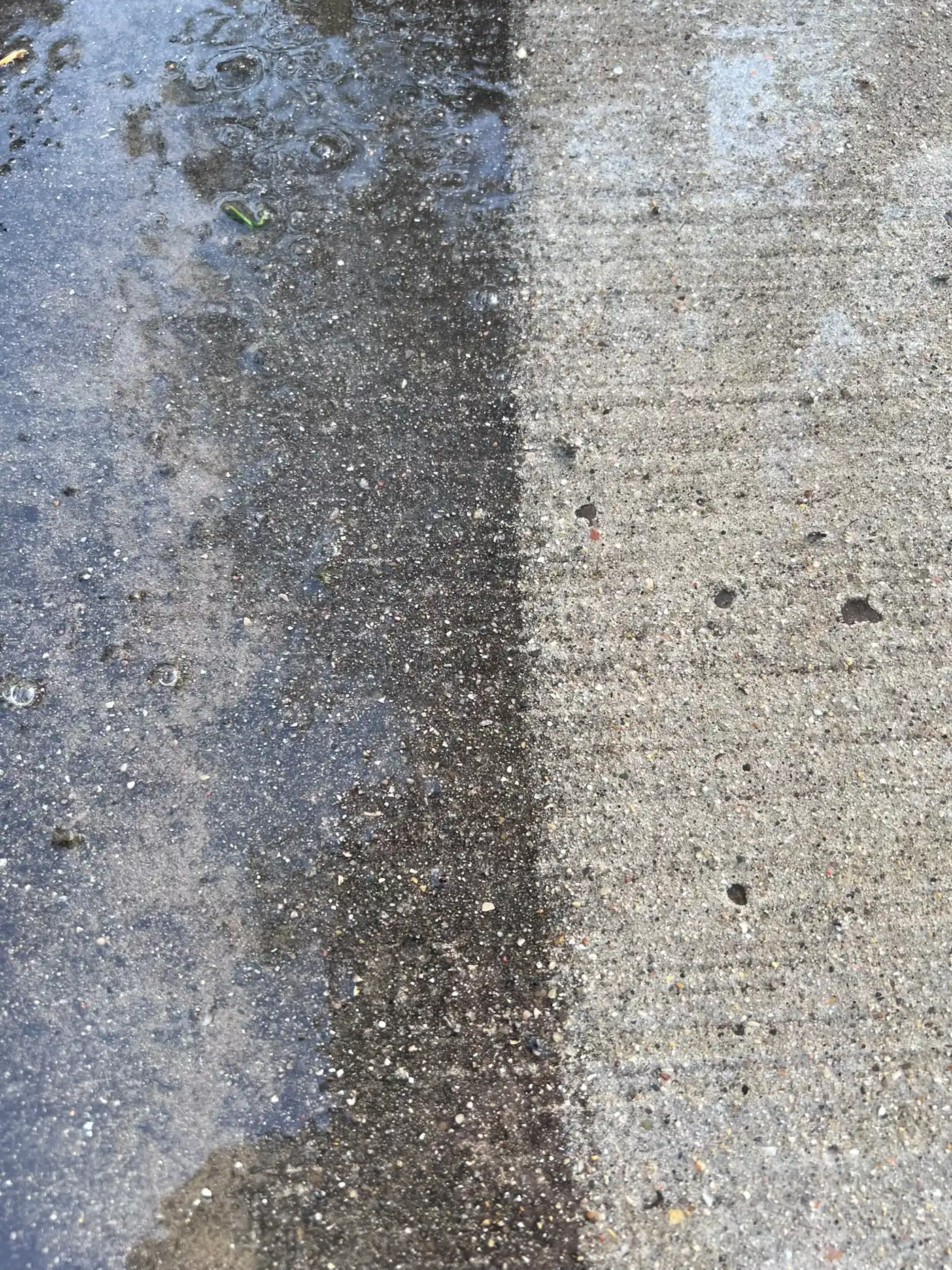
Read the result by looking at the surface around the water as well as the water itself. Water that beads on a surface with a visible sheen points to a film-forming sealer. Water that beads on concrete that looks dull and unchanged points to a penetrating sealer, which works inside the pores. Water that spreads and turns the concrete a shade darker means no working sealer is left at that spot. Our guide on when to reseal stamped concrete uses beading as a reseal reminder. Here the same pour of water sorts a film from a penetrant from bare concrete.
How does the xylene test separate solvent-based from water-based acrylic?
The xylene test separates solvent-based from water-based acrylic sealer by checking whether a strong solvent softens the film. Euclid Chemical explains why it works. A solvent-based acrylic is a polymer dissolved in a petroleum solvent such as xylene, and its dried film stays re-dissolvable, so xylene turns it sticky. A water-based acrylic dries by a different process into a film that cannot be re-dissolved in water and holds up well against other solvents.
Alliance Gator, a paver sealer manufacturer, publishes the procedure. In a low-traffic area, put a drop of xylene about the size of a quarter on the sealed surface, wait 15 seconds, and wipe it off. Then touch the spot. Tacky means solvent-based. A film that stays hard is usually a water-based acrylic, with two exceptions. A urethane or epoxy coating also stays hard under xylene, and Euclid's water-based sealer guide says xylene can turn a water-based coat soft and gummy within its first 24 to 48 hours, so a coat under two days old can mislead. Euclid's troubleshooting bulletin notes that xylene, sometimes labeled xylol, is sold in the paint department of home improvement stores, where paint thinners are sold.
Xylene is flammable, so use a small amount outdoors, wear chemical-resistant gloves, follow the safety precautions on the container, and keep it away from flames and pilot lights. The test only tells you about a film. If the water test showed no sheen and no film, there is nothing on top for the xylene to soften. When the result is unclear, or the film is thick and hard, treat it as an unknown coating. Alliance Gator's Satin Look data sheet calls for a sealer stripper to remove any unknown coating before its sealer goes down. Our water-based vs. solvent-based sealer guide compares the two acrylics for the new coat.
How do you run a crosshatch tape test before resealing?
A crosshatch tape test shows whether a new sealer will bond to the old one before you commit the full slab. Alliance Gator describes the steps:
- Pick a small test patch in a low-traffic area and make sure it is clean and dry.
- Apply the new sealer to the patch at the rate on its label.
- Let it dry for a full 24 hours.
- With a utility knife, cut a tic-tac-toe pattern through both the new and the old coat.
- Press a strip of duct tape over the cuts, then tear it off.
If the tape comes away clean, the new coat has bonded. If squares of sealer come off on the tape, the new coat is likely to lift the same way across the slab. Read the new product's label before the test, too. Alliance's Satin Look paver sealer, for example, is labeled for unsealed surfaces only and cannot be used as a resealer, so some products are ruled out before any tape comes out.
What does it mean when water soaks in and no film shows?
Water that soaks in with no film showing means the concrete has either a penetrating sealer past its working life, an acrylic film that has worn away, or no sealer at all. The xylene and tape tests act on a film. A penetrating sealer leaves no film for them to act on, so on concrete like this they give little useful information. That follows from how the two sealer types work rather than from a published test.
Concrete in this state is the simpler case for resealing, because there is no old coat for a new one to fight. The useful checks become cleanliness and dryness. Macomb Power Washing Solutions plans on renewing penetrating sealer on plain concrete every three to five years in Michigan, and the American Society of Concrete Contractors (ASCC) lists faded areas, patchiness and multiple color shades, especially when the surface is wet, as signs that decorative concrete needs new sealer.
How do the installer's paperwork and the surface's look help identify the sealer?
The installer's paperwork is the quickest way to identify the sealer, when it exists. ASCC's homeowner guide to concrete sealers has a line where the installer marks whether the sealer used was a solvent-based or water-based acrylic. If the original contractor gave you that sheet, or an invoice with a product name, the product's data sheet and the maker's FAQ are the places to check what can go on top of it.
The surface's look narrows it down when the paperwork is gone. Euclid Chemical notes that most acrylic sealers darken concrete and leave some gloss. Alliance Gator states that a solvent-based sealer gives a wet-look finish and a water-based product cannot. The table pairs each clue with the test that confirms it.
| Clue | What it suggests | Confirm with |
|---|---|---|
| Installer sheet marked solvent or water | The acrylic type, from the person who applied it | The product's data sheet |
| High-gloss wet look | Solvent-based acrylic film | Xylene drop turns tacky |
| Low sheen, color darker than bare concrete | Acrylic film of either type | Xylene drop, then tape test |
| Water beads, no sheen, color unchanged | Penetrating sealer | No tack from xylene, no film to cut |
| Water soaks in and darkens the concrete | Worn sealer or bare concrete | Repeat the water test in three spots |
What happens if you reseal over a sealer that isn't compatible?
Resealing over a sealer that isn't compatible leaves a new coat with a weak bond to the old one, and the weak bond shows up later as peeling or clouding. The crosshatch tape test is a small preview of that failure. Squares that lift on the tape show the same weak bond that foot traffic, tires and winter will test across the slab.
Manufacturers also set rules about order. Alliance Gator's sealer FAQ says a solvent-based sealer can go over another solvent-based or a water-based sealer, but a water-based sealer can never go over a solvent-based one. That is why the xylene result matters before anything is bought: a tacky reading rules out a water-based product for the reseal.
Not every source allows the switch the other way. Foundation Armor, another sealer maker, tells owners to recoat a water-based acrylic with a water-based sealer and a solvent-based acrylic with a solvent-based one, and says changing types may mean removing the old sealer first. ASCC's best-practice sheet on sealing stamped concrete says using the exact same sealer as the time before always gives the best results. The safe default is like over like, confirmed with the tape test.
Stacking coats has a second cost. Euclid Chemical lists heavy coats and a buildup of sealer applied over many years as a cause of trapped moisture and whitening in solvent-based sealers, and its troubleshooting bulletin says not to reseal until the previous coats have worn away or been stripped. A coat that fails over an old one also leaves two layers to remove instead of one. The repair for a cloudy or peeling film, and how sealer is stripped, are covered in our guide to fixing cloudy or peeling concrete sealer.
Why does testing first matter more in Michigan's short sealing season?
Testing first matters more in Michigan because there is little time to redo a failed coat before winter. Euclid Chemical points out that spring and fall often bring warm days followed by cold nights, and its water-based sealer guide asks for air and concrete to stay above 45°F for at least 24 hours after application. Once fall nights drop below that, a reseal that peels or clouds often cannot be stripped, dried and recoated until the next spring, so the slab spends a winter of freeze-thaw cycles and road salt under a failed film. Our guide to how long sealer needs before rain covers picking the sealing day itself.
ASCC's homeowner guide for decorative concrete is written around solvent-based and water-based acrylics, the film coats these tests were made for. A 24-hour tape test costs one day of the season and can save the slab from that winter. Macomb Power Washing Solutions identifies the existing sealer before anything new goes down, cleans the surface first through concrete cleaning, and quotes concrete sealing from $299 in a written, line-item quote within 24 hours.
Sources
- ASCC Decorative Concrete Council: Concrete Sealer Expectations & Maintenance Guide
- ASCC Decorative Concrete Council: Best Practices, Sealing Stamped Concrete
- Gator Studio: Solvent-Based vs. Water-Based Sealers
- Alliance Gator: FAQ, Gator Paver and Stone Sealers
- Alliance Gator: Gator Satin Look Technical Data Sheet
- Euclid Chemical Technical Bulletin CP-05: Concrete Sealer Troubleshooting
Want This Handled Properly?
Macomb Power Washing Solutions holds a 4.9-star rating across 177+ Google reviews, and free estimates go out within 24 hours. We carry $2M general liability plus workers' compensation.