
The short answer
Plan on at least 12 hours with no rain, dew or sprinkler water after sealing concrete, the American Society of Concrete Contractors' rule, and 24 hours when the label asks for it, as Alliance Gator's general guidance does. The product label decides. Concrete sealing with Macomb Power Washing Solutions starts at $299, booked around the forecast.
How long does concrete sealer need before rain hits it?
Concrete sealer needs at least 12 hours before rain hits it, and longer when its label asks for more. The general rule from the American Society of Concrete Contractors (ASCC) is not to seal when rain or condensation is expected within 12 hours of application. Many labels ask for more: Alliance Gator's general guidance for its paver sealers is no rain predicted for at least 24 hours after the sealer goes down. The 12-hour window is a planning floor for the day you seal, and the label for the product going down on your slab sets the real number.
Some products are rain-safe sooner. Alliance Gator's Satin Look, a solvent-based acrylic sealer for dry-cast concrete pavers, is listed on its technical data sheet as water repellent and rain-safe 90 minutes after application. That product is labeled for unsealed pavers only and cannot be used as a resealer, so its 90 minutes describes one product under its stated conditions. It does not carry over to a different sealer or to a reseal.
Why does rain or dew damage a fresh sealer coat?
Rain or dew damages a fresh sealer coat because water reaches the surface before the film has finished forming. Alliance Gator's sealer FAQ answers the question directly: rain within a few hours of application will hinder proper adhesion. For solvent-based acrylic, Euclid Chemical describes the closely related case of sealer put down on wet concrete, which does not bond to the surface and turns white.
Water-based acrylic is the type Euclid ties to rain by name. It forms its film by coalescence, meaning the water and then a small amount of coalescing solvent leave the coat and the acrylic beads fuse into one layer. Euclid's bulletin on water-based sealers says a coat rained on before that film is complete traps the extra moisture as it dries and turns milky white. The same bulletin names high humidity as a cause, which fits the ASCC rule counting condensation along with rain.
How do rain-safe times differ between the general rule and product labels?
Rain-safe times differ from the general rule to the label, and even between one maker's general advice and its own products, so the table sets them side by side. The ASCC figures are typical times at an air temperature of 70°F for decorative concrete sealers in general. Alliance Gator's general guidance comes from its sealer advice for homeowners, and the last column applies to its Satin Look paver sealer only.
| Milestone | ASCC general guidance (70°F) | Alliance Gator general guidance | Alliance Gator Satin Look label |
|---|---|---|---|
| Rain or moisture | None expected within 12 hours of application | No rain predicted for at least 24 hours | Rain-safe after 90 minutes |
| Dry to the touch | 1 to 2 hours | Follow the label | Not listed separately |
| Light foot traffic | 3 to 4 hours | Follow the label | 24 hours before using the area |
| Furniture and cars | 24 hours or more | Follow the label | 24 hours before using the area |
| Weather before sealing | Surface completely dry | Pavers completely dry | At least 48 hours of dry conditions |
| Air and surface temperature | Follow the label | Usually 60°F to 80°F is ideal | 60°F to 85°F, surface cool to the touch |
The foot-traffic and car rows give the sources' own figures. On a surface we seal, our minimum is longer than any column: 48 hours before people walk on it and 72 hours before a car drives on it, as the walk-and-drive section below explains.
Water-based and solvent-based acrylics also react differently to the weather around the rain. Euclid's guidance ties solvent-based whitening to wet concrete and water-based whitening to cold or humid air, so a humid, drizzly morning is a poor day for either one. Euclid's water-based guide also wants both the air and the slab held above 45°F for a full 24 hours after application, so a cold night after sealing is a weather risk as real as a shower.
Does heavy dew or condensation count as rain for fresh sealer?
Heavy dew counts as rain for fresh sealer, because the ASCC rule is written as rain or condensation within 12 hours. Dew is condensation: on a clear, calm night the slab cools below the dew point of the air, and water forms on the surface the same way it forms on a cold glass. A sealer coat that has not cured takes on that water just as it would a light shower.
The dew limit is easy to miss because the forecast shows no rain. A patio sealed at 3pm stays inside its 12-hour window until 3am, and on a clear, calm September night dew can start to form soon after sunset, well inside that window. Lawn sprinklers count for the same reason, since they put water on the slab. Turn off irrigation zones that reach the concrete for at least the label's rain-safe time, and longer if the label gives no figure. Sprinklers cause a second, later problem too: Euclid traces white water spots on sealed concrete to hard sprinkler water drying and leaving its minerals behind.
How long before you can walk on or drive on sealed concrete?
You can usually walk on sealed concrete after 3 to 4 hours and drive on it after 24 hours or more, according to ASCC's general guidance at 70°F. ASCC also advises keeping furniture off for the same 24 hours or more. Those times are stated for a 70°F day, and a cooler fall day gives the coat less warmth to dry. On concrete and pavers we seal, we hold to a longer rule: 48 hours before anyone walks on it or sets furniture back, and 72 hours before a car rolls onto it.
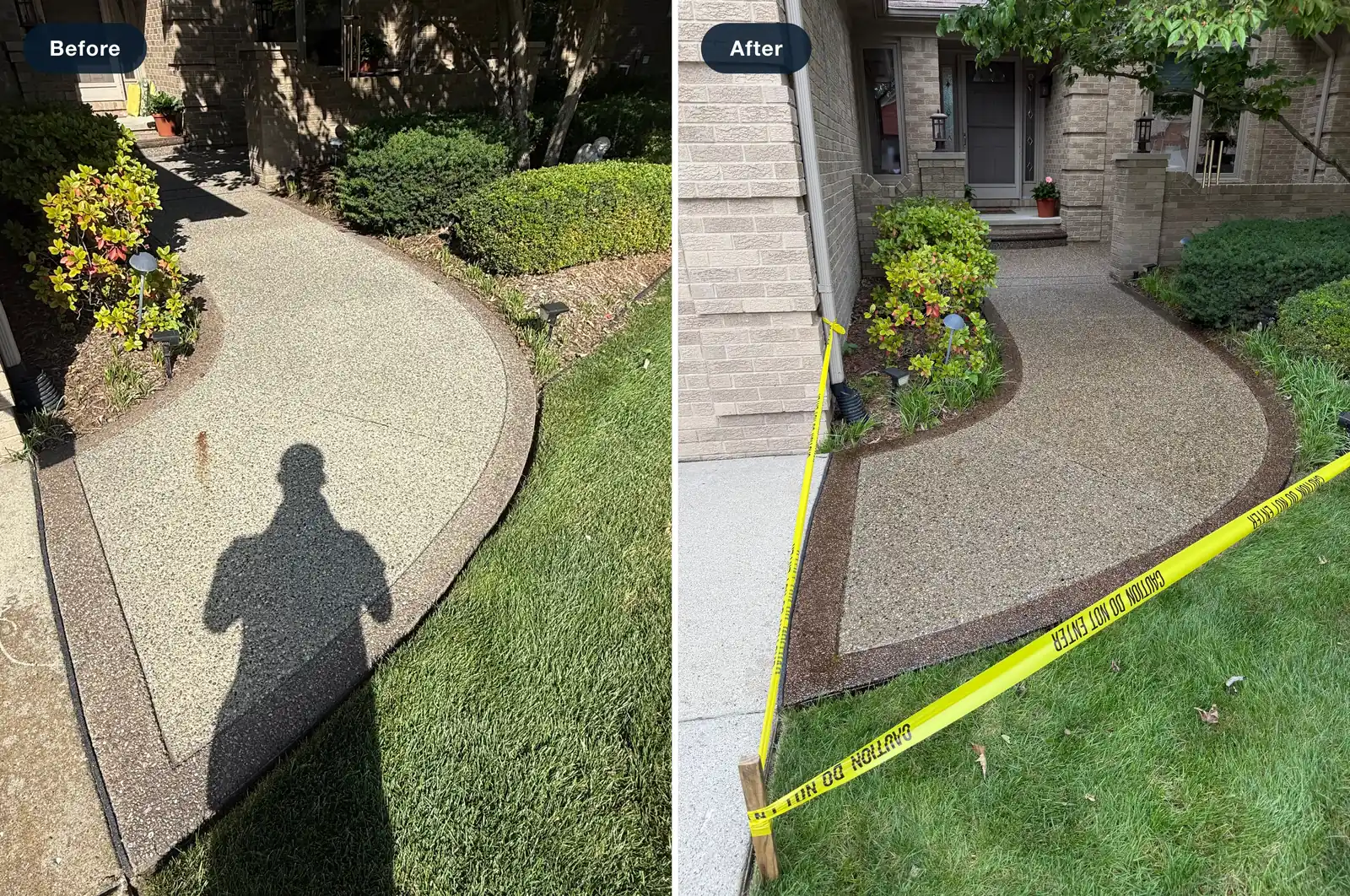
Product labels can be stricter than the general rule. Alliance Gator's Satin Look asks for 24 hours before the sealed area is used at all. Our guide on resealing stamped concrete uses the same 48 hours on foot and 72 hours for cars as our minimum. When a label or cold, damp weather calls for a longer wait than any of these, the longer wait wins, and it costs nothing.
What should you do if a storm hits sealer that was just applied?
If a storm hits sealer that was just applied, keep people, pets and cars off it, let it dry completely, and judge it only once it is dry. The steps below follow the order of the problem, from the first minutes of rain to the dry slab the next day.
- Note the time the rain started and compare it with the rain-safe time on the label. Rain that arrived after that time is usually not a problem.
- Keep traffic off the coat and leave it alone while it dries. Walking or rolling on a wet, uncured film marks it.
- Once the slab is dry, look for white haze, powdery patches or spots where the film lifted.
- Do not roll another coat over a whitened area. Euclid lists heavy coats and buildup as causes of trapped moisture and whitening, so a second coat on top seals the problem in.
A coat that dries clear and even needs nothing more. For a water-based coat that dried milky but is still fully bonded, Euclid says a xylene solvent wash may save it if done within the first 24 to 48 hours, while a coat that dried chalky or powdery has to be removed and reapplied. Whitening that shows up weeks or months later is usually blushing from moisture trapped under the film, and the repair steps for it live in our post on sealer that turns white, cloudy or flaky.
Which other label limits matter besides rain?
Air temperature, surface temperature and humidity are the label limits that matter besides rain. Alliance Gator's Satin Look, for example, must go down between 60°F and 85°F, onto a paver surface that is cool to the touch. A slab in afternoon sun runs warmer than the air, so the air reading alone can pass while the surface fails.
Humidity matters most for water-based acrylics, which Euclid says dry white or powdery when it is too cold or too humid for the film to fuse. Our water-based vs. solvent-based sealer guide covers how each type handles cold and damp air, and our guide to bubbles and blotches in fresh sealer covers what a hot slab does to the coat.
How do you pick a sealing day in a Michigan summer or fall?
A good Michigan sealing day has a dry forecast for at least the next 12 hours, or 24 when the label asks, a dry slab, temperatures inside the label's range, and enough daylight for the coat to dry before evening dew. In July and August a common threat is an afternoon thunderstorm, so an early start, after the morning dew has dried, gives the coat the most time before storms build. In September and October the nights grow longer and cooler, which gives a slab more hours to chill below the dew point, so in Macomb and Oakland County the 12-hour condensation rule can decide more dates than the rain forecast does.
The calendar is short. Euclid notes that spring and fall often pair warm days with cold nights, which is when its 45°F, 24-hour minimum for water-based sealer is hardest to meet. A coat ruined by a late storm may have to wait until spring to be stripped and redone, which leaves the slab facing a winter of freeze-thaw without the protection described in our guide to Michigan winters and unsealed concrete. Macomb Power Washing Solutions plans sealing around a dry forecast and a fully dry slab. Concrete sealing starts from $299 and paver restoration from $399.
Sources
- ASCC Decorative Concrete Council: Concrete Sealer Expectations & Maintenance Guide
- Gator Studio: 6 Sealer Don'ts
- Alliance Gator: FAQ, Gator Paver and Stone Sealers
- Alliance Gator: Gator Satin Look Technical Data Sheet
- Euclid Chemical Technical Bulletin CP-24: Water Based Sealers, Guide to Successful Application
- Euclid Chemical Technical Bulletin CP-05: Concrete Sealer Troubleshooting
Want This Handled Properly?
Macomb Power Washing Solutions holds a 4.9-star rating across 177+ Google reviews, and free estimates go out within 24 hours. We carry $2M general liability plus workers' compensation.