
The short answer
A power washing company should carry general liability for property damage and workers' compensation, which Michigan's MCL 418.115 requires at 3 or more employees, or one working 35 hours weekly for 13 weeks. Get the certificate from their insurance agent and check the name, dates and limits. Macomb Power Washing Solutions carries $2 million general liability plus workers' comp.
What insurance should a power washing company carry in Michigan?
A power washing company that works on houses in Michigan should carry two policies a homeowner can verify: general liability insurance and workers' compensation. General liability pays for damage the crew causes to your property or to someone else's. Workers' compensation pays for the crew's own injuries. A company that arrives with a truck and trailer should also carry commercial auto coverage for the vehicle parked in your driveway.
Insurance carries extra weight in exterior cleaning because Michigan does not issue a state trade license for exterior cleaning. The checks left to a homeowner are the business registration, the certificate of insurance and the written quote.
What does general liability insurance cover on a power washing job?
General liability insurance pays for damage the crew causes to property that belongs to someone else. On a house wash the common incidents are small: a ladder foot through a window screen, a pane cracked by a dropped tool or a dented downspout. Cleaning solution drifting onto plants or a neighbor's car is a different case, because many contractor liability policies carry a pollution exclusion that insurers can apply to chemical overspray and runoff. Ask whether overspray damage is covered, or whether the company carries separate pollution coverage. General liability also covers injury to a third party, such as a visitor who trips over a hose on the front walk.
General liability limits come as two numbers on the certificate. The each-occurrence limit is the most the policy pays for one incident. The general aggregate is the most it pays for all claims in the policy year. Both numbers should be large enough to cover the most expensive thing near the work, whether that is a bay window, a composite deck or the car in the driveway.
General liability does not pay to redo a wash that came out streaky. Liability policies are written to cover damage to other property, not the quality of the contractor's own work. Workmanship is a matter for the company's own guarantee and for a written quote that names the cleaning method for each surface.
Why does workers' compensation matter to a homeowner?
Workers' compensation matters to a homeowner because a ladder fall happens on the homeowner's property. Exterior cleaning puts technicians on extension ladders at the gutter line and at the roof edge during roof treatment. In Macomb and Oakland counties that work is routine: algae on north walls in the humid air near Lake St. Clair and the inland lakes, gutters packed with leaves under mature tree canopy, and black streaks on shaded roofs.
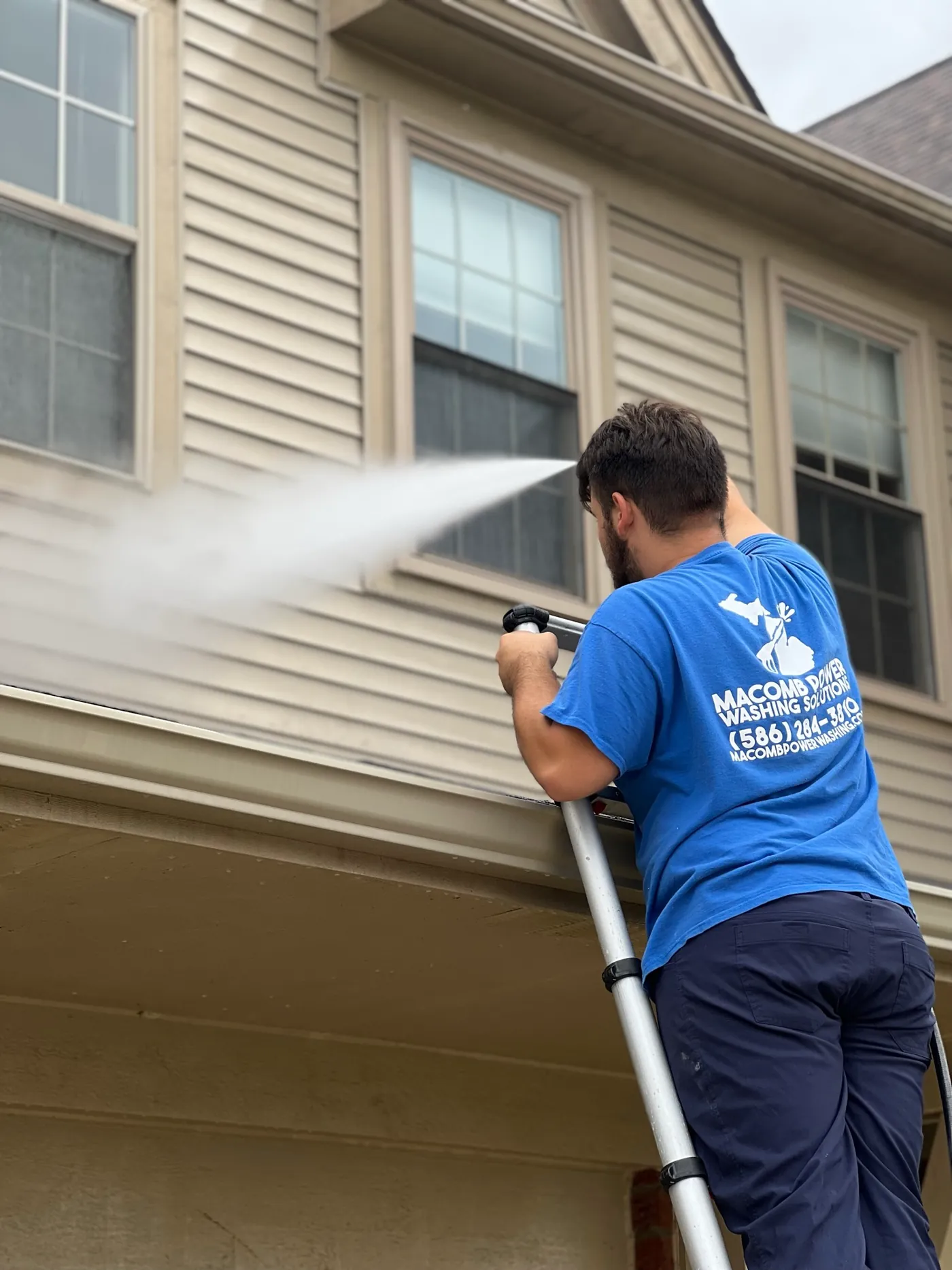
Ladder footing on a Michigan property changes with the season. Spring ground softened by freeze-thaw gives a ladder foot less to bear on. A lawn soaked during the pre-wet that protects landscaping before a soft wash does the same thing in summer.
Michigan sets the workers' compensation requirement in MCL 418.115, part of the Workers' Disability Compensation Act. A private employer must carry coverage once it regularly employs 3 or more people. A smaller employer must carry it once a single employee has worked 35 or more hours a week for 13 weeks or longer during the preceding 52 weeks.
A company below the MCL 418.115 thresholds can operate legally with no workers' compensation policy, and a sole owner working alone is the usual example. Without a workers' comp policy, an injury on your property has no coverage of that kind behind it. Michigan's rule that makes a hiring business pay compensation to an uninsured contractor's workers, MCL 418.171, applies to employers covered by the act, so a typical homeowner's exposure is a negligence or premises claim that the homeowners policy may have to answer. Ask who will be on your job and whether each person on the ladder is covered.
Does a power washing company need a license in Michigan?
Michigan has no state trade license for exterior cleaning. Exterior cleaning is not a trade the state issues a license for, so the most useful questions for a power washing company are about its registration and its insurance.
A Michigan business registration is public and easy to check. An LLC or corporation files with the Corporations Division of the Michigan Department of Licensing and Regulatory Affairs, and the state's business entity search shows whether the entity exists and is active. Macomb Power Washing Solutions is an insured Michigan LLC, and the business name on our quotes is the name on our insurance.
How do I check that a certificate of insurance is real?
A certificate of insurance, often called a COI, is a one-page summary of a company's policies, usually printed on the standard ACORD 25 form. Ask for the COI to come straight from the company's insurance agent, not as an attachment forwarded by the company. A certificate sent by the agency is harder to alter and shows the policy was in force on the day the agent issued it.
A phone call to the insurance agency confirms a certificate in a few minutes. Look up the agency's phone number yourself instead of using the number printed on the certificate, then ask whether the policy is active for the dates of your job. A policy can lapse after a certificate goes out, so a certificate issued close to the job date tells you more than one issued last spring.
Workers' compensation coverage in Michigan can be checked online. The state's Workers' Disability Compensation Agency runs a free coverage lookup by employer name, with records updated weekly. A company that shows no coverage may be below the MCL 418.115 thresholds, so read the result alongside the number of people on your job.
What should the certificate of insurance show?
Every certificate of insurance should be checked for the named insured, the policy dates and the limits. The table lists each line on a standard certificate and its warning sign.
| Certificate line | What to check | Warning sign |
|---|---|---|
| Named insured | The exact legal business name on your quote and invoice | A different business name, or a personal name on a business quote |
| Producer | The insurance agency's name and contact details | No agency listed, or contact details that reach the contractor |
| Policy dates | An effective date before your job and an expiration date after it | A policy that expires before your job date |
| General liability | Each-occurrence and general aggregate limits | Limits below the value of what sits near the work |
| Workers' compensation | A policy number and dates in the workers' comp section | A blank section on a company that sends a crew |
| Certificate holder | Your name and property address | A company unwilling to have one issued in your name |
Here is what a certificate for Macomb Power Washing Solutions shows. The named insured is Macomb Power Washing Solutions, LLC. The general liability section shows $2 million in coverage, and the workers' compensation section shows a policy in force. A homeowner in Clinton Township, Sterling Heights or Troy can ask for that certificate with the quote and ask that it come from our agent.
When should a homeowner or condo association be listed as additional insured?
Additional insured status is a policy endorsement, and it is different from being the certificate holder. A certificate holder receives the certificate, and the form itself states that the certificate does not change or extend the policy. An additional insured is added to the contractor's general liability policy and can make a claim under it.
A homeowner booking a house wash usually needs a certificate of insurance, not an additional insured endorsement. Condo associations, property managers and commercial landlords commonly write additional insured requirements into their contracts, because a crew washing several buildings works around common property the association is responsible for. Our condo association power washing guide covers how boards contract that work, and our checklist of commercial vendor insurance requirements covers the endorsements property managers ask for.
What should I ask a power washing company about insurance before the crew arrives?
A short list of insurance questions belongs in the quote conversation, not on the morning of the job.
- What general liability limits do you carry, and can your agent send me a certificate?
- Do you carry workers' compensation, and will everyone on my job be covered?
- Is the name on the certificate the same name that will be on my invoice?
- Who do I call if something is damaged, and how is the claim handled?
A written quote should put the insurance answers on paper. At Macomb Power Washing Solutions, house washing starts from $349, the quote arrives in writing as line items within 24 hours, and the coverage behind the work is $2 million general liability plus workers' compensation. The same coverage stands behind a driveway power washing job and a second-story soft washing job.
Keep the certificate with the invoice after the job is done. A torn screen noticed a week after a wash still traces back to the visit, and the certificate names the carrier and policy to reference when you call the company about it.
Sources
- Michigan Legislature: MCL 418.115, employers subject to the Workers' Disability Compensation Act
- Michigan Legislature: MCL 418.171, principal liability for a contractor's workers
- Michigan Workers' Disability Compensation Agency: Employer Frequently Asked Questions
- FTC: How To Avoid a Home Improvement Scam
- MoneyGeek: Pressure Washing Business Insurance Requirements
Want This Handled Properly?
Macomb Power Washing Solutions holds a 4.9-star rating across 177+ Google reviews, and free estimates go out within 24 hours. We carry $2M general liability plus workers' compensation.