
The short answer
Manufactured stone veneer is cleaned with a water rinse, mild detergent or a cleaner the stone maker approves, and a soft-bristled brush. CMHA and makers such as ProVia say not to pressure wash it, though some guidance allows a low-pressure rinse, so check your brand's care sheet. Keep acids, wire brushes and deicing salt off the stone.
How do you clean manufactured stone veneer without damaging it?
Manufactured stone veneer is cleaned gently, starting with the least aggressive step and moving up only as needed. The Concrete Masonry and Hardscapes Association (CMHA), a masonry trade association, put its advice in a January 2026 article, and ProVia, a stone veneer manufacturer, gives matching steps in its care guide:
- Rinse debris and light dirt off with plain water.
- For a deeper clean, wet the stone with warm water and a little mild detergent, or a cleaner the stone maker recommends.
- Scrub gently with a soft-bristled brush.
- Rinse with fresh water so no cleaner is left on the stone.
What is manufactured stone veneer, and how is it different from natural stone?
Manufactured stone veneer (MSV) is a cast concrete product shaped and colored to look like natural stone, usually adhered to the wall with mortar over metal lath. It is often called cultured stone, after one well-known brand, or faux stone. It covers wainscots, entry columns, chimneys and outdoor kitchens on many newer homes.
Manufactured stone veneer differs from natural stone in what it is made of and how it handles cleaning. Natural stone is quarried rock cut into thin pieces. Manufactured stone is concrete, so it behaves like other cement-based masonry: it absorbs water, carries soluble salts, and reacts with acids. The units are thin and fastened to the wall with mortar rather than stacked as a structural wall, which is why the bond and the water behind them matter so much.
Why do CMHA and many stone makers say not to pressure wash it?
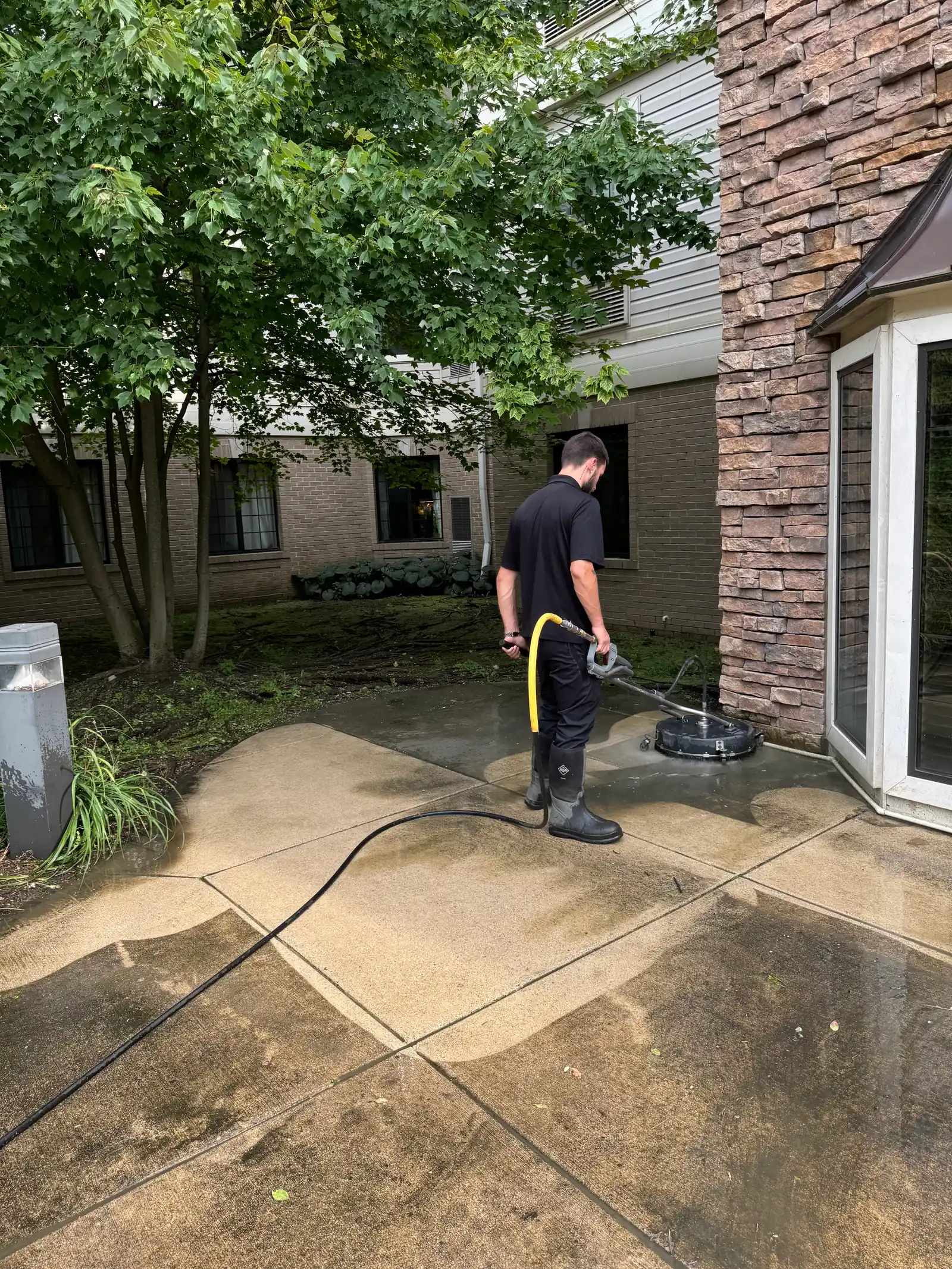
CMHA and many stone makers say not to pressure wash manufactured stone veneer, and they group it with sandblasting and wire brushing as methods too aggressive for the cast concrete face. ProVia's care page says do not pressure wash or sandblast. CMHA says a power washer should not be used. An installation and maintenance article in Masonry Magazine, written by the technical director of a stone veneer maker, goes further and says not to power-wash the stone at any pressure. Guidance is not uniform, though: a separate Masonry Magazine article on manufactured stone maintenance quotes a masonry supplier recommending a wide 20- to 40-degree spray tip when washing and rinsing with low to no pressure, so the care sheet for your brand decides.
Water forced into stone veneer is a second concern. The stone is adhered with mortar over lath, and the wall is built to shed rain, not to take a jet of water at the joints and edges. Water driven behind the stone has to dry out through the veneer, carrying salts toward the face as it goes. That is the same path that produces white haze on the lowest courses. Low-pressure application and rinsing, the approach behind soft washing, keep the water on the surface.
Which cleaners and tools are off limits on stone veneer?
Acids, vinegar, wire brushes and harsh chemicals are off limits on stone veneer under the guidance from CMHA and ProVia. Acid attacks cement-based materials such as the concrete in the stone and the mortar around it. Masonry Magazine warns that a wire brush damages the surface of the stone. ProVia also lists vinegar among the products not to use.
| Cleaner or tool | Use on manufactured stone veneer? | Source of the rule |
|---|---|---|
| Plain water rinse | Yes | CMHA, ProVia |
| Soft-bristled brush | Yes | CMHA, ProVia |
| Mild detergent and warm water | Yes, with a soft brush | ProVia, CMHA |
| Bio-safe cleaner approved by the stone maker | Yes | CMHA |
| Pressure washer or sandblaster | No | CMHA, ProVia |
| Wire brush | No | CMHA, ProVia |
| Raw acid or vinegar | No | CMHA (acid), ProVia (acid and vinegar) |
| Deicers, salt, pool and harsh cleaning chemicals | Keep off the stone | CMHA |
Stone brands differ in the details, so the care sheet for the stone on your house wins over any general list. When the brand is unknown, the safe default is the gentlest method that gets the wall clean.
How do road salt and ice melt damage veneer near steps and drives?
Road salt and ice melt damage stone veneer by soaking into the concrete with meltwater and drying out as salt inside and on the stone. CMHA tells owners not to let manufactured stone contact deicing materials or salt. In a Southeast Michigan winter, that is hard to avoid for veneer next to a salted walk, porch step or driveway. Shoveled snow piled against the wainscot, plow spray and splash from melting slush all reach the bottom courses.
Keeping salt off stone veneer starts with how the walks are treated. Shovel before spreading anything, use only as much ice melt as the walk needs, and keep snow piles off the stone. Our guide to safe ice melt for concrete and pavers compares the products for the walk itself. In spring, a gentle freshwater rinse of the lowest courses removes salt residue before it goes through more wet and dry cycles. Stone run down a step riser is especially exposed; Masonry Magazine calls that placement a water management challenge that invites deicer exposure.
What does white haze on stone veneer mean?
White haze on stone veneer is usually efflorescence, a deposit of salts carried to the surface by water moving through the stone and mortar. ProVia says moisture behind the stone can migrate to the surface and leave this white stain, and that it may go away on its own once the moisture is controlled. The chemistry is explained in our efflorescence explainer for brick and block.
White haze on stone veneer is a reason to look for the water source before scrubbing. Masonry Magazine recommends letting the wall dry, brushing with a soft brush and clean water, and rinsing well. It mentions a dilute vinegar solution for stubborn cases, while ProVia lists vinegar as off limits for its stone, which is one more reason to check your brand's care guide. Haze that keeps coming back points to a leak at a cap, window, gutter or the bottom of the wall.
Why do the bottom courses get the dirtiest, and how much clearance should there be?
The bottom courses of stone veneer get the dirtiest because they take splash from rain, roof runoff, mulch beds and slush. Masonry Magazine notes that splashing from roof runoff and rain can stain the stone. Rough stone texture holds the soil that bounces up, and the shaded base of a wall dries slowly, so algae and mildew show there first.
Stone veneer needs clearance where it meets soil and paving so water can drain instead of wicking up the wall. Masonry Magazine says running stone to or below grade is a building code violation that affects warranty coverage, and it gives about 2 inches of clearance above paved surfaces such as a step. The International Residential Code, the model for Michigan's residential code, sets the minimums in section R703.12.1 of its 2015 edition: at least 4 inches above earth, 2 inches above paved areas, or 1/2 inch above walking surfaces supported by the same foundation as the wall. Stone buried in mulch or soil stays wet, stains, and grows efflorescence on its lowest courses.
Should manufactured stone veneer be sealed?
Manufactured stone veneer generally does not need to be sealed. ProVia says sealing is not required or recommended for its stone. If an owner chooses to seal, ProVia calls for a breathable silane-siloxane masonry sealer, tested first on a small, out-of-sight area. Masonry Magazine adds that these breathable treatments do not make the stone waterproof and recommends checking a few pieces for changes in color or sheen.
A film-forming sealer on stone veneer is a poor fit for the same reason it is on brick: it slows drying and holds moisture and salts behind the surface, which matters in a Michigan freeze-thaw winter, as our post on sealing a brick house explains. Fixing caps, flashing and clearance does more than any coating.
When a whole house is washed, stone veneer calls for gentler handling than the siding above it, so mention the stone when asking for a quote. House washing from Macomb Power Washing Solutions starts from $349, quoted in writing within 24 hours. For stone around an outdoor kitchen or patio, see our post on cleaning pergolas, furniture and outdoor kitchens.
Sources
- Concrete Masonry and Hardscapes Association, How to Clean Manufactured Stone Veneer
- ProVia, How to Clean Stone Veneer
- Masonry Magazine, Built to Last: Installation + Maintenance Best Practices for Manufactured Stone Veneer (Jeff Tew, Westlake Royal Stone Solutions)
- Masonry Magazine, Manufactured Stone Maintenance: Keeping Stones Pristine
- Pennsylvania Housing Research Center (Penn State), Manufactured Stone Veneer webinar handouts, quoting IRC R703.12.1
Want This Handled Properly?
Macomb Power Washing Solutions holds a 4.9-star rating across 177+ Google reviews, and free estimates go out within 24 hours. We carry $2M general liability plus workers' compensation.