
The short answer
An apartment complex in Michigan is usually washed on a split schedule: walkways, breezeways and stairs each spring after salt season and each fall after leaf drop, siding every two to three years on shaded walls, gutters twice a year, and dumpster enclosures quarterly. Macomb Power Washing Solutions quotes each area as its own line item.
How often should an apartment complex be pressure washed?
An apartment complex is pressure washed on several schedules at once, because walkways, building siding, gutters and trash areas get dirty at different speeds. Flat concrete that residents walk on every day needs attention at least twice a year in Michigan, once in spring and once in fall. Soft-washed siding lasts two to three years on a shaded wall before algae returns, and longer where the sun reaches. Gutters are a twice-a-year job on a wooded site, and dumpster enclosures need the shortest cycle on the property.
A single "wash the complex every year" contract tends to overserve the sunny walls and underserve the breezeways. Splitting the property into areas, each with its own interval, puts the money where the dirt and the slip risk are.
What should an apartment exterior cleaning schedule include?
An apartment exterior cleaning schedule should list every outdoor surface residents and visitors use or see, with a method and an interval for each. A typical garden-style or walk-up community in Macomb and Oakland County has these areas:
- Walkways, entries and stoops: concrete that carries salt, grit and gum.
- Breezeways and open stairwells: covered concrete or steel stairs that stay damp and dark.
- Building siding, soffits and trim: vinyl, brick, painted block or fiber cement, soft washed.
- Gutters and downspouts: cleaned out, plus the black streaks on their faces.
- Dumpster enclosures and compactor pads: grease, leachate and odor.
- Mailbox kiosks, leasing office entry and amenity areas: the spots prospects see first.
- Parking lot curbs, sidewalks and signs: salt film and tire marks along the edges.
How often do breezeways, stairwells and walkways need washing?
Breezeways, stairwells and walkways need washing at least twice a year at a Michigan apartment community, in spring and in fall. The spring wash removes the white film of road salt and ice melt residue, the traction grit and the winter's tracked-in dirt. The fall wash clears leaves, seed pods and the algae that grows on shaded concrete over a humid summer. The Concrete Masonry and Hardscapes Association recommends the same spring and fall rhythm for paver walks, with the spring sweep removing leftover deicing chemicals and winter sand.
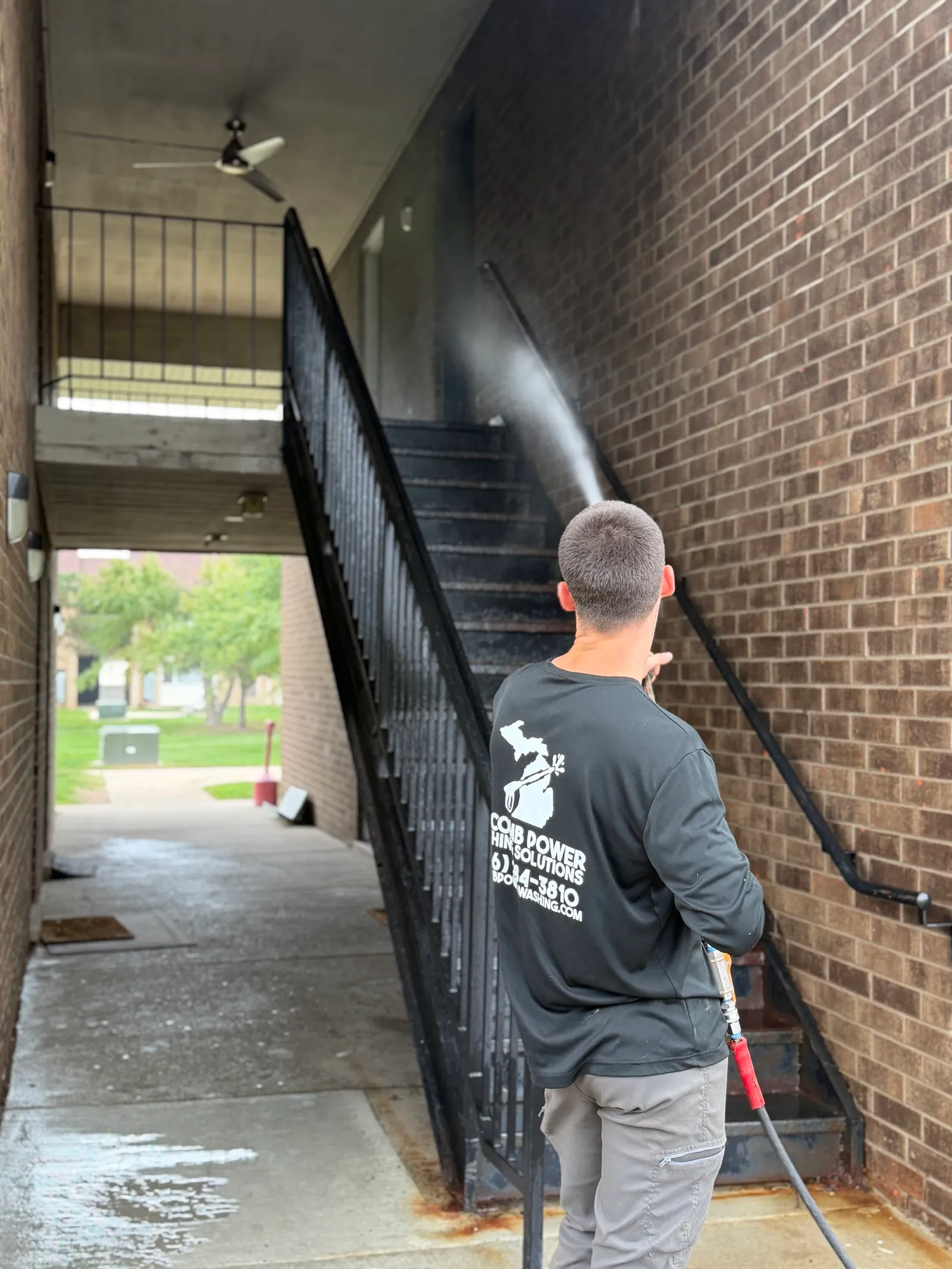
Shade changes the interval on stairs and walks. A breezeway is shaded by design, and a north-facing stair tread or a walk under mature trees can stay damp long enough to grow a green film that turns slick when wet. Those spots may need a treatment between the two scheduled washes. Busy entries near the leasing office and the mailbox kiosk collect gum and spills, and a midsummer pass there keeps them in line. Concrete that will be sealed should be washed in late summer or early fall, so the slab has time to dry before sealing and the sealer is in place before the first freeze.
How often should building siding and gutters be cleaned?
Building siding on an apartment complex should be soft washed every two to three years where walls are shaded, and less often where they get full sun. Soft washing is a low-pressure cleaning method that uses a cleaning solution to kill algae and mildew instead of blasting it off. North-facing walls and walls under tree canopy grow algae first, for the reasons in our guide to why the north side of a house is always green. A simple plan is to soft wash a third to a half of the buildings each year, so every building comes around every two to three years, and to start each building on its north and shaded walls.
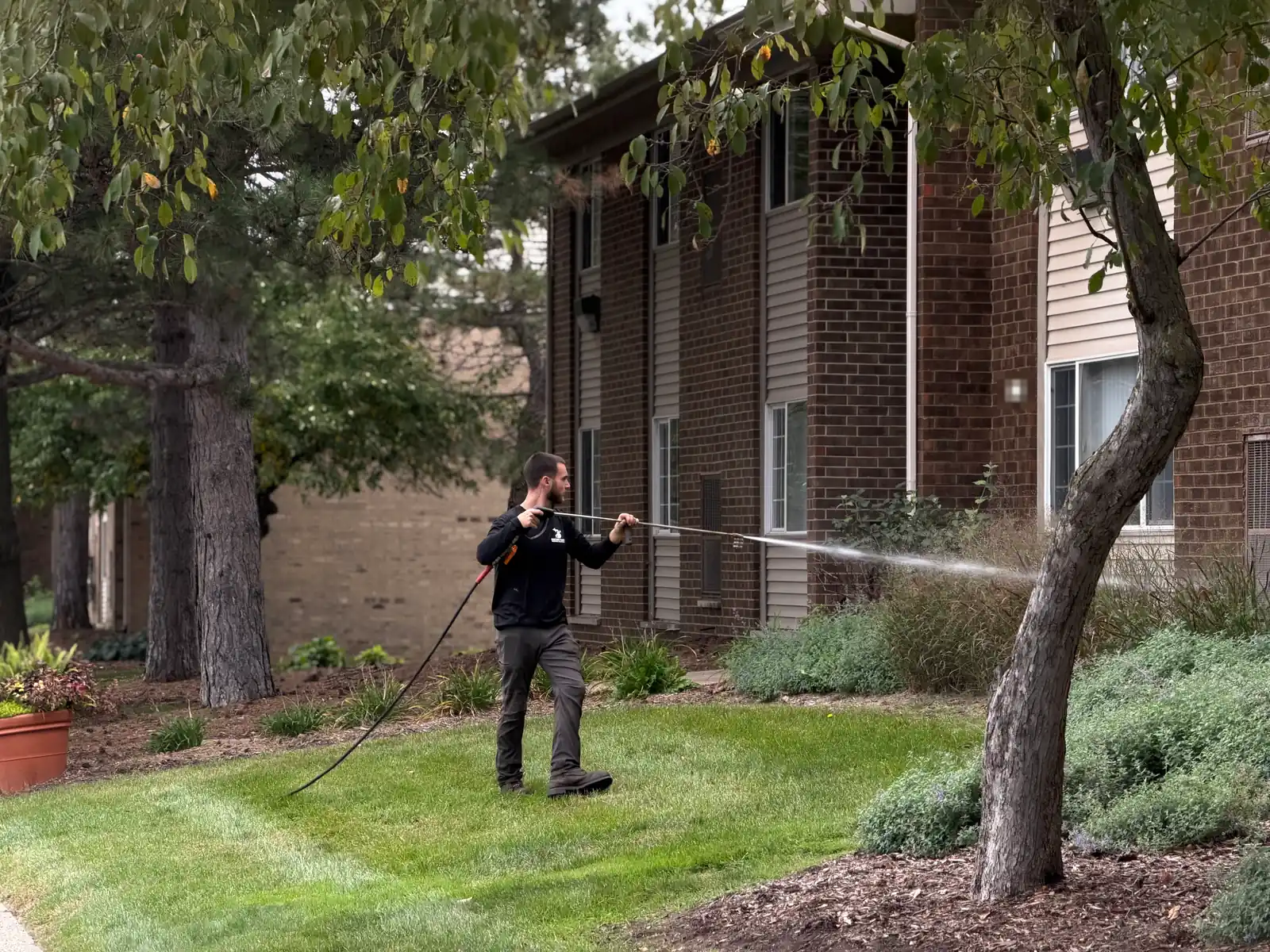
Gutters on apartment buildings should be cleaned twice a year, late fall after the leaves finish dropping and again in spring. Clogged gutters overflow onto walkways and entries, where the water freezes into ice in a Michigan winter. Buildings under oaks and maples may need a third visit. Gutter cleaning can be booked with the fall walkway wash so one visit handles both.
Why do dumpster enclosures and mailbox areas need their own schedule?
Dumpster enclosures need their own schedule because grease and leachate soak into the concrete and feed odor and pests much faster than ordinary dirt builds up. Our dumpster pad cleaning guide covers the hot-water method and suggests quarterly service for a shared multi-tenant enclosure, with shorter intervals in summer heat. An apartment trash area shared by dozens of households fits that pattern.
Mailbox kiosks and package areas need their own schedule for a different reason: every resident visits them, often daily. Gum, spilled drinks, bird droppings under the canopy and salt tracked in from the lot build up in a small space. Cleaning them on the walkway schedule, with spot work in between, keeps the busiest square footage on the property in line with the rest.
What does Michigan law say about a landlord's duty for common areas?
Michigan law makes the condition of common areas a landlord's duty in every residential lease. Under MCL 554.139(1), the lessor covenants that "the premises and all common areas are fit for the use intended by the parties," and agrees to keep the premises in reasonable repair and to comply with applicable state and local health and safety laws. The statute says it is to be liberally construed. The parties may modify these obligations only when the lease has a current term of at least one year. The Michigan Supreme Court has also read the covenant narrowly. In Allison v AEW Capital Management (2008) it held that a parking lot is a common area but that the statute does not require a lessor to keep it in ideal condition, only fit for its intended use.
The same court changed how premises liability cases treat visible hazards in Kandil-Elsayed v F & E Oil, Inc, decided July 28, 2023. The court overruled the part of Lugo v Ameritech Corp that treated open and obvious dangers as a question of duty, and held that a land possessor owes invitees a duty to exercise reasonable care against an unreasonable risk of harm from a dangerous condition of the land. Whether a hazard was open and obvious is now weighed as part of breach and comparative fault, not as a reason no duty existed.
This section is general information, not legal advice. For a property manager, the practical point is that the condition of walks and stairs, and what was done to keep them safe, carries weight. A slick algae film on a shaded stair is a maintenance item, and a dated record of treating it is evidence that care was taken. Ask your attorney or insurer how your own leases and policies apply.
How do you schedule washing around occupied units?
Washing around occupied units works best on a building-by-building rotation with written notice a few days ahead. The notice should tell residents which day their building is scheduled, to close windows, to move patio and balcony items and pet bowls inside, and where to park so cars are clear of the work area.
Stairs and breezeways are washed one route at a time, so residents keep a dry way in and out, with cones at wet areas. Midday, when many residents are at work, is often the quietest window for breezeways, while entries near a leasing office suit early mornings. Our hours run Monday through Saturday, 8am to 10pm, and we are closed Sunday.
Landscaping and ground-floor windows are protected the same way on every building. Plants are soaked before solution goes on and rinsed after, and window screens and sills are rinsed when the walls are done.
Why does a written cleaning log matter for Michigan property managers?
A written cleaning log matters because it records what was cleaned, when and how, in a form an owner, an insurer or an attorney can read later. An invoice with one total does not show which stairwell was treated in April.
A useful log entry lists the date, the building or area, the method used, the weather, the contractor, and before-and-after photos. It also notes anything the crew saw that maintenance should fix, such as a cracked stair tread, a loose railing or a downspout dumping water onto a walk. Keep the contractor's certificate of insurance in the same file. Our coverage is $2M in general liability plus workers' compensation, and our commercial vendor requirements guide lists the other documents to collect.
What does a yearly apartment cleaning calendar look like?
A yearly apartment cleaning calendar in Michigan follows the seasons: salt removal in spring, building washes through the warm months, sealing before the cold, and gutters after leaf drop. The table below is a starting point to adjust after a walkthrough.
| Season | Area | Work | Why in Michigan |
|---|---|---|---|
| April to May | Walks, breezeways, stairs, entries | Surface clean, gum and salt film removal | Winter salt and grit left on concrete |
| Spring | Gutters | Clean out, flush downspouts | Seed pods and storm debris |
| May to September | Building siding, a third to a half of the buildings each year | Soft wash, shaded walls first | Algae grows in humid summers |
| Every quarter, more in summer | Dumpster enclosures | Hot water and degreaser | Heat speeds odor and pests |
| Late August to September | Concrete to be sealed | Clean, dry, then seal | Sealer in place before the first freeze |
| October to November | Walks, stairs, gutters | Fall wash and gutter clean-out | Wet leaves are slick and clog gutters before ice |
Each line in the calendar can be quoted and scheduled separately. Macomb Power Washing Solutions sends a written quote for commercial power washing within 24 hours, with each calendar line priced separately and no travel fee anywhere in its service area. How commercial work is usually priced, per square foot and per visit, is covered in our guide to commercial pressure washing pricing.
Sources
- MCL 554.139: Covenants of fitness and repair in residential leases (Michigan Legislature)
- Kandil-Elsayed v F & E Oil, Inc, Michigan Supreme Court, decided July 28, 2023
- Allison v AEW Capital Management, LLP, Michigan Supreme Court, filed June 25, 2008
- Operation and Maintenance Guide for Interlocking Concrete Pavement, PAV-TEC-006 (Concrete Masonry and Hardscapes Association)
Want This Handled Properly?
Macomb Power Washing Solutions holds a 4.9-star rating across 177+ Google reviews, and free estimates go out within 24 hours. We carry $2M general liability plus workers' compensation.