
The short answer
Roof cleaning is worth it when the shingles are sound. The warranty risk comes from pressure washing, not from cleaning done as the Asphalt Roofing Manufacturers Association describes: bleach solution, 15 to 20 minutes of dwell, low-pressure rinse. Check your brand's warranty wording. Roof treatment from Macomb Power Washing Solutions starts at $450 in Macomb and Oakland County.
Is roof cleaning worth it on an asphalt shingle roof?
Roof cleaning is worth it when the shingles under the streaks are still sound. Sound means the tabs lie flat, the granule surface is intact and the deck feels solid. On a roof in that condition, the streaks are growth sitting on shingles with service life left, and a treatment removes the growth without taking that life away.
Roof cleaning is not worth it when the shingles have already failed. A treatment kills algae, moss and lichen. A treatment cannot put granules back, flatten a curled tab or firm up a soft deck. When those signs are present, the money belongs with a roofer, and cleaning can wait for the new roof.
Black streaks on an asphalt shingle roof in Macomb and Oakland County are typically Gloeocapsa magma, a blue-green algae that holds moisture against the surface and is widely reported to feed on the limestone filler in asphalt shingles. Our post on black streaks on a roof covers the organism. This page covers the decision: the cleaning method, the warranty question, when to call a roofer and how the costs compare.
What method does ARMA recommend for cleaning algae off shingles?
The Asphalt Roofing Manufacturers Association, the trade association for North American asphalt shingle makers, publishes two documents on roof algae at asphaltroofing.org. Its algae and moss guide calls for a 50:50 mix of laundry-strength liquid chlorine bleach and water, applied to the roof with a sprayer. Its algae discoloration bulletin, updated in 2024, notes that mixing directions vary among shingle manufacturers.
Dwell time follows the spray application in the ARMA method. The bleach solution stays on the shingles for 15 to 20 minutes. The algae and moss guide allows a longer dwell when needed, as long as the solution does not dry completely, while the 2024 bulletin caps it at 20 minutes. The rinse is thorough and uses low-pressure water.
ARMA rules out two things. Both documents say not to use a pressure washer on an asphalt shingle roof, because the force strips granules. The 2024 bulletin also says to avoid scrubbing, because friction loosens granules the same way, and it calls for eye protection and rubber gloves. Both documents call for protecting the landscaping below.
A roof treatment from Macomb Power Washing Solutions follows the low-pressure approach in the ARMA bulletin. The solution goes on at low pressure, it gets time to dwell, plants are pre-wet and rinsed, and no pressure washer touches the shingles. The steps are laid out on our roof cleaning service page.
Will roof cleaning void my shingle warranty?
ARMA's bulletin describes a cleaning method and does not set warranty terms, but it does say that other cleaning chemicals or methods should not be used without the shingle manufacturer's approval. Each shingle manufacturer writes its own limited warranty, and the wording differs by brand and by product line. The answer for any one roof is in that roof's warranty document.
Finding the shingle brand is the first step in checking a warranty. The roofer's contract or invoice usually names the brand and product line. A leftover bundle in the garage or attic has the name printed on the wrapper. Manufacturers post their warranty documents online.
The exclusions section is the part of a shingle warranty to read closely. Look for wording about cleaning, pressure washing, chemicals, foot traffic or maintenance. A shingle warranty covers defects in the product. Granule loss from a pressure washer is damage caused by the cleaning, and a manufacturer has no reason to pay for it. A low-pressure bleach treatment is the method the manufacturers' own trade association describes.
Algae-resistant shingles need one extra check before cleaning. Some shingles are made with copper granules that slow algae growth, and those products often carry separate algae coverage with its own term. If a roof sold as algae resistant is streaking while that coverage is still in effect, contact the manufacturer before anyone treats the roof, so it can be seen in the condition a claim would describe.
When does a roof need a roofer instead of a cleaning?
A roofer should look at a roof before any cleaning when the shingles show wear a treatment cannot reverse. Most of the signs below can be seen from the ground with binoculars, from a ladder at the eave, or from inside the attic.
- Curling or cupping. Tab edges that turn up, or tab centers that dish down, have lost flexibility and no longer shed water as designed.
- Bare granule spots. Patches where the colored granules are gone and the dark asphalt shows through are open to direct UV and wear quickly after that.
- Soft decking. A deck that gives underfoot, or a dip in the roofline between rafters, points to moisture damage in the sheathing below the shingles.
- Cracked, lifted or missing shingles. Wind and ice both work on shingles that no longer seal down.
- Water stains in the attic. Dark sheathing, stained insulation or ceiling stains below the roof mean water is already getting through.
Cleaning a roof with curling, bare granule spots, soft decking or attic water stains spends the treatment on shingles near the end of their life. A roof cleaning crew working from the ground and the eave sees much of the same wear, and the quote should say when a roof is a roofer's job first.
What does roof cleaning cost compared with replacing a roof early?
Roof treatment from Macomb Power Washing Solutions starts at $450 in Macomb and Oakland County, with zero travel fees and a written line-item quote within 24 hours. The price moves with roof size, pitch, stories and how established the growth is. A treatment is repeated every three to five years. National cost ranges are covered in our guide to how much roof cleaning costs.
| Question | Roof treatment | Early roof replacement |
|---|---|---|
| Starting cost | From $450 | A roofer's written quote, many times the cost of a treatment |
| How often | Every three to five years | Once, for the service life of the new roof |
| What it fixes | Algae streaks, moss and lichen on sound shingles | Curling, bare granule spots, soft decking and leaks |
| What it cannot fix | Lost granules, curled tabs or a damaged deck | Future algae on shaded slopes |
| Right call when | Shingles lie flat and keep their granules | Shingles show the roofer signs listed above |
Early replacement is the expensive answer to a cosmetic problem. A roof with streaks but sound shingles still has years of service ahead of it. Replacing that roof because it looks bad from the street pays for a new roof years before the old one wore out. A new roof costs many times the price of a treatment, and a roofer's written quote gives the real figure for a specific house.
Algae regrowth applies to a new roof as well. A new roof on the same lot sits under the same trees and catches the same airborne spores. Without algae-resistant granules, its north slope can streak again in time.
Why do north-facing and shaded roofs in Macomb and Oakland County regrow first?
North-facing roof slopes regrow first because they get the least direct sun. Dew, rain and melting frost stay on a north slope hours longer than on a south slope, and algae grows wherever a surface stays damp. One house can have a clean south face and a streaked north face.
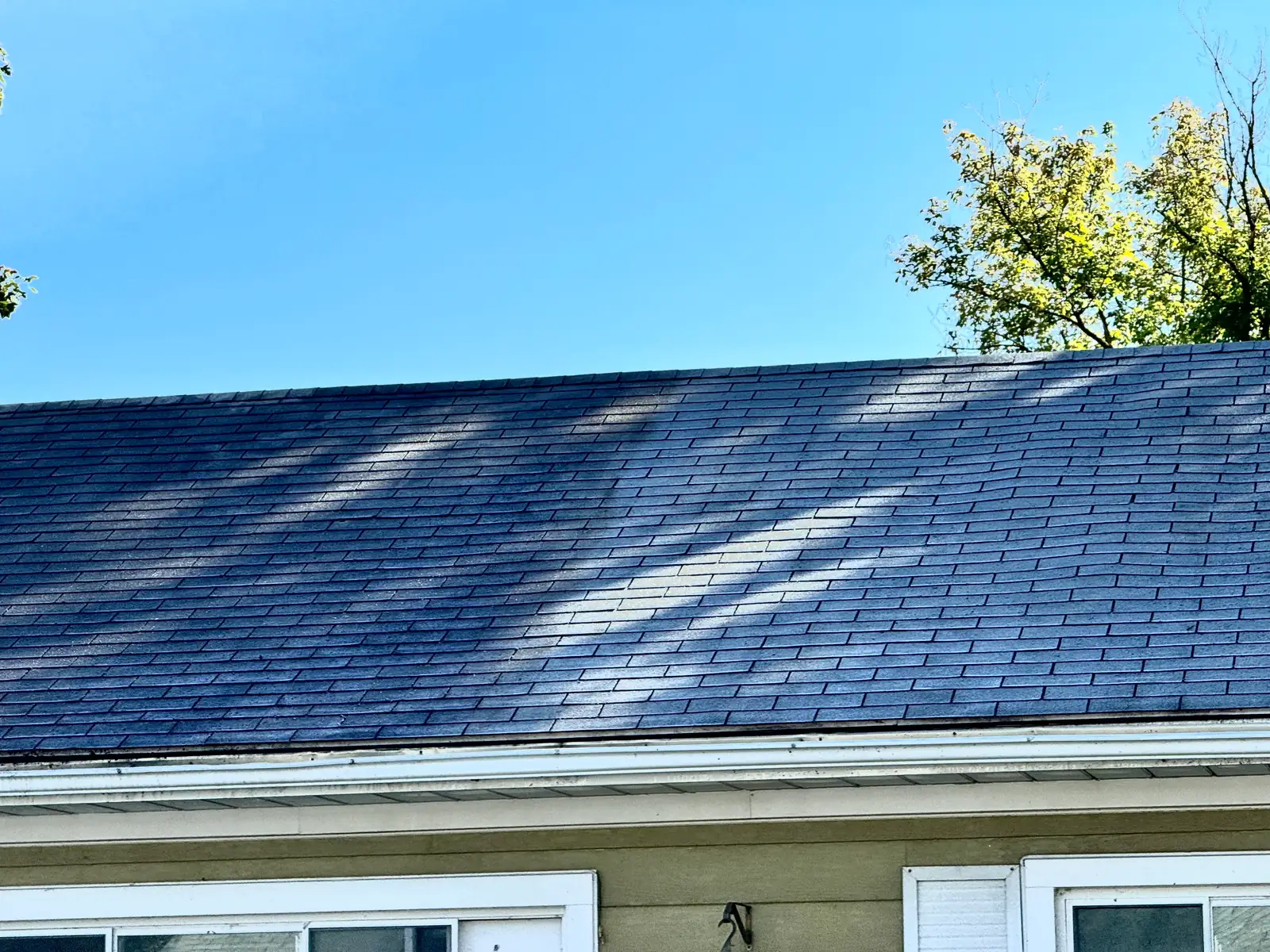
Tree canopy keeps a roof damp longer. Maples and oaks shade the shingles all summer and drop leaves and seeds that collect in valleys and behind chimneys. Those piles hold water against the shingles, and moss often starts in them.
Nearby water adds to the damp hours on some roofs. Homes near Lake St. Clair in St. Clair Shores, Harrison Township and New Baltimore, and homes around the inland lakes of Oakland County in West Bloomfield Township, Waterford Township and Commerce Township, can see heavier dew on humid mornings. More damp hours give algae more time to grow back after a treatment.
Freeze-thaw is what makes moss on a Michigan roof more than a stain. ARMA's algae and moss guide notes that moss can lift or curl the leading edges of shingles, which raises the risk of blow-off. Water held under a lifted edge freezes, expands and pushes the edge higher through the winter, which weakens the seal and raises the risk of wind blow-off.
Shaded slopes set the cleaning schedule for a roof. On a north-facing or tree-covered roof, plan for the three-year end of the three-to-five-year range. A roof in open sun on every side tends toward the five-year end.
How do you decide between cleaning, waiting and calling a roofer?
The roof cleaning decision comes down to the shingles under the growth. Streaks on flat shingles with intact granules call for a roof treatment. Curling, bare spots or a soft deck call for a roofer first. Streaks on an algae-resistant roof still inside its algae coverage call for the manufacturer first.
Waiting on a sound roof has a cost. Algae holds moisture, moss lifts edges, and the longer growth stays on a roof the more granule wear it causes. A treatment on a roof that still has years left protects those years, and the same visit can include soft washing for the siding and gutters below it.
Sources
Want This Handled Properly?
Macomb Power Washing Solutions holds a 4.9-star rating across 177+ Google reviews, and free estimates go out within 24 hours. We carry $2M general liability plus workers' compensation.